

Don’t Get Cold Feet Over Your Podiatry Billing Process
Why the Podiatry Billing Process Is Costing Your Practice Money
The podiatry billing process is a multi-step workflow that converts clinical foot care services into accurate insurance claims and, ultimately, collected revenue. Here’s a quick overview of the core steps:
- Patient registration & insurance verification – confirm coverage before the visit
- Clinical documentation – record diagnoses, findings, and medical necessity
- ICD-10 & CPT coding – assign correct diagnosis and procedure codes
- Modifier application – add required modifiers (e.g., Q7, Q8, Q9 for Medicare routine foot care)
- Claim scrubbing – check for errors before submission
- Electronic claim submission – send to the payer
- Payment posting – record what was paid and what was adjusted
- Denial management – appeal, correct, and resubmit rejected claims
Podiatry billing looks straightforward on paper. In practice, it’s one of the most denial-prone specialties in medicine.
Medicare restricts routine foot care coverage heavily. Commercial payers each have their own rules. Modifiers must match specific clinical findings. And documentation gaps — even small ones — can trigger denials or audits.
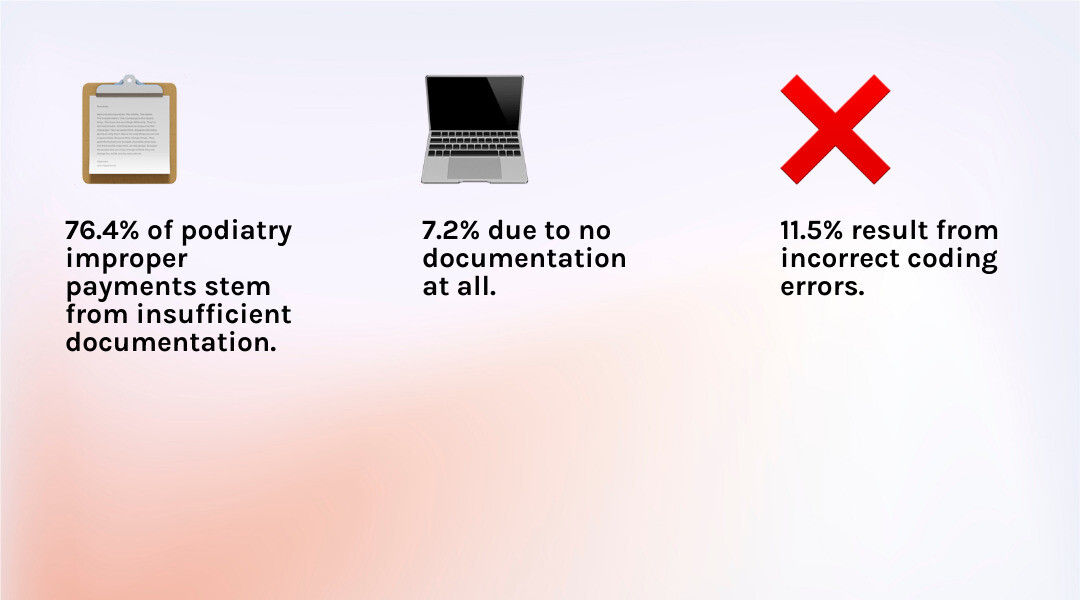
The numbers make this painfully clear. The improper payment rate for podiatry care sits at 11.2%, representing a projected $216.9 million in improper payments. Of those, a striking 76.4% stem from insufficient documentation alone.
That means the vast majority of lost revenue isn’t caused by complex billing disputes. It’s caused by missing or incomplete clinical notes.
For a busy podiatrist already stretched thin between patient care and practice management, that’s a serious problem — and one that’s entirely solvable with the right workflow.
Understanding the Step-by-Step Podiatry Billing Process

To keep your practice’s financial health as strong as a well-aligned arch, we need to look at the podiatry billing process as a cohesive system. It isn’t just a “back-office” task; it starts the moment a patient calls for an appointment.
Patient Registration and Eligibility Verification
The first step is often where the most preventable errors occur. We must verify patient insurance coverage and benefits before any services are rendered. This includes checking for copayments, deductibles, and specifically whether the patient’s plan has “routine foot care” exclusions. Many commercial plans follow Medicare’s lead and exclude basic nail or callus care unless specific medical criteria are met.
Clinical Documentation and Coding
Once the patient is in the chair, the “real” billing work begins. You aren’t just treating a foot; you are building a legal and financial case for reimbursement. From Service to Settlement: Understanding Podiatry Claims Processing highlights that documentation must clearly support medical necessity.
We then translate these clinical notes into standardized language:
- ICD-10 Coding: Selecting the most specific diagnosis code (e.g., Type 2 diabetes with foot ulcer).
- CPT Selection: Choosing the correct procedure code (e.g., 11721 for debridement of 6 or more nails).
Claim Scrubbing and Submission
Before a claim hits the payer’s system, it should go through “claim scrubbing.” This is an automated check for common errors like missing modifiers, mismatched gender/procedure codes, or invalid ICD-10 codes. From Claims to Cash: Mastering Medical Billing for Your Podiatry Practice explains that clean claims—those submitted without errors the first time—are the fastest way to stabilize your cash flow.
Payment Posting and Denial Management
After submission, we receive an Electronic Remittance Advice (ERA). We post these payments to the patient accounts and, crucially, analyze any denials. If a claim is rejected, we don’t just “write it off.” We investigate the reason, correct the error, and resubmit or appeal promptly.
Navigating Medicare Guidelines and Routine Foot Care
Medicare’s stance on podiatry is famous (or perhaps infamous) for its complexity. Generally, Medicare does not cover routine foot care—things like cutting corns or calluses, or trimming/debriding nails. However, there are critical exceptions based on systemic conditions.
Systemic Conditions and Medical Necessity
Coverage is often “presumed” if the patient has a systemic disease so severe that routine care by a non-professional would be hazardous. Common qualifying conditions include:
- Diabetes Mellitus
- Peripheral Vascular Disease (PVD)
- Arteriosclerosis obliterans
- Chronic venous hypertension
According to the Article – Billing and Coding: Routine Foot Care (A57954), the patient must also be under the active care of a physician (MD or DO) for that systemic condition within the six months prior to the podiatric service.
The 60-Day Frequency Rule
Medicare generally allows for routine foot care once every 60 days. Billing more frequently than this usually results in an automatic denial unless there is extreme medical justification documented in the notes. Following Medicare Podiatry Billing Guidelines is essential to ensure you aren’t flagged for “over-utilization.”
Understanding Class Findings
To justify coverage, we look for physical evidence of vascular or neurological impairment, categorized into Classes A, B, and C.
| Class Finding | Description of Physical Evidence |
|---|---|
| Class A | Non-traumatic amputation of foot or integral skeletal portion. |
| Class B | Absent posterior tibial pulse; absent dorsalis pedis pulse; or three of the following: trophic changes (hair loss, nail changes, skin texture, color), skin temperature changes, or edema. |
| Class C | Claudication; temperature changes; edema; paresthesias; or burning. |
Mastering Q-Modifiers in the Podiatry Billing Process
To tell Medicare that a patient meets the criteria for “presumed coverage,” we use Q-modifiers. These are not optional; they are the “keys” that unlock payment.
- Modifier Q7: Used when there is one Class A finding.
- Modifier Q8: Used when there are two Class B findings.
- Modifier Q9: Used when there is one Class B and two Class C findings.
Demystifying Medicare Podiatry: What’s Covered, When, and How to Calculate Costs notes that these modifiers must be supported by the physical exam documented in your chart for that specific date of service. You cannot simply “default” to Q8 for every diabetic patient; the pulses must actually be absent or the trophic changes must be visible and recorded.
Essential Coding and Documentation for Podiatric Success
Accuracy in the podiatry billing process relies on knowing your most common codes like the back of your hand—or the bottom of your foot.
Common CPT Codes
- 11720 & 11721: Debridement of nails (1-5 nails vs. 6 or more).
- 11730: Avulsion of nail plate, partial or complete, simple; single.
- 20550: Injection(s); single tendon sheath, or ligament, aponeurosis (e.g., plantar fascia).
- 99202–99215: Evaluation and Management (E/M) codes for office visits.
For a deeper dive into these, check out Footing the Bill: A Podiatrist’s Handbook to CPT and ICD-10 Codes.
Laterality and Specificity
ICD-10-CM requires precise laterality. You cannot just code for “foot pain.” You must specify right foot, left foot, or bilateral. Using the wrong laterality specifier (1 for right, 2 for left, 3 for bilateral) is a leading cause of “incorrect coding” denials, which accounted for 11.5% of improper payments in 2024.
The Mycotic Nail Dilemma
Treatment of mycotic (fungal) nails is only covered if there is clinical evidence of mycosis and the patient experiences secondary issues like pain, secondary infection, or marked limitation of ambulation. As noted in Podiatry Care | CMS, simply having “yellow nails” isn’t enough for Medicare to foot the bill. You must document the functional deficit the patient is suffering.
For more tips on aligning your notes with your codes, see The Foot-Friendly Guide to Podiatry Billing and Coding.
Overcoming Common Challenges in the Podiatry Billing Process
The road to reimbursement is full of potholes. One major hurdle is “unbundling”—billing for components of a procedure that should be included in a single code. For example, you cannot typically bill for a separate E/M visit on the same day as a minor procedure (like nail debridement) unless the visit was for a “significant, separately identifiable” problem, requiring Modifier 25.
Another challenge is prior authorization. Many insurers now require “thumbs up” before you perform surgery or provide high-cost DME (Durable Medical Equipment) like custom orthotics. Don’t Trip Up: A Podiatrist’s Guide to Coding and Claims suggests that failing to secure these authorizations is essentially providing free care.
Finally, there is the risk of audits. Podiatry Billing Pitfalls: Your Guide to Staying Compliant and Audit-Free warns that consistent use of the same modifiers or codes for every patient can trigger a “red flag” for payers, leading to a request for medical records.
Strategies to Optimize Your Revenue Cycle Management (RCM)
If you want to stop leaving money on the table, you have to track your data. We recommend monitoring these key performance indicators (KPIs) monthly:
- Clean Claims Rate: Aim for 95% or higher.
- Days in AR (Accounts Receivable): Ideally, you want this under 30-40 days.
- Denial Rate: Keep this below 5%.
- Collection Ratio: What percentage of your “allowable” amount are you actually collecting?
Staff Training and Software
Your billing staff needs specialized training. General medical billers often don’t understand the nuances of T-modifiers (for toes) or the specific LCD (Local Coverage Determination) rules for podiatry. The Footwork of Finance: Mastering Podiatry Billing Compliance emphasizes that staying updated on annual CPT and ICD-10 changes is a non-negotiable part of the job.
Outsourcing vs. In-House Billing
This is the “million-dollar question” for many practices. In-house billing offers direct oversight, but it comes with high overhead: salaries, benefits, software costs, and the risk of “brain drain” if your biller leaves.
Don’t Get Tripped Up: Choosing the Right Podiatry Billing Service points out that outsourcing to a specialized firm—like us at Beacon Podiatric Billing Services—gives you access to a team of experts who do nothing but podiatry all day. We have the “payer-aware” workflows that general billing companies lack.
For more advice on streamlining your finances, visit The Art of the Bill: Streamlining Your Podiatry Practice Finances.
Frequently Asked Questions about Podiatry Billing
What are the most common reasons for podiatry claim denials?
The heavy hitters are insufficient documentation (76.4% of errors), incorrect coding (11.5%), and medical necessity issues (4.4%). Often, a claim is denied simply because the diagnosis code (ICD-10) doesn’t “match” the procedure code (CPT) according to the payer’s internal rules.
How does Medicare handle routine foot care coverage?
Medicare excludes it by default. It only pays if the patient has a systemic condition (like diabetes or chronic venous insufficiency) and physical findings (Class A, B, or C) that make the treatment medically necessary. You must also include the correct Q-modifier (Q7, Q8, or Q9) and ensure the patient has seen their primary doctor for the systemic condition within the last 6 months.
What are the benefits of outsourcing podiatry billing?
Outsourcing provides specialized expertise that internal staff may lack. It reduces your administrative overhead, ensures faster reimbursement through higher clean-claim rates, and provides a layer of compliance assurance. At Beacon, our 100% US-based team focuses entirely on podiatry, meaning we catch the “little things” that lead to big denials.
Conclusion
The podiatry billing process doesn’t have to be a source of stress or “cold feet.” By mastering the nuances of Medicare’s routine foot care rules, applying the correct Q-modifiers, and maintaining bulletproof documentation, you can ensure your practice is fairly compensated for the vital care you provide.
However, we know that your first priority is your patients, not wrestling with insurance companies. That’s where we come in. Beacon Podiatric Billing Services offers specialized RCM solutions designed specifically for podiatrists in New Jersey, Nevada, North Carolina, Nebraska, and Kentucky. We focus on maximizing your collections while you focus on getting your patients back on their feet.
Ready to secure your revenue? Audit-Proof Your Practice: A Guide to Podiatry Billing Compliance is a great place to start, or you can explore our full range of Billing Services today. Let us handle the “footwork” of your finances.