

Medical billing for podiatrists: Master & Boost 2026
Why Medical Billing for Podiatrists is Different (and More Challenging)
Medical billing for podiatrists is fundamentally different from general medical billing—and significantly more complex. If you’re struggling with delayed payments, high denial rates, or drowning in paperwork, you’re not alone.
Quick Answer: Key Differences in Podiatry Billing
- Specialized coding requirements – Unique CPT codes (11720-11721, 28285), ICD-10 codes (E11.621, M77.31), and HCPCS codes (L3020) specific to foot and ankle care
- Complex modifier rules – Q modifiers (Q7, Q8, Q9) for routine foot care, toe modifiers (TA-T9), and bilateral procedure modifiers (-50, -LT, -RT)
- Strict Medicare guidelines – Routine foot care only covered with qualifying systemic conditions like diabetes; specific frequency limits (e.g., 11721 covered up to 6x/year)
- Medical necessity documentation – Must prove Class A, B, or C findings and link every procedure to a qualifying diagnosis
- Mixed medical and surgical billing – Often billing multiple services in one visit, requiring precise documentation to avoid bundling denials
Podiatry is a medical specialty focused on diagnosing and treating conditions of the foot, ankle, and lower leg—from routine nail care to complex reconstructive surgery. This unique mix of services creates billing challenges that general medical practices never face.
The financial impact is real. Many podiatry practices experience denial rates exceeding 25% and wait months for payment on legitimate claims. The reason? Most billing resources lack the specialized knowledge to steer podiatry’s complex coding requirements, insurance regulations, and Medicare’s strict rules distinguishing “routine” from “medically necessary” foot care.
This guide will show you how to master the billing complexities specific to your specialty—from understanding Q modifiers and Class findings to choosing the right billing partner—so you can spend less time fighting with insurance companies and more time treating patients.
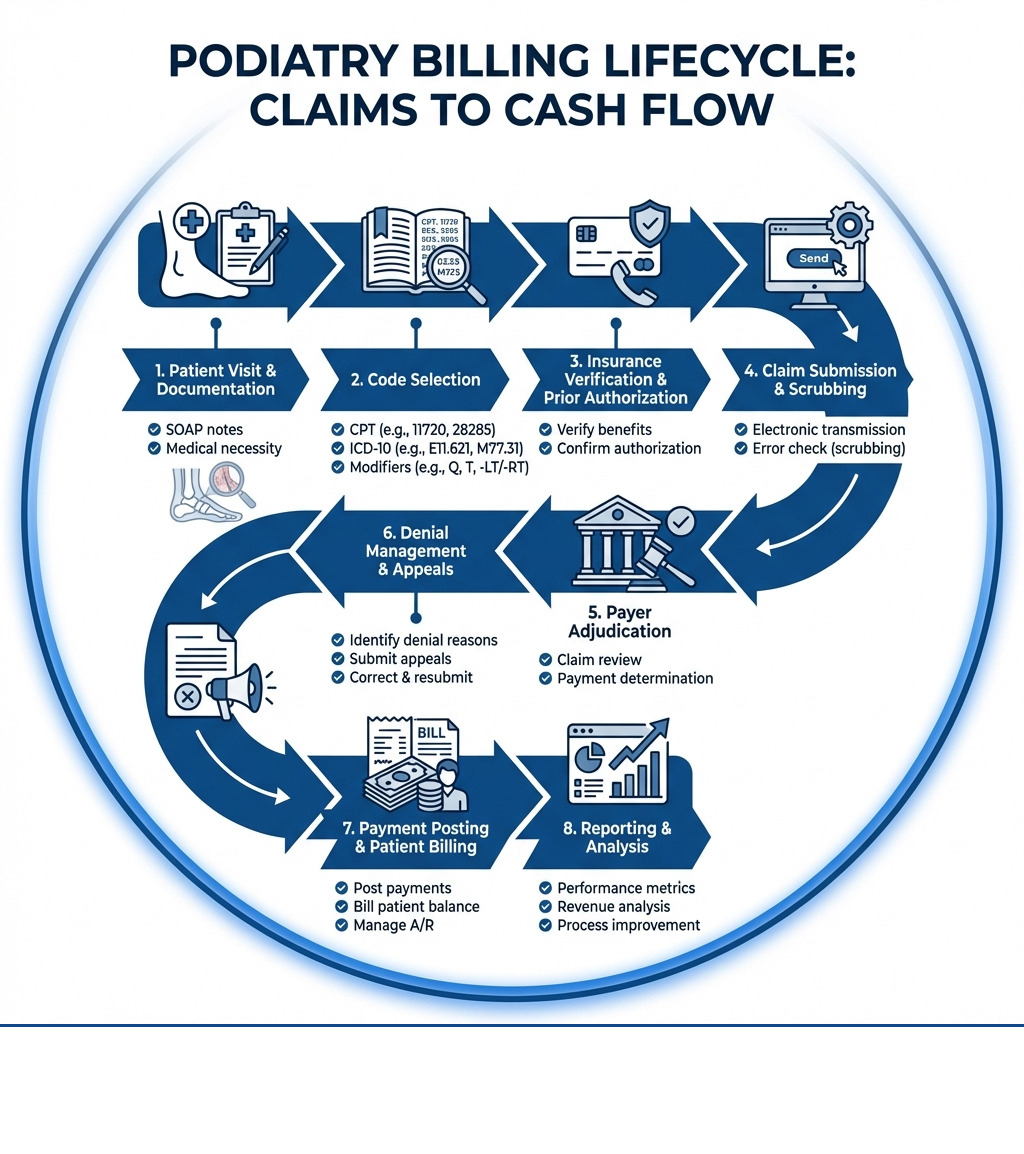
Medical billing for podiatrists terms to learn:
The Unique Financial Problems in Podiatry
The world of medical billing for podiatrists is a labyrinth of specific regulations, payer policies, and the constant need to justify medical necessity. Unlike other specialties, podiatry deals with services insurers may perceive as “routine,” even when they are critical for patient health, especially for those with systemic conditions. This creates unique financial problems that impact a practice’s revenue cycle.
Imagine a patient needing regular nail care due to diabetes. While seemingly routine, this service is vital for preventing serious complications like infections or amputations. Yet, reimbursement requires meticulous documentation and adherence to specific rules. Navigating these complex regulations and coding requirements can be a full-time job, often leading to high denial rates and delayed payments if not managed expertly. Recent payment adjustments for podiatry services also directly impact practice financial planning.

Common Challenges in Medical Billing for Podiatrists
Practices often stumble over several common problems in medical billing for podiatrists:
- Claim Denials: Perhaps the most frustrating challenge, common denial reasons include lack of medical necessity (especially for nail and callus care), missing documentation of class findings, incorrect modifier use, services deemed cosmetic, and missing prior authorizations. Without understanding why claims are denied, practices lose significant revenue.
- Proving Medical Necessity: For many podiatric services, particularly routine foot care, insurers require compelling evidence that the service is medically necessary, not merely for convenience or cosmetic reasons. This is especially true for Medicare.
- Bundled Services: Podiatrists often perform multiple procedures in one visit. Incorrect coding can lead to services being “bundled,” with only one being reimbursed, or denials for mutually exclusive procedures.
- Prior Authorizations: Many advanced procedures, orthotics, and certain medications require prior authorization. Missing this step almost guarantees a denial.
- Workers’ Compensation Cases: These cases have unique billing requirements that differ from standard health insurance, adding another layer of complexity.
The Critical Role of Documentation
Impeccable documentation is the heart of successful medical billing for podiatrists. Accurate, thorough, and compliant documentation is vital for your practice’s financial health and is the bedrock of every successful claim.
- SOAP Notes: Comprehensive SOAP (Subjective, Objective, Assessment, Plan) notes are essential. They must clearly articulate the patient’s condition, findings, diagnosis, and treatment plan to justify medical necessity.
- Linking Diagnosis to Procedure: Every CPT code must correlate with a supporting ICD-10 diagnosis. For example, billing for nail debridement requires a diagnosis code (like diabetes with neuropathy) that supports its medical necessity. Without this link, claims are often denied.
- Supporting Medical Necessity: Documentation must explain why a service was performed. For routine foot care, it must detail the systemic condition (e.g., diabetes), the physical findings (Class A, B, or C), and how the service prevents complications. This helps “audit-proof” your practice.
- Laterality: Specifying laterality (left, right, or bilateral) in diagnosis and procedure codes is critical for many foot and ankle conditions. Missing this detail can cause denials.
- Class Findings (A, B, C): When billing routine foot care for patients with systemic conditions, documenting specific “Class findings” is paramount. These findings (e.g., Class A: non-traumatic amputation; Class B: absent posterior tibial pulse, claudication, or edema) prove the patient’s at-risk status and justify medical necessity.
- Audit-Proofing: The goal of documentation is to create a clear, defensible record for any payer audit. This means ensuring consistency between the patient’s chart, submitted codes, and medical necessity criteria. For more strategies, consult our guide on Audit-Proof Your Practice: A Guide to Podiatry Billing Compliance.
Mastering Podiatry Codes, Modifiers, and Medicare Rules
Navigating the intricate world of coding and compliance is central to successful medical billing for podiatrists. It’s where the rubber meets the road, changing patient care into reimbursable claims. Understanding CPT, ICD-10, HCPCS codes, and the often-confusing array of modifiers, particularly in the context of Medicare guidelines, is not just about getting paid—it’s about ensuring compliance and avoiding costly audits.

Key CPT and ICD-10 Codes for Your Practice
For effective medical billing for podiatrists, we must be fluent in the specific codes that define your services. Here’s a look at some of the most frequently used codes:
- Office Visits (Evaluation and Management – E/M):
- 99203 – 99204: New patient office visits
- 99213 – 99214: Established patient office visits
- Nail Debridement/Care:
- 11720: Debridement of nail(s) by any method(s); 1 to 5 nails
- 11721: Debridement of nail(s) by any method(s); 6 or more nails
- 11730: Avulsion of nail plate, partial or complete, simple; single
- 11750: Excision of nail and nail matrix, partial or complete (e.g., permanent removal of ingrown toenail)
- Callus and Corn Removal:
- 11055: Paring or cutting of benign hyperkeratotic lesion (e.g., corn or callus); single lesion
- 11056: Paring or cutting of benign hyperkeratotic lesion (e.g., corn or callus); 2 to 4 lesions
- 11057: Paring or cutting of benign hyperkeratotic lesion (e.g., corn or callus); more than 4 lesions
- Injections:
- 20550: Injection(s); single tendon sheath, or ligament aponeurosis (e.g., plantar fascia)
- 20552: Injection(s); single or multiple trigger point(s), 1 or 2 muscle(s)
- 20610: Arthrocentesis, aspiration and/or injection; major joint or bursa (e.g., ankle, knee)
- Custom Orthotics (HCPCS Level II Codes):
- L3020: Foot orthosis, molded to patient model, ‘insert,’ extra-depth shoe, removable, each
- L3030: Foot orthosis, molded to patient model, ‘insert,’ prescription of, each
- L3040: Foot orthosis, molded to patient model, ‘insert,’ rigid, non-weight bearing, each
- Surgical Procedures:
- 28285: Correction, hammertoe (e.g., interphalangeal fusion, partial or total phalangectomy)
- 28450: Closed treatment of fracture metatarsal bone, without manipulation
- Wound Care:
- 11042-11047: Debridement, subcutaneous tissue; muscle; bone
- 97597: Debridement (e.g., high pressure waterjet with/without suction, sharp selective debridement with scissors, scalpel and forceps) open wound, (e.g., secondary repair, surgical aftercare, and stage 1 pressure ulcer); first 20 sq cm or less
- Common ICD-10 Codes:
- E11.621: Type 2 diabetes mellitus with foot ulcer
- M77.31: Plantar fasciitis, right foot
- M79.671: Pain in the left foot
- L60.0: Ingrowing nail
- L84: Corns and callosities
This is just a snapshot; a comprehensive list of essential podiatric medicine codes is much longer. The key is knowing not just what the codes are, but when and how to apply them correctly, always backed by robust documentation.
Essential Modifiers to Ensure Reimbursement
Modifiers are two-digit codes that provide additional information about a service or procedure without changing its definition. In medical billing for podiatrists, they are absolutely essential for clarifying specific circumstances and preventing denials.
- Q Modifiers (Q7, Q8, Q9): These are critical for routine foot care services when systemic conditions are present.
- Q7: One Class A finding (e.g., non-traumatic amputation).
- Q8: Two Class B findings (e.g., absence of posterior tibial pulse, claudication, significant edema). This modifier is often required for routine nail debridement (CPT 11721) when a systemic condition is present.
- Q9: One Class B and two Class C findings (e.g., trophic skin changes, absent deep tendon reflexes).
Applying these correctly, based on documented Class findings, is often the difference between payment and denial for routine foot care.
- Modifier 25: Used when a physician performs a significant, separately identifiable evaluation and management (E/M) service on the same day as a minor procedure. For example, if a patient comes in for a new problem (E/M) and you also perform a nail avulsion (procedure), Modifier 25 would be appended to the E/M code.
- Modifier 59: Indicates that two or more procedures performed on the same day were distinct and separate, even if they might normally be bundled. For example, if you remove a callus (11055) and a wart (17110) from different parts of the foot.
- LT/RT Modifiers: Specify laterality (Left or Right) for procedures performed on one side of the body. For instance, 28285-LT for a hammertoe correction on the left foot.
- Toe Modifiers (TA-T9): These specific modifiers identify which toe a procedure was performed on:
- TA: Left foot, great toe
- T1: Left foot, second toe
- T2: Left foot, third toe
- T3: Left foot, fourth toe
- T4: Left foot, fifth toe
- T5: Right foot, great toe
- T6: Right foot, second toe
- T7: Right foot, third toe
- T8: Right foot, fourth toe
- T9: Right foot, fifth toe
Using these ensures specificity and helps avoid confusion, though some CPT codes (like certain debridement codes) may not require them.
- Bilateral Procedures (Modifier 50): Applied when the same procedure is performed on both sides of the body during the same operative session. For example, if you perform a bunionectomy on both feet.
Navigating Medicare Coverage and Limitations
Medicare plays a significant role in medical billing for podiatrists due to the older demographic often seeking foot care. Understanding its specific guidelines and coverage limitations is crucial for any practice in New Jersey, Nevada, Nebraska, North Carolina, or Kentucky.
- Routine Foot Care Exceptions: Generally, Medicare does not cover routine foot care (e.g., trimming of nails, cutting corns/calluses) unless the patient has a qualifying systemic condition that puts them “at-risk.” These systemic conditions include diabetes mellitus, peripheral vascular disease, or chronic debilitating neurological diseases. The key is that the routine care must be medically necessary to prevent more serious complications.
- At-Risk Patients: For routine foot care to be covered, the patient must have one of the qualifying systemic conditions and a documented Class A, B, or C finding (as described above with Q modifiers). This directly links the routine service to the systemic risk.
- Frequency Limits: Medicare also imposes frequency limits. For example, CPT code 11721 (debridement of 6 or more nails) is typically covered up to six times a year, assuming the patient meets the required conditions and documentation. Billing more frequently without strong medical justification will likely lead to denials.
- Non-Covered Services: Elective services, purely cosmetic procedures, routine check-ups not tied to a systemic condition, and most supportive devices (unless part of a leg brace or therapeutic shoes for diabetics) are generally not covered. It’s vital to inform patients upfront about services that Medicare will not cover.
We continually monitor and adapt to Medicare’s official guidelines and other payer policies. For a deeper dive into what Medicare covers, we encourage you to read our detailed guide on Demystifying Medicare Podiatry: What’s Covered, When, and How to Calculate Costs.
Why Specialized Medical Billing for Podiatrists is Non-Negotiable
For many podiatry practices, outsourcing billing seems like an added expense. However, specialized medical billing for podiatrists is a non-negotiable strategy for growth and sustainability. It’s about turning claims into consistent cash flow.
The unique challenges in podiatry billing mean an in-house team, unless highly specialized, often struggles to keep up. This leads to delayed payments, lost revenue, and staff burnout. Partnering with experts isn’t just offloading tasks; it’s an investment in improved denial management, a streamlined appeals process, increased revenue, reduced operational costs, and greater overall efficiency and profitability.
Best Practices for Denial and Appeal Management
Denials are a reality in medical billing, but how they are managed determines their impact on your practice. For medical billing for podiatrists, effective denial and appeal management is crucial:
- Identifying Denial Reasons: The first step is to identify why a claim was denied: a coding error, lack of medical necessity documentation, missing prior authorization, or patient eligibility issues. Logging each denial and its reason is paramount.
- Timely Appeals: Payers have strict deadlines for appealing denials. A specialized service ensures appeals are submitted promptly to maximize the chances of overturning the decision.
- Correcting Coding Errors: If a denial is due to incorrect coding or modifier usage, the claim is corrected with all details (CPT, ICD-10, modifiers, laterality) verified before resubmission.
- Resubmitting Claims: After corrections, claims are resubmitted with any additional required documentation.
- Tracking Denial Trends: Analyzing recurring denial reasons helps identify systemic issues in documentation or coding. This proactive approach helps reduce future denials by over 25% by addressing root causes. We consistently improve collections by over 23% and reduce denials by over 25% by identifying and correcting key issues in podiatry billing.
The ROI of Outsourcing: By the Numbers
The financial benefits of outsourcing medical billing for podiatrists are compelling:
- Increased Collections: Expert billing services can consistently improve collections by over 23% through clean claim submissions, proactive follow-up, and effective denial management.
- Faster Payments: Specialized services accelerate your claims process, ensuring you get paid up to three times faster and significantly improving cash flow.
- High Clean Claim Rate: We aim for a 98% clean claim rate, meaning fewer rejections and faster processing.
- Reduced Operational Costs: Outsourcing eliminates in-house billing staff salaries, benefits, training, and software costs, cutting operational expenses while improving efficiency.
- Improved Staff Focus: With billing handled by experts, your staff can focus on patient care and other essential practice operations, enhancing efficiency and patient satisfaction.
This focus on key performance indicators (KPIs) is vital for practice growth. Learn more about managing your practice’s financial health in Live and Die by KPIs: The Podiatrist’s Guide to Practice Growth and Profitability.
Choosing the Right Billing Partner to Boost Your Bottom Line
When it comes to medical billing for podiatrists, selecting the right billing partner is one of the most critical decisions you’ll make for your practice’s financial health. It’s not just about finding someone to process claims; it’s about finding a strategic partner who understands the nuances of your specialty and is committed to your success.
Key Features to Look for in a Billing Service
As you consider your options, we encourage you to look for a partner that offers the following:
- Podiatry-Specific Expertise: This is paramount. A billing service that specializes in podiatry understands the unique CPT, ICD-10, and HCPCS codes, the complex modifier rules (like Q modifiers and toe modifiers), and the specific Medicare guidelines for routine foot care. They know how to prove medical necessity and steer the intricacies of your services in New Jersey, Nevada, Nebraska, North Carolina, and Kentucky.
- EHR Integration: Seamless integration with your existing Electronic Health Record (EHR) system is crucial for efficient data flow, reducing errors, and streamlining your workflow.
- Transparent Reporting: Look for a partner that provides clear, actionable reports on your practice’s financial performance, including collection rates, denial rates, and revenue trends. This transparency allows you to stay informed and make data-driven decisions.
- Proactive Denial Management: A good billing service doesn’t just process denials; they actively work to prevent them and have a robust, proactive system for appealing and resolving denied claims quickly.
- 100% Compliance Guarantee: With ever-changing regulations, ensuring compliance with HIPAA and all payer rules is non-negotiable. A partner offering a 100% compliance guarantee provides peace of mind.
- US-Based Support: Having a dedicated, US-based team ensures better communication, understanding of local regulations, and responsive support when you need it most.
For more guidance on finding the perfect fit for your practice, explore our article on 5 Proven Ways to Find a Podiatry Billing Company.
How Technology and Automation Transform Your Practice
In modern medical billing for podiatrists, technology and automation are game-changers. They are not just conveniences but essential tools that improve efficiency, accuracy, and profitability.
- Automated Eligibility Checks: Instantly verify patient insurance coverage and benefits before the appointment. This reduces surprises, minimizes denials due to inactive coverage, and allows for upfront discussions about patient financial responsibility.
- Claim Scrubbing Software: These advanced tools automatically review claims for errors, missing information, or coding inconsistencies before submission. This significantly increases the clean claim rate, leading to faster payments and fewer denials.
- Real-time Analytics Dashboards: Gain immediate insights into your practice’s financial performance. Track key metrics, identify trends, and make informed decisions to optimize your revenue cycle.
- Digital Payment Solutions: Offer patients convenient, secure ways to pay their balances, improving collection rates and patient satisfaction.
- Reduced Administrative Burden: By automating repetitive tasks, your staff is freed from tedious paperwork, allowing them to focus on patient care and other high-value activities.
Embracing technology and automation can truly transform your practice, making it more efficient and profitable. If you’re considering an EHR transition or looking for solutions to integrate your systems, our insights on Navigating Your Transition from TrakNet: Find Your Perfect EHR Match with Beacon can be a valuable resource.
Frequently Asked Questions about Podiatry Billing
We understand that medical billing for podiatrists can raise many questions. Here are some of the most common inquiries we receive:
How much do podiatry billing companies usually charge?
Most companies typically charge between 5% and 10% of monthly collections. This percentage-based model aligns the billing service’s success with your practice’s revenue. Factors influencing the exact percentage can include the volume of your claims, the complexity of your services, and the range of services provided by the billing company (e.g., credentialing, practice management consulting). When evaluating costs, we always recommend focusing on the value provided—the increased collections, faster payments, and reduced administrative burden—rather than just the raw percentage.
What is the difference between general and podiatry-specific billing?
The primary difference lies in specialization and complexity. General medical billing handles a broad range of specialties but may lack the deep expertise required for podiatry. Podiatry-specific billing involves:
- Specialized Codes: Knowledge of unique CPT, ICD-10, and HCPCS codes for foot and ankle procedures, which are not commonly found in other specialties.
- Routine Foot Care Rules: A profound understanding of Medicare’s strict rules regarding routine foot care, including when it’s covered and the specific documentation required.
- Modifier Complexity: Expert application of Q modifiers, toe modifiers (TA-T9), and other specific modifiers (-25, -59, -LT/-RT, -50) that are crucial for podiatric claims.
- Payer Nuances: Familiarity with how different payers (Medicare, commercial, Workers’ Comp) interpret and reimburse for foot and ankle procedures, including their unique medical necessity criteria and frequency limits.
This specialized knowledge ensures higher clean claim rates and fewer denials.
How do systemic conditions like diabetes affect billing for routine foot care?
Systemic conditions like diabetes significantly influence coverage and coding for routine foot care. For Medicare and many commercial payers, routine foot care (e.g., nail trimming, callus paring) is generally not covered unless it is medically necessary due to a systemic condition that places the patient “at-risk” for complications.
- Medical Necessity Trigger: The presence of a qualifying systemic condition (e.g., diabetes mellitus, peripheral vascular disease, chronic debilitating neurological disease) triggers the potential for coverage.
- Required Documentation (Class A, B, C findings): To prove medical necessity, your documentation must clearly identify specific “Class findings” associated with the systemic condition. These findings (e.g., absent pulses, trophic skin changes, significant edema) demonstrate the patient’s heightened risk.
- Use of Q Modifiers: Once medical necessity is established through systemic conditions and Class findings, specific Q modifiers (Q7, Q8, or Q9) must be appended to the CPT code for routine foot care. These modifiers signal to the payer that the service is medically justified to prevent more serious complications.
Without these elements—a qualifying systemic condition, documented Class findings, and the correct Q modifier—claims for routine foot care are almost certainly denied.
Conclusion: Focus on Patients, Not Paperwork
The journey from patient encounter to paid claim in medical billing for podiatrists is complex. We’ve explored the financial problems, critical documentation, intricate codes, essential modifiers, and demanding Medicare regulations. The constant challenge of proving medical necessity, mitigating denials, and staying current with payer policies can divert valuable time and resources away from what matters most: your patients.
This is where specialized expertise becomes invaluable. Partnering with a billing service that deeply understands podiatry can transform your practice’s financial health. Imagine increased collections, faster payments, and a significantly reduced administrative burden. This allows you to focus on your patients, enhancing your practice’s operations and patient satisfaction.
Outsourcing your medical billing for podiatrists is an investment in your practice’s efficiency, compliance, and profitability. It’s about securing financial stability so you can concentrate on delivering exceptional patient care.
Ready to streamline your practice and optimize your revenue? Streamline your practice with expert billing services today!