

Podiatry Billing Audit: 5 Audit-Proof Steps 2026
Why Podiatry Billing Audits Demand Your Immediate Attention
Podiatry billing audits are more than just administrative headaches—they represent a significant financial and legal threat to your practice. If you’re searching for ways to prevent billing audits, here’s what you need to know right now:
Quick Answer: How to Prevent a Podiatry Billing Audit
- Document thoroughly – Every service must have clear medical necessity with objective findings
- Use modifiers correctly – Especially Modifier 25 for E/M services and Q modifiers for at-risk patients
- Audit yourself first – Conduct quarterly internal reviews before payers find errors
- Train your staff – Keep everyone current on coding changes and payer policies
- Invest in technology – Use claim-scrubbing software and podiatry-specific EHR templates
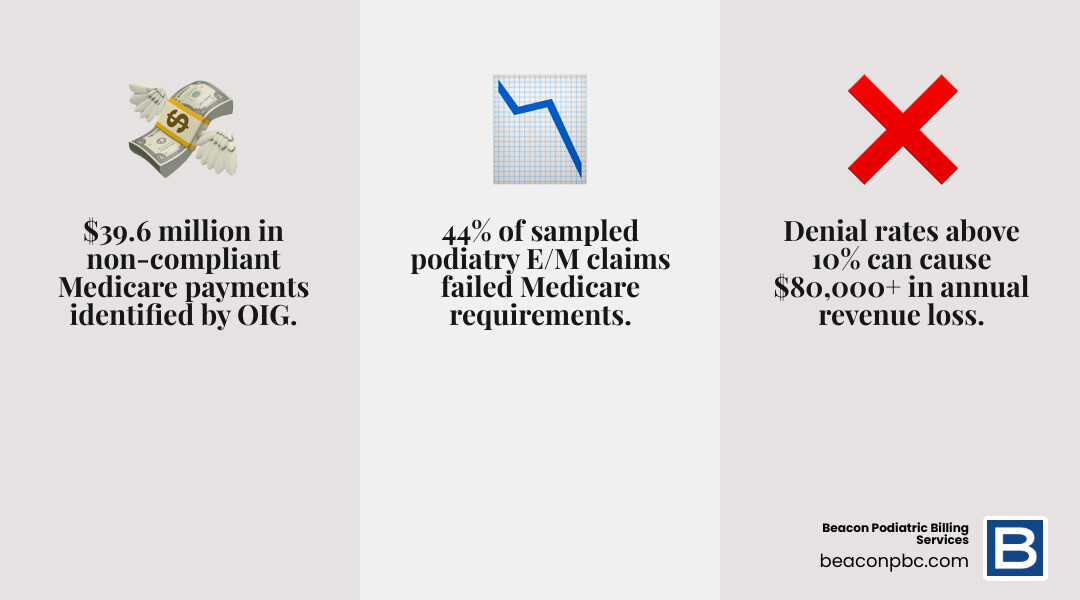
The stakes are higher than you might think. According to a recent Office of Inspector General (OIG) audit, 44 out of 100 sampled podiatry claims for Evaluation and Management services failed to meet Medicare requirements. When extrapolated, this translated to approximately $39.6 million in improper payments during just one audit period.
And it’s not just Medicare. Denial rates above 10% can cause $80,000 to $120,000 in annual revenue loss for a typical podiatry practice. Even worse, practices under audit scrutiny face the possibility of recoupment demands, exclusion from federal programs, and irreparable damage to their reputation.
The root cause? Most improper payments occur because providers didn’t comply with coverage, coding, or billing rules. Missing documentation, incorrect modifiers, and unclear medical necessity top the list of errors that trigger audits.
But here’s the good news: audits are largely preventable. With the right systems in place—robust documentation practices, regular self-audits, and specialized billing expertise—you can significantly reduce your audit risk while maximizing legitimate reimbursement.
This guide will walk you through everything you need to know to audit-proof your podiatry practice, from understanding who’s watching your claims to building bulletproof documentation that withstands scrutiny.
Understanding the Podiatry Billing Audit Landscape
Imagine walking into your practice one morning to find an audit notice from a major payer. It’s enough to make anyone’s heart race! But understanding the landscape of a podiatry billing audit can help explain the process and prepare you for what’s ahead. Audits aren’t random acts of fate; they’re often triggered by specific events or patterns.
The primary reasons for audits range from the mundane to the serious. Sometimes, it’s as simple as a patient complaint about a charge they don’t understand, or even a fellow provider or disgruntled employee raising a red flag. More often, audits are triggered by unusual billing patterns, such as billing services generally two standard deviations above the mean for your specialty, or high-cost claims that stand out from the crowd. Inconsistent coding, a focus on high-risk areas, or even just random selection can also lead to scrutiny. The goal for payers, especially government programs, is to reduce improper payments and prevent fraud, waste, and abuse.
Who Audits Podiatry Practices?
You might encounter several types of auditors, each with a slightly different focus:
- Medicare Administrative Contractors (MACs): These are the workhorses of Medicare. They process claims, provide education, and conduct medical reviews to ensure compliance with Medicare rules.
- Recovery Audit Contractors (RACs): RACs are incentivized to identify and recover improper Medicare payments, whether overpayments or underpayments. They often review claims going back three years.
- Comprehensive Error Rate Testing (CERT): CERT contractors measure improper payments in the Medicare Fee-for-Service (FFS) program by sampling claims and assessing their accuracy against Medicare coverage, coding, and billing criteria.
- Office of Inspector General (OIG): The OIG is the watchdog for federal healthcare programs. They conduct audits and investigations into fraud, waste, and abuse, often publishing reports that highlight areas of concern, like their audit of podiatrists’ E/M services.
- Private Payer Audits: Private insurance companies have their own Special Investigation Units (SIUs) that conduct audits, often following similar triggers as federal payers.
- Medicaid Audits: State Medicaid programs also conduct audits, often with specific requirements that can vary by state, such as those seen in Nebraska or New Jersey.
Why CMS Scrutinizes Podiatry Billing
The Centers for Medicare & Medicaid Services (CMS) plays a monumental role in podiatry billing. They set the standards for coding, establish National Coverage Determinations (NCDs) and Local Coverage Determinations (LCDs) that define medically necessary services, and monitor compliance through audits. For podiatrists, CMS scrutiny is particularly sharp due to several factors:
- High Volume of Routine Procedures: Podiatry often involves a high volume of services like routine foot care, which have very specific and often misunderstood coverage criteria.
- Vulnerability to Errors: The intricate nature of podiatry-specific coding, modifiers, and documentation requirements for medical necessity creates ample opportunity for errors.
- Focus on E/M Services: OIG reports consistently highlight issues with Evaluation and Management (E/M) services, especially when billed with modifier 25 on the same day as a procedure.
- Routine Foot Care Rules: Medicare generally excludes routine foot care unless specific systemic conditions (like diabetes with peripheral neuropathy) make non-professional care unsafe. Documenting this medical necessity is a frequent challenge. In fact, one OIG audit found that nearly half of sampled routine foot care claims did not meet Medicare requirements, leading to an estimated $4.4 million in improper payments.
- High-Cost Claims: Any service that involves a higher reimbursement amount can naturally attract more attention.
Understanding and adhering to the guidelines outlined in the Medicare Podiatry Billing Guidelines is paramount. Our team at Guide is always keeping an eye on Practice Management & Growth trends and regulatory changes to help your practice stay ahead.
Red Flags: Common Triggers for a Podiatry Billing Audit
When it comes to podiatry billing audits, certain billing practices are like waving a red flag in front of a bull. Identifying and correcting these common errors is your first line of defense against unwanted scrutiny.

The most frequent culprits include general coding errors such as upcoding (billing for a more complex service than performed), unbundling (billing separately for services that should be grouped), using outdated codes, or simply mismatched CPT and ICD codes. Beyond these, incorrect modifier usage and documentation deficiencies are significant triggers. Claims for E/M services performed on the same day as a procedure are also a prime area of audit focus, as is the subtle but critical distinction between routine versus medically necessary foot care.
Modifier Misuse: The Role of Modifier 25 and Q Modifiers
Modifiers are powerful tools that provide additional information about a service, but their misuse is a top reason for claim denials and audits.
- Modifier 25: This modifier indicates that an E/M service was “significant and separately identifiable” from another procedure performed by the same physician on the same day. For example, if a patient comes in for a new, acute problem that requires a comprehensive E/M, and during that visit, a minor procedure (like an injection) is also performed, Modifier 25 might be appropriate for the E/M. However, if the E/M was simply pre- or post-procedure work inherent to the procedure itself, then Modifier 25 should not be used. The OIG has specifically highlighted Modifier 25 usage by podiatrists as an area of concern, with many claims failing to meet Medicare requirements.
- Modifier 59: This modifier is used to indicate that a procedure or service was distinct or independent from other non-E/M services performed on the same day. It often signals that two procedures, usually bundled, were performed at different sites or during different encounters.
- Q Modifiers (Q7, Q8, Q9): These are vital for routine foot care, indicating the severity of a patient’s at-risk condition, such as peripheral vascular disease (Q7), diabetes (Q8), or other qualifying systemic conditions (Q9). Misusing or forgetting these modifiers is a top reason insurers deny podiatry claims related to routine foot care.
Common modifier errors often stem from a lack of understanding of specific payer rules or simply the overuse of modifiers without adequate documentation to support their application. Staying current with Billing & Coding Updates is crucial to avoid these pitfalls.
Routine Foot Care vs. Medically Necessary Services
This is arguably one of the most significant areas of audit risk for podiatrists. Medicare generally considers routine foot care (e.g., trimming nails, paring corns/calluses) a non-covered service. However, exceptions exist when the patient has certain systemic conditions that make non-professional care unsafe.
| Service Type | Typical CPT Codes | Documentation Requirements | Payer Scrutiny Level |
|---|---|---|---|
| Routine Foot Care | 11720, 11721, 11055-11057 | – Qualifying systemic condition (diabetes, PVD, etc.) | High |
| – Q modifiers (Q7, Q8, Q9) | |||
| – Objective findings of severity (e.g., neuropathy, ischemia) | |||
| Medically Necessary Care | 28XXX (surgery), 20XXX (debridement), 99XXX (E/M) | – Medical necessity clearly linked to diagnosis/injury | Moderate to High |
| – Detailed history, exam, medical decision-making | |||
| – Supporting diagnostic tests (X-rays, labs) |
Documentation must clearly support the medical necessity for routine foot care, linking it to a qualifying systemic condition of sufficient severity. For example, if a patient with diabetes receives routine nail care, the chart must detail the complications of diabetes (e.g., peripheral neuropathy, circulatory compromise) that make the service medically necessary. Without this, the claim will be denied, and could trigger an audit.
Top 5 Billing Errors That Attract Auditors
Based on OIG reports and common denial trends, here are the top 5 billing errors that make podiatry practices stand out to auditors:
- Billing E/M services with a procedure without Modifier 25 (or inappropriately with it): As discussed, the E/M service must be truly distinct and significant from the procedure performed on the same day.
- Insufficient documentation for medical necessity of routine foot care: Claims lacking detailed evidence of qualifying systemic conditions and their severity are prime targets.
- Upcoding nail debridement or lesion removal: Billing for a higher number of lesions than documented, or for debridement inconsistent with the documented clinical findings.
- Incorrectly billing for DME like CAM walkers: CMS, for example, does not allow CAM walkers for ulcer management, even if used for offloading. Billing for DME requires specific orders, medical necessity, and patient-signed receipts.
- Lack of a signed and dated physician’s order: Essential for Durable Medical Equipment (DME) and many other services. All chart notes should be signed and dated, too.
Building Your Defense: Documentation and Proactive Prevention
The best offense is a good defense, and in podiatry billing audits, that defense is built on meticulous documentation and proactive prevention strategies. We can’t stress this enough: “rock-solid charting” is your ultimate shield against audit findings.
Proactive strategies involve a combination of internal vigilance, continuous education, and leveraging technology. This means regularly conducting internal audits, ensuring your staff is thoroughly trained on current coding and documentation requirements, and investing in tools that help prevent errors before they ever leave your office. As a leading resource for medical auditing, AAPC emphasizes that implementing an auditing program is the most effective defense against federal and payer audits. Our focus on Quality Management ensures we help you integrate these best practices seamlessly.
Best Practices for Audit-Proof Documentation
Your patient charts are more than just medical records; they are legal documents that tell the story of the care you provide. When an auditor reviews your claims, they are comparing the billed services against your documentation.
- Rock-Solid Charting: Every service rendered must be clearly supported by your notes. This includes the medical necessity, the specific procedures performed, and the outcomes.
- Legibility and Timeliness: Ensure all notes are legible and documented in real-time or immediately after the visit. Delayed or messy notes raise red flags.
- Signed and Dated Notes: All entries must be signed (manually or electronically) and dated by the rendering provider. Maintain a signature log if necessary.
- Clear Link Between Diagnosis and Treatment: The medical necessity for every service must be explicitly stated and supported. If you treat a diabetic ulcer, your notes should clearly link the ulcer to the patient’s diabetes and describe why the treatment is necessary.
- Documenting Objective Findings: Especially for conditions like routine foot care or when pain is a qualifying diagnosis, objective evidence (e.g., specific circulatory or neurological findings, precise anatomic details, infection details) is crucial. Avoid vague terms.
- DME Documentation Requirements: For Durable Medical Equipment, ensure a clear order is in the chart, indicating the item, its medical necessity, and the duration needed. Upon dispensement, obtain a patient-signed receipt confirming they received the item, instructions, and fit.
How to Conduct a Proactive Podiatry Billing Audit
Why wait for an external auditor to find errors when you can find and fix them yourself? Conducting regular internal audits is a cornerstone of compliance.
- Designate Responsibility: Assign a staff member or team to oversee the audit process.
- Understand the Scope: Decide whether you’re performing a prospective audit (reviewing claims before submission) or a retrospective audit (reviewing previously paid claims).
- Select a Sample: OIG recommends reviewing 5-10 charts per provider. A standard sample size for a comprehensive audit is often 10-15 charts. Ensure your sample includes claims from various payers and service types, especially high-risk areas like routine foot care or E/M with procedures.
- Review Against Payer Policies: Compare your selected claims against the latest CPT and ICD-10 codes, NCDs, LCDs, and specific payer guidelines. For example, if you’re in New Jersey or Nevada, verify compliance with your state’s Medicaid requirements.
- Identify Patterns and Errors: Look for recurring coding errors, documentation deficiencies, or inappropriate modifier usage.
- Create a Corrective Action Plan: For every identified error, develop a plan. This might include staff training, revising internal policies, or updating EHR templates.
- Frequency: The OIG recommends annual audits. However, if your accuracy rates are below 90%, you might need to audit quarterly or even monthly.
Regularly reviewing Articles on coding updates and compliance can provide valuable insights for your internal audit process.
Navigating the Aftermath: Responding to and Appealing Audits
Even with the best proactive measures, an audit notice might still arrive. It’s not the end of the world, but your response can significantly impact the outcome. Ignoring an audit or responding inadequately can lead to severe consequences.
The consequences of failing a podiatry billing audit can be substantial. These include not only financial penalties and recoupment demands for past payments but also potential Corporate Integrity Agreements (CIAs), exclusion from federal healthcare programs (which can effectively shut down a practice), and irreparable damage to your reputation within the medical community and among patients. Keeping an eye on your Financial Health KPIs can help you detect issues before they escalate to an audit.
Strategies for Appealing a Podiatry Billing Audit Finding
If you disagree with an audit finding, you have the right to appeal. This process can be complex, but with a strategic approach, you can often overturn unfavorable decisions.
- Understand the Appeals Process: For Medicare, there are several levels of appeal, starting with redetermination by the MAC, then reconsideration by a Qualified Independent Contractor (QIC), followed by hearings with an Administrative Law Judge (ALJ), and potentially higher federal review.
- Review the Audit Request Thoroughly: Understand exactly what the auditor found and why. This is crucial for crafting your appeal.
- Assemble a Response Team: This should include your billing staff, relevant providers, and potentially legal counsel or an experienced billing consultant.
- Gather and Organize Documentation: The medical record is your strongest defense. Ensure all requested documentation is complete, legible, and directly supports the billed services.
- Draft a Strong Appeal Letter: Clearly articulate why you believe the audit finding is incorrect, referencing specific medical record entries, coding guidelines, NCDs/LCDs, and payer policies. Avoid emotional language; stick to facts.
- Present Clear Evidence: Highlight the elements in your documentation that demonstrate medical necessity and appropriate coding.
- Communicate with Auditors: Maintain open and professional communication throughout the process.
- Seek Legal Counsel: If the audit findings are significant, involve allegations of fraud, or if you’re struggling with the appeal process, engaging legal counsel specializing in healthcare law can be invaluable. They can interpret notices, review documentation, represent your practice, and advise on compliance issues.
As one expert noted, “Appealing audits is always recommended, as chart reviewers may use algorithms that can be defended with proper chart notes and billing justifications.”
The Consequences of a Failed Podiatry Billing Audit
The financial and operational fallout from a failed audit can be devastating.
- Financial Impact: You could face significant recoupment demands for payments already received, potentially amounting to millions of dollars, as seen in the OIG’s $39.6 million estimate for non-compliant E/M services. Fines and penalties can also be imposed.
- Legal Ramifications: Depending on the severity, a failed audit could lead to investigations under the False Claims Act, Anti-Kickback Statute, or Stark Law, resulting in civil monetary penalties, treble damages, and even criminal charges in cases of proven fraud.
- Increased Future Scrutiny: Once your practice is on a payer’s radar, you’re likely to face increased scrutiny and more frequent audits in the future.
- OIG Exclusion List: For severe violations, the OIG can exclude providers from participating in all federal healthcare programs, including Medicare and Medicaid. This often means the permanent closure of your practice.
- Damage to Practice Viability: Beyond the direct financial and legal hits, a failed audit can severely damage your practice’s reputation, affecting patient trust and referrals, and making it difficult to maintain staff.
Conclusion
Navigating the complex world of podiatry billing audits can feel like walking through a minefield. However, by understanding the landscape, identifying the red flags, and building a robust defense, you can significantly reduce your risk and protect your practice’s financial health.
The key strategies we’ve discussed — meticulous documentation, diligent internal audits, continuous staff education, and correct modifier usage — form the bedrock of proactive compliance. As statistics show, practices that invest in specialized podiatry billing services see a 20–25% higher first-pass claim acceptance rate and specialized Revenue Cycle Management (RCM) boasts a 96%+ clean claim rate compared to 85% for general billing services. Outsourcing typically boosts collections by 15–25% and dramatically cuts internal costs.
Leveraging technology, such as claim-scrubbing tools and podiatry-specific EHR templates, also plays a crucial role in preventing errors before they become audit triggers. With the right expertise, technology, and commitment to compliance, you can audit-proof your practice and ensure its long-term success.
At Guide Podiatric Billing Services, we specialize in helping podiatry practices like yours in New Jersey, Nevada, Nebraska, North Carolina, and Kentucky steer these complexities. Our 100% US-based team provides the dedicated, podiatry-specific expertise and personalized service needed to maximize your collections and streamline your operations. Don’t let billing errors put your practice at risk.
Contact Beacon for a free billing audit today and let us help you reclaim every dollar your clinic deserves.