

Podiatry medical billing: Crush Denials in 2026
Introduction: Why Every Step Counts in Podiatry Billing
Podiatry medical billing is the specialized process of submitting claims for foot and ankle care. It differs significantly from general medical billing due to its unique coding, strict Medicare rules, and complex modifier usage that directly impacts reimbursement.
What makes podiatry billing unique:
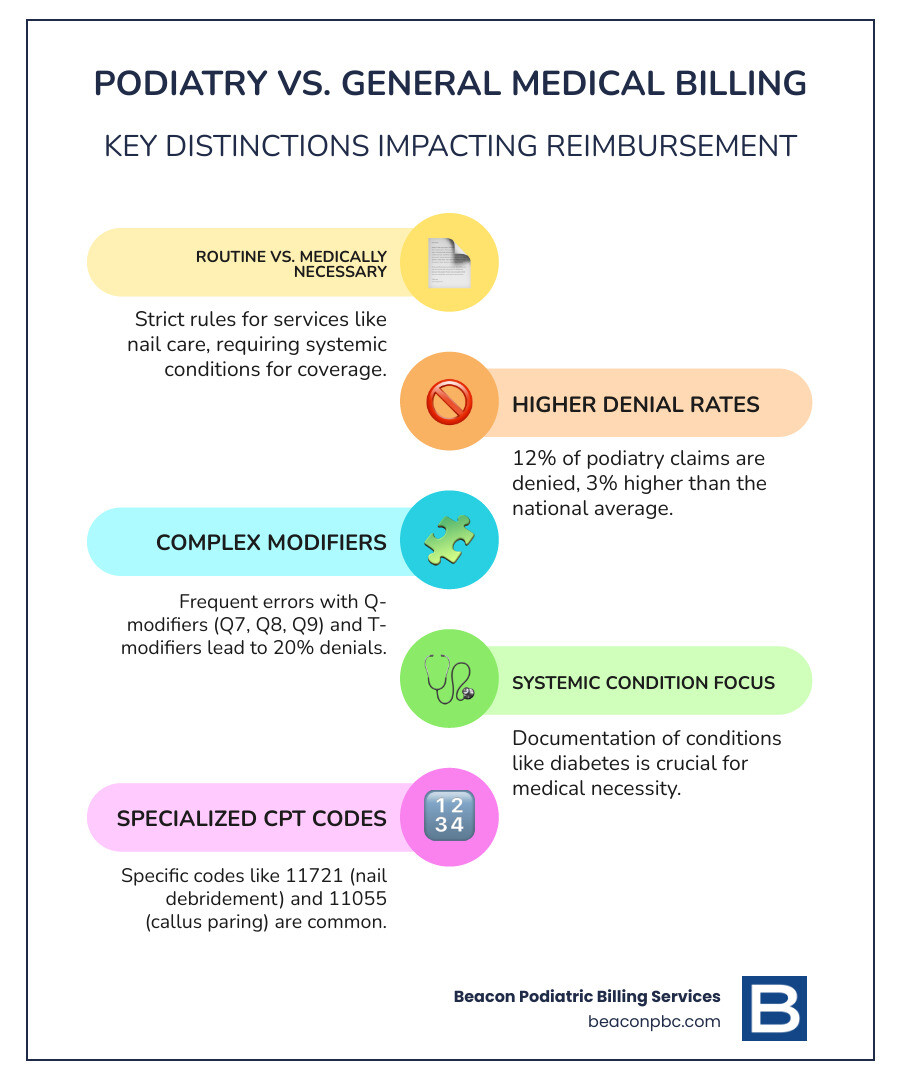
- Routine vs. Medically Necessary Care – Services like nail trimming are only covered when linked to systemic conditions like diabetes.
- High Denial Rates – Podiatry claims face a 12% denial rate, 3% higher than the national average.
- Complex Modifiers – 20% of podiatry claim denials stem from modifier errors, particularly Q-modifiers (Q7, Q8, Q9).
- Surgical Coding Challenges – Podiatry surgery claims are rejected 15% more often than general surgery claims.
- Financial Impact – Practices can lose over $50,000 annually from billing errors alone.
Podiatrists manage everything from routine nail care for diabetic patients to complex reconstructive surgeries. The challenge is that a single visit can blend medical and surgical services, creating a billing complexity that other specialties rarely encounter. A patient encounter might include a foot exam, nail debridement, and a discussion about bunion surgery—each requiring different codes, modifiers, and justification for medical necessity.
This complexity is compounded by payer-specific rules, especially Medicare’s strict distinction between “routine” and “medically necessary” foot care. Without proper documentation of systemic conditions, claims for routine services can lead to audits and recoupments. With treatments for diabetic foot ulcers increasing by 30% from 2020 to 2024 and driving $2 billion in claims, proper documentation can reduce denials by up to 35%.
The Unique Challenges of Podiatry Billing
The world of podiatry medical billing is a maze of unique challenges that can impact a practice’s financial stability. Unlike other specialties, podiatry blends routine care with complex procedures, leading to frequent issues with claim denials.

The primary struggle is differentiating between routine and medically necessary care. Services like nail trimming are often denied unless a specific medical condition justifies them. This, combined with varying payer policies and documentation gaps, contributes to high denial rates. For example, podiatry surgery claims are rejected 15% more often than general surgery claims, and 20% of all podiatry denials stem from modifier errors alone. These unique aspects demand specialized knowledge and constant vigilance.
Why is Podiatry Medical Billing So Complex?
The complexity of podiatry medical billing stems from the link between foot conditions and systemic health issues. Many “routine” services are only covered by insurance if they are a direct result of a larger condition.
For instance, Medicare won’t cover routine foot care unless the patient has a qualifying systemic condition like:
- Diabetes: Diabetic neuropathy or peripheral vascular disease (PVD) can lead to severe foot complications, making routine care medically necessary to prevent infections or amputations.
- Peripheral Vascular Disease (PVD): Impaired circulation increases the risk of non-healing wounds.
- Neuropathy: Nerve damage can make patients unaware of injuries, requiring professional foot care.
To prove medical necessity for these conditions, “Class Findings” (A, B, or C) must be documented to categorize the patient’s risk level. Without this documentation, claims for services like nail debridement (CPT 11721) or callus paring (CPT 11055) will likely be denied. For more detailed guidance on Medicare’s specific requirements, we encourage you to review our resources on More on Medicare Podiatry Billing Guidelines.
Navigating Payer Policies: Medicare vs. Commercial Payers
The rules for podiatry medical billing vary significantly between Medicare and commercial payers.
Medicare’s Strict Rules:
Medicare has stringent guidelines for podiatry. Routine foot care is generally non-covered unless a systemic condition is documented with Class Findings and the correct Q-modifier (Q7, Q8, Q9). Medicare also enforces frequency limits, typically allowing routine care only once every 60 days, and requires that the systemic condition be managed by a provider within six months of the service.
Commercial Payer Nuances:
Commercial payers add their own layers of complexity:
- Pre-authorization: Many plans require prior authorization for surgeries, custom orthotics (e.g., L3020), and Durable Medical Equipment (DME).
- Frequency Limits: These can differ from Medicare’s rules or apply to different procedures.
- Bundling Edits: Payers have unique rules for billing multiple procedures in one visit. Using modifiers like -59 is crucial to prevent improper bundling denials.
- Workers’ Compensation: These cases have their own set of rules, forms, and authorization requirements, which vary by state. We are well-versed in the guidelines for New Jersey, Nevada, Nebraska, North Carolina, and Kentucky.
Cracking the Code: Essential CPT, ICD-10, and Modifiers
In podiatry medical billing, accurate coding is the language that ensures proper payment. A single error can lead to a denied claim and lost revenue. Proper coding translates services into billable units, justifies medical necessity, and maintains compliance.

Keeping up with CPT, ICD-10, and payer guidelines is a full-time job, which is why specialized expertise is so valuable. For more in-depth guidance, our resource Podiatry Billing Made Easy: Your Ultimate Cheat Sheet for CPT Modifiers and Diagnosis Codes is invaluable.
Common CPT and ICD-10 Codes in Podiatry
Mastering the most frequently used codes is fundamental for any podiatry practice.
Common CPT Codes (Current Procedural Terminology):
- CPT 11721 (Debridement of nail(s); six or more): A heavily used code (40% of podiatry Medicare claims in 2023) requiring documentation of medical necessity.
- CPT 11055 (Paring or cutting of benign hyperkeratotic lesion; single lesion): Accounts for 25% of routine care visits and also requires justification.
- CPT 99213 (Established patient office visit, 15-29 minutes): Represents 60% of podiatry E/M claims for follow-up care and management.
- CPT 28296 (Correction, hallux valgus (bunion)…with metatarsal osteotomy): A common surgical code that can net $500-$800 per procedure.
- Other common CPTs: Nail Care (11719-11765), Skin Procedures (11055-11307), Injections (20550-64450), Surgery (28001-28405), Wound Care (11042-97598), and Orthotics (L3000-L3050).
Common ICD-10 Codes (International Classification of Diseases, 10th Revision):
These diagnosis codes provide the “why” for the service. Specificity and laterality are crucial.
- E11.621: Type 2 diabetes mellitus with foot ulcer
- M77.31: Plantar fasciitis, right foot
- L84: Corns and callosities
- L60.0: Ingrowing nail
- M79.671: Pain in the left foot
Key Modifiers and When to Use Them
Modifiers are essential in podiatry medical billing to provide additional information and prevent denials. Modifier errors account for 20% of all podiatry claim denials.
- Q Modifiers (Q7, Q8, Q9): Used for Medicare to indicate Class Findings (A, B, C) that justify routine foot care due to a systemic condition.
- Q7: One Class A finding.
- Q8: Two Class B findings.
- Q9: One Class B and two Class C findings.
- Laterality Modifiers (LT, RT): Specify the left or right side of the body.
- Toe Modifiers (TA-T9): Identify the specific toe treated (e.g., TA for the left great toe, T9 for the right fifth toe). Note: Not used with CPT codes 97598, 11720, and 11721.
- Modifier 25: Used when a significant, separately identifiable E/M service is performed on the same day as a minor procedure.
- Modifier 59: Indicates that two procedures performed on the same day were distinct and separate, overriding bundling edits.
- Modifier 50: Applied when the same procedure is performed bilaterally.
Correct modifier use is critical for accurately representing services and ensuring fair reimbursement, especially given the inconsistent rules among payers.
The Blueprint for Flawless Podiatry Medical Billing
A successful podiatry practice is built on a robust and efficient podiatry medical billing system. A clear blueprint for revenue cycle management (RCM) is essential to prevent financial strain. Optimizing your workflow with technology and best practices can transform billing from a headache into a streamlined, profitable operation. For more insights, visit our section on More on Practice Management & Growth.
Key Components of a Successful Podiatry Medical Billing Workflow
An effective podiatry medical billing workflow is a continuous cycle that maximizes reimbursement and minimizes denials.
- Patient Registration and Eligibility Verification: Accurately capture patient data and verify insurance eligibility and benefits before every appointment to prevent coverage-related denials. We ensure patients in our service areas of New Jersey, Nevada, Nebraska, North Carolina, and Kentucky have their information accurately processed.
- Accurate Documentation (SOAP Notes): If it wasn’t documented, it wasn’t done. Complete SOAP notes must justify the medical necessity of all services, especially for routine foot care, and include details like Class Findings for Medicare. Proper documentation can reduce denials by up to 35%.
- Coding and Charge Entry: Translate services into billable codes by selecting the most accurate CPT, ICD-10, and HCPCS codes. Apply all necessary modifiers (Q-modifiers, LT/RT, 25, 59, etc.) and check for bundling edits.
- Claim Submission: Scrub claims for errors before submission and file them electronically for faster processing, adhering to all payer-specific deadlines.
- Payment Posting: Accurately post payments from insurers and patients, reconcile them against billed amounts, and manage patient balances.
- Denial Management and Appeals: Promptly identify the reasons for denials, such as lack of medical necessity or incorrect modifiers. Take immediate action to correct and resubmit or appeal with supporting documentation. Analyzing denial trends helps prevent future errors. For more on common denial reasons, refer to Common denial reasons in podiatry.
Leveraging Technology: EHR and Practice Management Systems
Technology is essential for efficient podiatry medical billing. Electronic Health Records (EHR) and Practice Management Systems (PMS) are the backbone of a streamlined workflow.
- EHR Integration: A podiatry-specific EHR with custom templates and coding suggestions reduces manual errors and ensures clinical documentation supports billing.
- Automated Billing Processes: Modern PMS automates tasks like charge capture and claim scrubbing, freeing up staff for high-value work like denial management. Claim scrubbers can reduce errors by as much as 50%.
- Reporting and Analytics: Use system reports to track key performance indicators (KPIs) like denial rates and days in A/R to optimize your financial performance. Understanding your More on Financial Health KPIs is vital for practice growth.
- Telehealth Billing: With telehealth for diabetic foot checks increasing by 45% since 2022, your system must correctly bill for virtual visits using the proper Place of Service (POS) codes.
The Strategic Advantage: Partnering with Podiatry Billing Experts
Given the inherent complexities of podiatry medical billing, many practices find that managing billing in-house consumes valuable time and resources. Partnering with specialized podiatry billing experts offers a significant strategic advantage, allowing you to focus on patient care while maximizing your financial performance.
What are the Benefits of Working with Podiatry Billing Specialists?
- Increased Revenue: Specialists leverage their deep knowledge of podiatry-specific codes, modifiers, and payer rules to reduce denials and maximize reimbursements, often boosting revenue by up to 20%.
- Improved Efficiency: Outsourcing billing frees your staff to concentrate on patient care and practice operations, enhancing overall productivity and patient satisfaction.
- Reduced Costs: Eliminate the overhead associated with an in-house billing team, including salaries, benefits, software subscriptions, and ongoing training.
- Guaranteed Compliance: A dedicated billing partner stays current with all regulations, including HIPAA, ensuring your practice avoids costly penalties and remains compliant.
- Proactive Denial Management: Experts don’t just process claims; they analyze denial patterns to prevent future errors and aggressively appeal any incorrect denials to recover revenue.
- Transparent Reporting: Receive clear, detailed reports on your practice’s financial health, including key metrics like clean claim rates, days in A/R, and payment trends.
By entrusting your billing to experts, you gain a partner dedicated to the financial success of your podiatry practice. For more on how we stay ahead of industry changes, see our More on Billing and Coding Updates.
Frequently Asked Questions about Podiatry Billing
How do systemic conditions like diabetes affect insurance coverage for routine foot care?
Systemic conditions are critical for insurance coverage, especially with Medicare. Services like nail debridement are typically not covered unless a patient has a qualifying condition like diabetes, peripheral vascular disease (PVD), or neuropathy. To secure reimbursement, the service must be documented as medically necessary using specific “Class Findings” and billed with the appropriate Q-modifier (Q7, Q8, Q9). Medicare also requires that a provider manage the systemic condition within six months of the foot care service.
What is the most common reason for podiatry claim denials?
The most common reasons for podiatry medical billing denials are:
- Lack of Medical Necessity: Documentation fails to link the service to a qualifying systemic condition or otherwise justify the treatment.
- Incorrect Modifier Usage: As noted, 20% of podiatry denials stem from errors with Q-modifiers, laterality (LT/RT), or procedural modifiers (-25, -59).
- Inadequate Documentation: Incomplete or unclear records that don’t support the billed codes.
- Missing Prior Authorizations: Failure to obtain pre-approval for certain procedures or DME.
- Bundling Errors: Billing for services that payers consider part of another procedure performed on the same day.
How can a practice reduce its podiatry billing errors?
Reducing podiatry medical billing errors requires a proactive approach:
- Regular Staff Training: Keep your team updated on the latest CPT, ICD-10, and payer-specific rules.
- Pre-submission Audits: Review claims for accuracy before they are sent. This can catch up to 80% of common errors.
- Use Podiatry-Specific Software: Leverage EHR and billing software with built-in claim scrubbers and podiatry templates.
- Verify Eligibility Every Time: Confirm each patient’s insurance coverage and benefits before every visit.
- Meticulous Documentation: Ensure clinical notes are detailed, clear, and explicitly support the medical necessity of every service.
- Proactive Denial Management: Analyze denial reasons to identify trends and implement corrective actions to prevent them from recurring.
Conclusion: Step into Financial Health
Navigating the intricacies of podiatry medical billing is a complex marathon of precision and expertise. From the unique challenges of routine versus medically necessary care to the critical application of modifiers, every detail impacts a practice’s financial health. We’ve seen how practices can lose roughly $50,000 annually due to billing errors, a stark reminder of the importance of getting it right.
The key to success lies in understanding these nuances, meticulous documentation, and leveraging specialized knowledge. It’s about ensuring every step, from patient registration to denial management, contributes to a robust revenue cycle.
By partnering with dedicated podiatry medical billing experts, practices in New Jersey, Nevada, Nebraska, North Carolina, and Kentucky can transform their billing operations. We provide the specialized expertise needed to maximize reimbursements, reduce denials, and allow podiatrists to focus on what they do best: providing exceptional foot and ankle care.
Don’t let billing complexities trip up your practice. Step into financial health with a partner who understands the unique demands of podiatry.