
Podiatry Coding Guidelines: Prevent 76.4% Denials
Why Podiatry Coding Guidelines Matter for Your Practice
Podiatry coding guidelines are the rules and requirements that determine whether your claims get paid or denied. Understanding these guidelines means the difference between a healthy revenue cycle and constant cash flow headaches.
Quick Answer: Essential Podiatry Coding Guidelines
- Document medical necessity thoroughly – 76.4% of denials are due to insufficient documentation
- Link systemic conditions to routine foot care – Diabetes, peripheral neuropathy, and vascular disease justify coverage
- Use Q-modifiers correctly – Q7, Q8, and Q9 indicate Class A, B, or C findings for routine care
- Apply modifier -25 for same-day E/M and procedures – Must be significant and separately identifiable
- Know your frequency limits – Routine foot care is typically covered once every 60 days
- Master key CPT codes – 11720/11721 (nail debridement), 11719 (nail trimming), G0127 (dystrophic nails)
- Stay current with annual updates – CPT and ICD-10 codes change every year
The numbers tell a stark story. In 2024, podiatry services had an 11.2% improper payment rate, totaling $216.9 million in projected losses. More than three-quarters of these errors stemmed from one simple problem: insufficient documentation.
For busy podiatrists, this translates to real-world pain. Denied claims mean delayed payments. Delayed payments mean reduced collections. And reduced collections mean less time for what matters most—patient care.
This guide from Guide Podiatric Billing Services cuts through the complexity. You’ll learn exactly which codes to use, how to document medical necessity, when to apply modifiers, and how to stay compliant with Medicare and commercial payers. Whether you’re handling billing in-house or working with a billing service, these fundamentals are non-negotiable.
The good news? Most coding errors are preventable. Practices that conduct quarterly audits see 17% fewer denials than those that audit annually. With the right knowledge and systems in place, you can dramatically improve your clean claim rate.
The Root of the Problem: Why Podiatry Claims Are Denied and How to Prevent It
Imagine this: You’ve provided excellent care to a patient, carefully performing a procedure that genuinely improved their quality of life. You submit the claim, confident in your work, only to receive a dreaded “DENIED” stamp. It’s frustrating, isn’t it? This scenario is all too common in podiatry, and understanding why it happens is the first step to preventing it.

Our research shows that the improper payment rate for podiatry care reached 11.2% in 2024, amounting to a staggering $216.9 million in projected improper payments. This isn’t just bad luck; it points to systemic issues that we can address together.
The primary culprits behind these denials are:
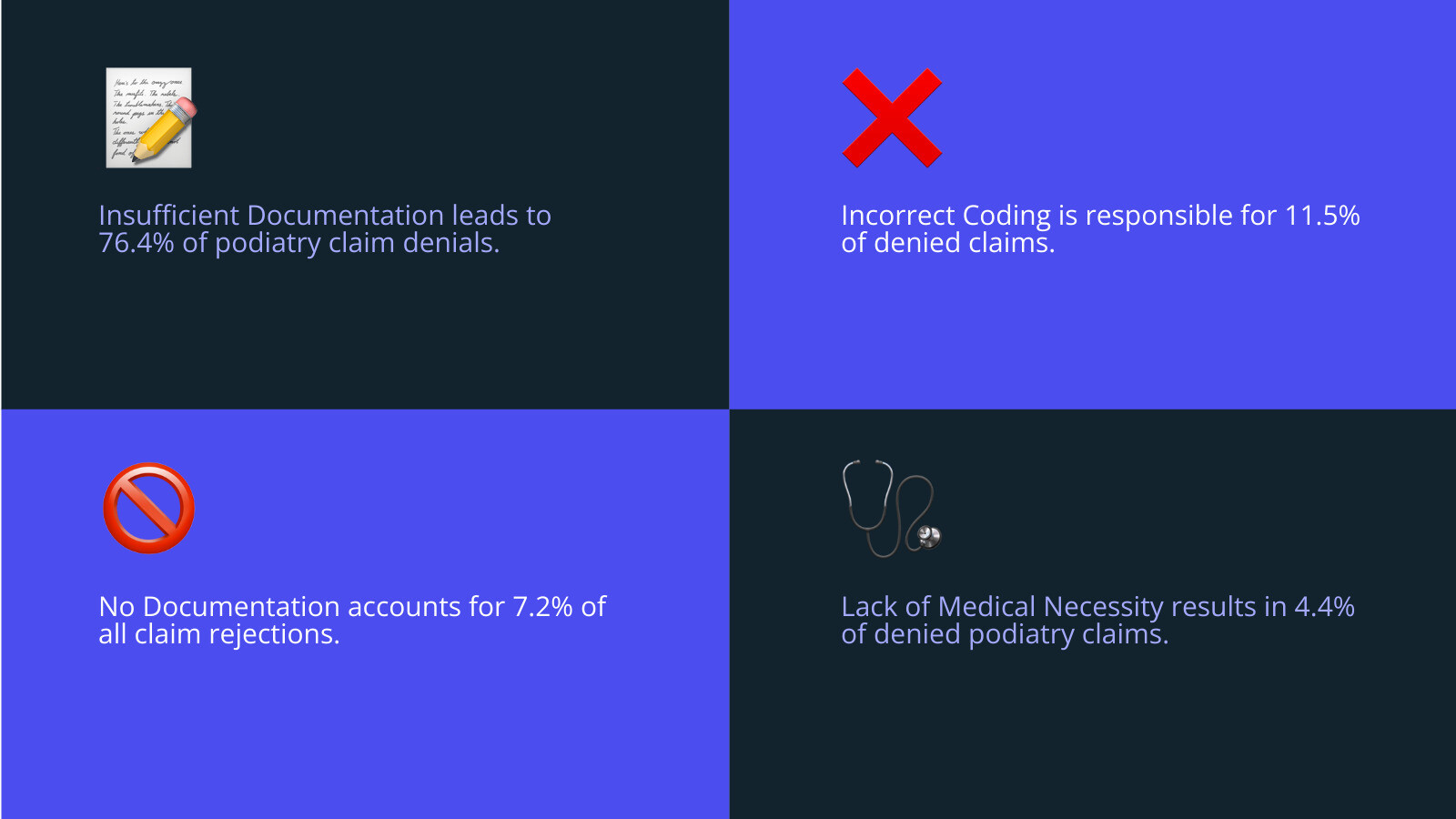
- Insufficient Documentation (76.4%): This is the undisputed heavyweight champion of claim denials. If your notes don’t clearly and precisely tell the story of medical necessity, the payer won’t pay. It’s like trying to win a court case without presenting any evidence.
- Incorrect Coding (11.5%): Using the wrong CPT or ICD-10 code, or missing crucial modifiers, can quickly derail a claim. Coding is constantly evolving, and what was correct last year might be outdated today.
- No Documentation (7.2%): Even worse than insufficient documentation is no documentation at all. This often points to administrative oversights or missing records.
- Lack of Medical Necessity (4.4%): If the service provided isn’t deemed medically necessary by the payer’s standards, it won’t be covered. This is particularly critical for routine foot care.
- Missing or Incorrect Modifiers: Modifiers are like special instructions for payers, providing additional context about a service. Without them, or with the wrong ones, your claim might be misunderstood and rejected.
- Exceeding Frequency Limits: Many services, especially routine foot care, have specific frequency limitations. Billing too often without proper justification is a red flag for payers.
- Payer Policy Variations: What Medicare covers might be different from what a commercial plan covers. Navigating these varied rules can feel like walking through a minefield.
The Centers for Medicare & Medicaid Services (CMS) offers valuable Podiatry Care compliance tips to help podiatrists sidestep these pitfalls. They emphasize the need for thorough documentation and a clear understanding of coverage rules, especially for services that might be considered routine. Guide Podiatric Billing Services helps practices interpret and apply these guidelines so your claims are clean and compliant from the start.
Critical Documentation Requirements for Medical Necessity
When it comes to getting paid, documentation isn’t just good practice—it is essential. For podiatry practices, it is the bedrock of successful revenue cycle management. Without robust clinical notes, even the most expertly performed procedure can lead to a denial. “If it wasn’t documented, it wasn’t done” (or at least, it wasn’t medically necessary in the eyes of the payer).
Here is what to focus on:
- SOAP Notes: The classic Subjective, Objective, Assessment, and Plan format remains a cornerstone. Ensure your SOAP notes are comprehensive, detailing the patient’s chief complaint, relevant history, your findings on examination, your diagnosis, and your treatment plan. Every step should clearly link to the medical necessity of the service provided.
- Linking Diagnosis to Procedure: This is non-negotiable. Every CPT code you bill must be directly supported by a relevant ICD-10 diagnosis code. For instance, if you’re debriding a nail, the diagnosis shouldn’t just be “nail pain.” It needs to be a specific condition that necessitates the debridement, like onychomycosis causing pain or an ingrown toenail with infection.
- Documenting Systemic Conditions: For services like routine foot care, the presence and impact of systemic conditions (e.g., diabetes, peripheral neuropathy, vascular disease) are paramount. Your documentation must clearly describe how these conditions make the patient’s foot care medically necessary and how failure to provide care would be hazardous.
- Physician’s Orders: For certain procedures or referrals, clear physician’s orders are essential. This ensures continuity of care and supports the medical necessity of your services.
- Patient’s Functional Limitations: How does the patient’s condition affect their daily life? Documenting functional limitations—such as difficulty walking, wearing shoes, or performing self-care—can strongly support medical necessity.
- Active Care Documentation: When billing for routine foot care due to complicating systemic diseases (especially for Medicare beneficiaries), documentation must show that the patient is under the active care of a doctor of medicine or osteopathy for that systemic condition. This typically means the patient has been seen by their primary physician for the qualifying disease within the last six months. Record the name of the primary physician and the approximate date of their last visit.
By carefully adhering to these documentation standards, you significantly strengthen your claims and reduce the likelihood of denials. It is a bit more work upfront, but it pays dividends in reimbursement and peace of mind.
Mastering Routine Foot Care: Systemic Conditions, Class Findings, and Q-Modifiers
Ah, routine foot care—a service that can be both essential for patient health and a minefield for billing. Generally, routine foot care services like cutting corns, calluses, or trimming nails are excluded from Medicare coverage. This is because they’re often considered hygienic or preventive maintenance that patients could perform themselves or that don’t address a localized illness or injury.
However, there’s a crucial “but” to this rule: medically necessary exceptions. These exceptions typically arise when systemic conditions make routine foot care a vital part of a patient’s overall health management, preventing more severe complications.
The systemic conditions that most frequently justify coverage for routine foot care include:
- Diabetes Mellitus: With over 38 million Americans affected, diabetes is a leading cause of foot complications. Patients with diabetes are at a significantly higher risk of developing foot ulcers (15-34% in their lifetime) and, if untreated, amputations (15-20% of ulcers). This makes routine foot care critical for prevention.
- Peripheral Neuropathy: This condition reduces sensation in the feet, making patients unaware of minor injuries or infections that can quickly escalate. Neuropathy can stem from various causes, including diabetes, alcoholism, or traumatic injury.
- Peripheral Vascular Disease (PVD): Conditions like arteriosclerosis obliterans, Buerger’s disease, or chronic thrombophlebitis impair circulation to the feet, hindering healing and increasing the risk of infection.
For these conditions to support coverage, there’s an active care requirement. The patient must be under the care of a physician (D.O. or M.D.) for the systemic disease causing them to seek routine foot care. Medicare generally considers this requirement met if the patient saw their primary physician for the complicating disease within six months prior to the routine foot care service.
Understanding Class Findings and Q-Modifiers
To further clarify medical necessity for routine foot care, especially for Medicare beneficiaries, we use specific “Class Findings” and corresponding “Q-Modifiers.” These findings describe the severity of peripheral involvement and help justify why a patient cannot safely perform self-care.
Here’s how they break down:
| Class Finding Category | Description | Corresponding Q-Modifier |
|---|---|---|
| Class A | Nontraumatic amputation of foot or integral skeletal portion. This is the most severe finding, indicating significant prior damage. | Q7 |
| Class B | Evidence of severe peripheral involvement. This requires at least two of the following conditions to be present: – Absent posterior tibial pulse – Absent dorsalis pedis pulse – Advanced trophic changes (e.g., hair growth decrease/absence, nail changes, pigmentary changes, skin texture/color changes) (must have three of these to count as one Class B finding) |
Q8 |
| Class C | Evidence of moderate peripheral involvement. This requires at least one of the following conditions to be present: – Claudication (pain in legs during exercise) – Temperature changes (e.g., cold feet) – Edema – Paresthesia (abnormal sensations like tingling or numbness) – Burning |
Q9 |
Note: For a presumption of coverage to apply, specific combinations of these findings are required:
- Q7: One Class A finding.
- Q8: Two Class B findings.
- Q9: One Class B and two Class C findings.
These modifiers are essential because they provide a clear, standardized way to communicate the medical necessity of routine foot care to payers. Without them, claims for these services are almost certain to be denied. Proper application of these Q-modifiers, alongside thorough documentation of the underlying systemic condition and the specific physical findings, is critical for successful reimbursement.
Your Podiatry Coding Toolkit: Essential CPT, ICD-10, and Modifiers
Navigating podiatry coding guidelines can feel like learning a new language, but with the right toolkit, you can master it. This toolkit consists of three main components: CPT codes, ICD-10 codes, and modifiers. Each plays a vital role in accurately describing the services you provide and the conditions you treat, ensuring you get reimbursed for your expertise.

CPT (Current Procedural Terminology) codes describe what you did. ICD-10 (International Classification of Diseases, 10th Revision) codes explain why you did it (the diagnosis). And modifiers add extra details or special circumstances to a CPT code. Together, they form the narrative of your patient encounters, directly impacting your revenue cycle. Staying updated on billing and coding updates is an ongoing commitment for any successful podiatry practice.
Key CPT Codes for Common Podiatry Procedures
Here are some of the CPT codes frequently used in podiatry:
- Nail Debridement (11720, 11721):
- 11720: Debridement of nail(s) by any method; one to five nails.
- 11721: Debridement of nail(s) by any method; six or more nails.
These are commonly used for dystrophic or mycotic nails that are thickened and difficult for the patient to manage.
- Nail Trimming (11719, G0127):
- 11719: Trimming of nondystrophic nails, any number. This is generally considered routine and often not covered unless specific systemic conditions are present.
- G0127: Trimming of dystrophic nails, any number. This HCPCS Level II code is specific to Medicare for trimming dystrophic nails when medically necessary.
- Lesion Paring/Debridement (11055-11057):
- 11055: Paring or cutting of benign hyperkeratotic lesion (e.g., corn or callus); single lesion.
- 11056: Paring or cutting of benign hyperkeratotic lesion (e.g., corn or callus); two to four lesions.
- 11057: Paring or cutting of benign hyperkeratotic lesion (e.g., corn or callus); more than four lesions.
These codes are used for symptomatic corns and calluses. Medical necessity must be well-documented, especially for routine services.
- Injections (20550, 20551):
- 20550: Injection(s); single tendon sheath, or ligament, aponeurosis (e.g., plantar “fascia”).
- 20551: Injection(s); single tendon origin/insertion.
These are frequently used for conditions like plantar fasciitis or tendinitis.
- Nail Avulsion (11730):
- 11730: Avulsion of nail plate, partial or complete, simple; single. This code is used for ingrown toenails. Additional nails can be billed with add-on code 11732.
- E/M Codes (99202-99215): These Evaluation and Management codes are used for office visits and describe the complexity of the patient encounter.
- 99202-99205: New patient office visit codes, varying by complexity/time.
- 99212-99215: Established patient office visit codes, varying by complexity/time.
Since 2021, E/M coding often relies on time spent or Medical Decision Making (MDM).
Essential ICD-10 Codes to Support Medical Necessity
Linking the correct ICD-10 codes to your CPT codes is paramount for demonstrating medical necessity. Here are some essential categories and examples:
- Diabetes with Complications (E08-E13 series): These codes are critical for justifying routine foot care and other services for diabetic patients. Examples include:
- E11.621: Type 2 diabetes mellitus with foot ulcer.
- E11.40: Type 2 diabetes mellitus with diabetic neuropathy, unspecified.
- Atherosclerosis (I70 series): For patients with peripheral vascular disease.
- I70.201: Unspecified atherosclerosis of native arteries of extremities, right leg.
- Peripheral Neuropathy (G60-G64 series):
- G62.9: Polyneuropathy, unspecified.
- G60.0: Hereditary motor and sensory neuropathy.
- Onychomycosis (B35.1): Fungal infection of the nail, often leading to dystrophic nails.
- Corns and Callosities (L84): For symptomatic hyperkeratotic lesions.
- Plantar Fasciitis (M72.2): A common cause of heel pain.
- Ingrowing Nail (L60.0): For conditions requiring nail avulsion.
Specificity and laterality (left/right) are key for ICD-10 codes. An unspecified code or missing laterality can lead to denials. Always choose the most specific code available that accurately reflects the patient’s condition.
The Power of Modifiers: A Guide to Accurate Podiatry Coding Guidelines
Modifiers are two-character codes appended to CPT codes that provide additional information about a service without changing its definition. They clarify that a service was performed, altered, or was distinct from another. Misusing or omitting modifiers is a common reason for denials.
- Modifier -25 (Significant, Separately Identifiable E/M Service): This is a superstar in podiatry. Use -25 when a separately identifiable E/M service (like an office visit) is performed on the same day as a minor procedure. For example, if a patient comes in for an evaluation of new foot pain (E/M) and you also perform an injection for plantar fasciitis (procedure), append -25 to the E/M code (e.g., 99213-25). This tells the payer that the E/M wasn’t just part of the procedure’s decision-making.
- Modifier -59 (Distinct Procedural Service): When two procedures that might normally be bundled together are performed on the same day, but are distinct and separate (e.g., different sites, different encounters, or different lesions), use -59. For instance, if you remove a callus (11055) and a wart (17110) from different parts of the foot, -59 would be appended to one of the codes.
- Laterality Modifiers (-LT, -RT): These indicate whether a service was performed on the left (-LT) or right (-RT) side of the body. For bilateral procedures, some payers prefer using -50 (bilateral procedure) on a single line, while others prefer -LT and -RT on separate lines. Always check payer-specific guidelines.
- Q-Modifiers (Q7, Q8, Q9): As discussed, these are crucial for routine foot care to indicate the presence of Class A, B, or C findings that justify medical necessity due to systemic conditions.
- Toe Modifiers (TA-T9): These are anatomical modifiers used to specify which toe a procedure was performed on.
- TA: Left foot, great toe
- T1: Left foot, second toe
- …
- T9: Right foot, fifth toe
These are often required for procedures like hammertoe corrections or nail avulsions to ensure precise billing. Mastering these modifiers is a critical skill for any podiatry practice and a key focus for teams that want to improve coding accuracy and reimbursement.
Best Practices for Compliant and Profitable Podiatry Coding Guidelines
Ensuring your practice runs smoothly isn’t just about patient care; it’s also about robust revenue cycle management and unwavering compliance. In the intricate world of podiatry coding guidelines, best practices aren’t just suggestions—they are necessities for financial health and avoiding audits.
Guide Podiatric Billing Services understands that compliance isn’t a one-time task; it’s an ongoing commitment. This means staying on top of payer policies and continuously refining coding processes for practices in New Jersey, Nevada, Nebraska, North Carolina, Kentucky, and beyond.
Medicare vs. Commercial Payer Differences
A challenge in podiatry billing is the variation between payers. What Medicare covers and how it wants claims submitted can differ significantly from commercial insurance plans.
- Prior Authorization Requirements: Commercial payers are often more stringent with prior authorizations for certain procedures or durable medical equipment (DME). Always verify authorization requirements before providing the service.
- Covered Services Lists: While Medicare has specific rules for routine foot care, commercial plans may have their own definitions and exclusions. Some might be more generous, others stricter.
- Frequency Limitations: Even for covered services, frequency limits can vary. Medicare generally covers routine foot care once every 60 days, but commercial plans might have different intervals.
- Different Modifier Rules: While many modifiers are universally recognized, some payers may have specific preferences or interpretations for certain modifiers, especially for bundled services.
- Fee Schedules: Reimbursement rates and fee schedules vary widely between Medicare, Medicaid, and commercial insurers.
Always verify patient eligibility and benefits with each payer before rendering services. This proactive step can prevent denials and support a healthier cash flow. Guide also develops internal Medicare podiatry billing reference materials to help practices steer these federal requirements.
Staying Current and Improving Accuracy
The coding landscape is not static; it’s a dynamic environment that demands continuous attention. CPT and ICD-10 codes are updated annually, and payer policies can change at any moment.
- Annual CPT/ICD-10 Updates: The American Medical Association (AMA) releases CPT updates, and CMS releases ICD-10 updates, typically effective January 1st. Review these changes carefully to avoid using outdated codes.
- Subscribing to Payer Newsletters: Medicare Administrative Contractors (MACs) and commercial payers often publish newsletters or alerts detailing policy changes. Subscribing to these is a simple yet effective way to stay informed.
- AAPC Coding Resources: Organizations like the American Academy of Professional Coders (AAPC) provide resources, training, and certifications to help coders stay current.
- Regular Internal Audits: This is perhaps the most impactful best practice. The MGMA (Medical Group Management Association) reported that practices conducting quarterly internal audits experienced 17% fewer denials compared to those auditing annually. Audits help identify common errors, documentation gaps, and denial patterns, allowing you to implement corrective actions.
- Staff Training: Continuous education for your billing staff and providers is essential. Regular training sessions on coding updates, documentation best practices, and payer-specific requirements ensure everyone is on the same page and equipped to handle the complexities.
By integrating these best practices into daily operations, podiatry practices can ensure not only compliance but also improved revenue cycle performance, allowing providers to focus more on patient care and less on administrative battles.
Frequently Asked Questions about Podiatry Coding
We get a lot of questions about podiatry coding guidelines, and for good reason! The nuances can be tricky. Here are some of the most common questions we hear, along with our expert answers.
What is the single biggest reason for podiatry claim denials?
The single biggest reason for podiatry claim denials, by a significant margin, is insufficient documentation. Our research shows that insufficient documentation accounted for a staggering 76.4% of improper payments for podiatric providers during the 2024 reporting period. This means that even if you provided excellent, medically necessary care, if your clinical notes don’t clearly and completely support every aspect of that service—from the patient’s symptoms and your examination findings to your assessment and treatment plan—the payer will likely deny the claim. It’s crucial to document thoroughly and precisely, ensuring that another clinician (or an auditor) could read your notes and understand exactly why each service was performed and why it was medically necessary.
Can I bill for an E/M service and a minor procedure on the same day?
Yes, you absolutely can bill for an Evaluation and Management (E/M) service and a minor procedure on the same day, but there’s a critical rule to follow: you must append modifier -25 to the E/M code. Modifier -25 signifies that the E/M service was “significant and separately identifiable” from the minor procedure. This means that you performed a distinct E/M service (e.g., a comprehensive history, exam, and medical decision-making related to a new problem or a significant exacerbation of an existing one) that went beyond the usual pre- and post-procedure work inherent in the minor procedure itself. Without modifier -25, many payers will bundle the E/M service into the procedure, resulting in only the procedure being reimbursed. Always ensure your documentation clearly supports both the separate E/M service and the procedure.
How often can medically necessary routine foot care be billed to Medicare?
Generally, Medicare considers medically necessary routine foot care services to be covered no more than once every 60 days. This frequency limitation is in place to ensure that services are provided only when clinically appropriate and to prevent overutilization. However, if a patient’s medical condition is severe and unstable, requiring more frequent interventions to prevent serious complications (such as ulceration or amputation), it may be possible to bill more often. In such cases, your documentation must be exceptionally robust, clearly justifying the increased frequency due to the patient’s specific, rapidly changing, or high-risk status. Exceeding the 60-day rule without compelling and well-documented medical necessity will almost certainly lead to claim denials.
Conclusion: Step Up Your Billing Game
Navigating the complexities of podiatry coding guidelines can feel like a marathon, but with the right knowledge and best practices, your practice can thrive. The key takeaways are clear:
- Documentation is king: Meticulous, detailed, and medically necessary documentation is your strongest defense against denials.
- Master medical necessity: Understand when and why services are covered, especially for routine foot care and systemic conditions.
- Use modifiers correctly: These small but mighty codes provide crucial context that can make or break a claim.
- Stay updated: The coding landscape is dynamic; commit to continuous learning and adapt to annual changes and payer policy shifts.
Guide Podiatric Billing Services offers specialized, 100% US-based podiatry billing and revenue cycle management to help you apply these principles every day. With podiatry-specific expertise and personalized support for practices in Jersey City and Succasunna (New Jersey), Las Vegas (Nevada), Omaha (Nebraska), Charlotte (North Carolina), Ashland (Kentucky), and across the USA, Guide focuses on maximizing your collections while you focus on patient care.