

Podiatry Medical Billing Company 2026: Banish Headaches
Why Podiatry Billing Demands Specialized Expertise
A podiatry medical billing company specializes in handling the complex coding, payer rules, and compliance requirements unique to foot and ankle care. These companies help practices reduce claim denials, accelerate payments, and maximize revenue by applying podiatry-specific expertise that general billing services often lack.
Top reasons podiatrists outsource their billing:
- Specialized coding knowledge – Understanding Q modifiers, routine vs. medically necessary care distinctions, and podiatry-specific CPT codes
- Higher clean claim rates – Specialized services achieve 98%+ clean claim rates vs. industry average of 65-80%
- Faster payments – Claims processed up to 3x faster with expert handling
- Revenue increase – Practices typically see 20-35% revenue improvement within 90 days
- Reduced administrative burden – Staff can focus entirely on patient care instead of insurance follow-up
The financial stability of your podiatry practice hinges on billing accuracy and timely reimbursement. Yet podiatry billing is notoriously complex—insurance companies frequently deny claims they don’t consider “medically necessary,” payers have inconsistent modifier requirements, and procedures are often bundled inappropriately.
According to industry data, podiatrists can lose approximately 10% of their income due to underpayments from non-specialized billing services. The complexity stems from unique challenges: distinguishing routine foot care from medically necessary treatment, navigating location-based billing rules for office vs. hospital procedures, and managing payer-specific policies that change frequently.
Many practices struggle with this administrative burden. As one practice manager noted, “Other companies were complicated and took too much of my time.” The result? Delayed payments, mounting accounts receivable, and less time for what matters most—caring for patients.
A specialized podiatry medical billing company solves these problems by bringing certified coders, proven processes, and deep payer knowledge to your practice. They handle everything from eligibility verification to denial appeals, ensuring you’re reimbursed correctly and quickly.
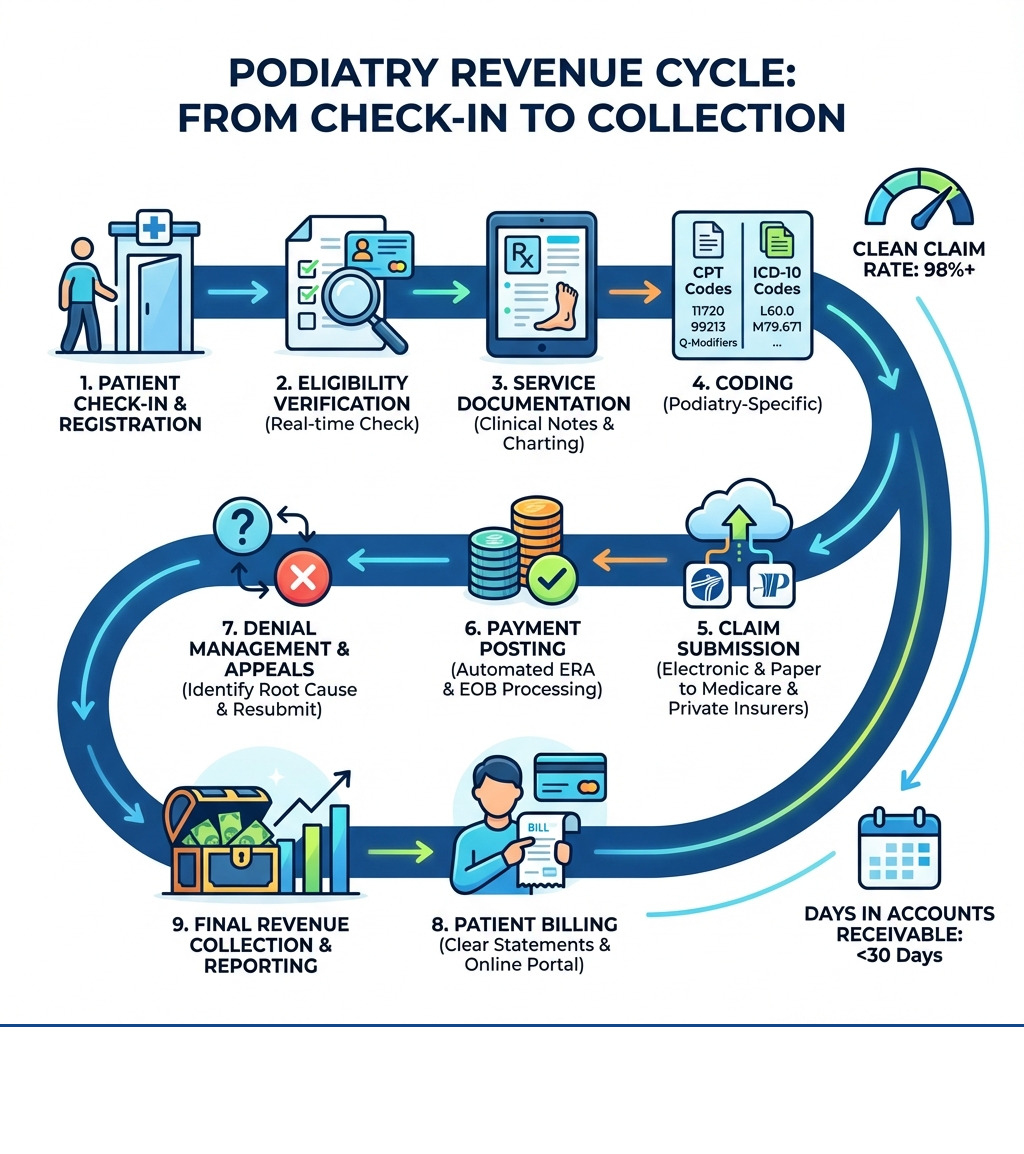
Podiatry medical billing company terminology:
Why Podiatry Billing is a Specialty, Not a General Task
Podiatry medical billing is far from a one-size-fits-all solution. Unlike general medical billing, our field presents a unique set of challenges that demand specialized knowledge and a keen eye for detail. The very nature of foot and ankle care, from routine treatments to complex surgeries, means navigating a minefield of payer-specific rules and medical necessity definitions.

One of the primary problems we face is the constant battle between what is considered “routine” versus “medically necessary” care. Many insurance companies, including Medicare, often view podiatry services as elective or cosmetic, leading to high denial rates if not coded and documented carefully. For instance, routine foot care might be covered if the patient has a systemic condition like diabetes, but not otherwise. This distinction requires precise documentation and the correct application of modifiers to justify the medical necessity of our services.
Furthermore, we encounter issues with procedure bundling, where insurers combine multiple procedures into a single payment, even if they were distinct and separately performed. Identifying and appealing inappropriate bundling requires a deep understanding of podiatry procedures and payer policies. Location-based billing also adds a layer of complexity; performing a procedure in an office versus a hospital or nursing home can require different modifiers and authorization numbers, and errors here can lead to immediate claim rejection. The complexities are so significant that we’ve created The Foot-Friendly Guide to Podiatry Billing and Coding to help our practices steer these waters.
The high denial rates in podiatry billing are a testament to these unique challenges. Without a specialized podiatry medical billing company that understands these nuances, practices risk significant revenue loss and increased administrative burden.
The Unique Challenges of Podiatry Coding and Modifiers
The backbone of successful podiatry billing lies in accurate coding. We’re talking about more than just slapping a code on a service; it’s about selecting the right CPT codes and ICD-10 codes, and crucially, applying the correct modifiers. Modifiers are subcategories of CPT codes that provide additional details about a diagnosis or treatment, and they often determine whether a service is covered or not. Insurers, however, have different rules for modifiers, making it a constant challenge to stay updated.
For instance, Q modifiers (Q7, Q8, Q9) are essential in podiatry billing as they convey specific patient condition findings, particularly when dealing with routine foot care for patients with systemic conditions. Failing to use these correctly, or using them inconsistently, can lead to immediate denials. Surgical procedures and non-surgical procedures each have their own intricate coding guidelines, requiring certified coders who specialize in podiatry to ensure maximum reimbursement.
The American Medical Association (AMA) provides a CPT code overview, but the application within podiatry is highly specialized. Our team needs to be adept in using the correct CPT and diagnosis codes following established guidelines, ensuring they align with National Coverage Determinations (NCDs) and Local Coverage Determinations (LCDs). Inaccurate podiatry billing due to incorrect coding or modifier use can lead to underpayment, revenue loss, and non-compliance with regulations. For an even deeper dive into this, check out Footing the Bill: A Podiatrist’s Handbook to CPT and ICD-10 Codes.
Navigating Payer Policies: Medicare vs. Private Insurance
Understanding the differences between Medicare and private insurance policies is paramount for a podiatry medical billing company. Medicare, with its stringent guidelines, significantly influences industry standards. It explicitly outlines what services it will cover for patients, and these policies often shape how private insurers approach podiatry claims.
For Medicare, covered podiatric services generally include chronic condition-related foot care treatments, wound care services, hyperbaric oxygen therapy for particular lower extremity wounds, and wart treatments—provided all Medicare criteria are satisfied and medical necessity is clearly demonstrated. However, Medicare typically excludes coverage for elective podiatry services outside reasonable foot care, routine check-ups not part of an initial diagnosis (unless specific Q8 codes are used for metabolic, neurologic, or peripheral vascular diseases), foot subluxation treatments, flat foot care, and most supportive devices except orthotic shoes as part of a leg brace and therapeutic shoes for diabetics. This makes Demystifying Medicare Podiatry and our Medicare Podiatry Billing Guidelines essential resources.
Private insurance policies, on the other hand, vary considerably. While they often align with Medicare’s principles, each insurer develops unique policies regarding podiatry claim coverage. For example, Blue Cross Blue Shield and similar private insurers often reject claims for elective treatments but may provide coverage for diabetic foot care, fungal nail treatments, foot and ankle surgical procedures, injury treatments, wart removal, durable medical equipment, and aspirations or injections—all with precise coding. The key for us is to carefully track and understand these varying policies, ensuring that each claim is custom to the specific payer’s requirements to maximize reimbursement and minimize denials.
The Strategic Advantage: Why Outsourcing Podiatry Billing Makes Sense
We understand that running a podiatry practice means balancing patient care with the constant demands of financial management. This is where outsourcing your medical billing to a specialized podiatry medical billing company truly shines. It’s not just about offloading tasks; it’s about gaining a strategic advantage that impacts your practice’s bottom line and operational efficiency.

One of the most immediate benefits we observe is significant cost reduction. Imagine eliminating the need for in-house billing staff, their salaries, benefits, training, and the ongoing investment in billing software. Outsourcing allows you to convert these fixed costs into a variable expense, often a percentage of collections, which means our success is directly tied to yours. This can lead to substantial savings, freeing up resources that can be reinvested into patient care or practice growth.
Beyond cost, outsourcing leads to increased revenue. Specialized billing companies, with their deep expertise in podiatry coding and payer rules, achieve higher clean claim rates—often 98% or more. This means fewer denials, faster payments (sometimes 3x faster), and a healthier cash flow. We’ve seen practices experience a 20-35% revenue improvement within just 90 days. Our dedicated team relentlessly pursues every dollar, from initial claim submission to diligent denial management and appeals.
This shift also allows your invaluable staff to focus entirely on patient care. Instead of spending hours on insurance follow-ups, claim rejections, and administrative burdens, they can dedicate their energy to what they do best: supporting your patients. This not only reduces administrative workload but also improves patient satisfaction and staff morale.
Access to expertise is another critical advantage. The medical billing landscape is constantly changing, with new codes, regulations, and compliance requirements emerging regularly. A specialized podiatry medical billing company like ours stays on top of these changes, ensuring your practice remains compliant and profitable. This mitigates risks associated with staff retention and the learning curve of keeping up with complex regulations like HIPAA and MIPS/MACRA. Our Billing Services are designed to bring all these benefits to your practice.
[TABLE] Comparing In-House vs. Outsourced Podiatry Billing
| Feature | In-House Billing | Outsourced Billing |
|---|---|---|
| Cost | High (salaries, benefits, software, training) | Lower (percentage-based, no overhead) |
| Expertise | Limited to current staff knowledge | Access to certified, specialized podiatry coders |
| Efficiency | Dependent on staff workload and turnover | Streamlined, dedicated processes for faster claims |
| Compliance | Burden on practice to stay updated | Experts manage regulatory changes (HIPAA, MIPS) |
| Focus | Staff juggles billing and patient duties | Practice focuses 100% on patient care |
What to Look for in a Top-Tier Podiatry Medical Billing Company
When you’re ready to outsource your billing, choosing the right podiatry medical billing company is a critical decision for your practice’s financial health. We believe it’s about finding a partner, not just a vendor. Here’s what we recommend looking for:
First and foremost, specialization in podiatry is non-negotiable. As we’ve discussed, podiatry billing has unique complexities that a general medical billing service simply won’t grasp. You need a team that lives and breathes foot and ankle coding, understands Q modifiers, and steers the nuances of routine vs. medically necessary care effortlessly.
Next, look for certified coders. Specifically, AAPC-certified coders demonstrate a commitment to industry standards and ongoing education. This ensures accuracy in coding, which is directly linked to your reimbursement rates and compliance.
A 100% US-based team is another crucial factor. This ensures clear communication, adherence to US compliance regulations, and a better understanding of the local healthcare landscape, especially in states like New Jersey, Nevada, Nebraska, North Carolina, and Kentucky.
Technology integration is key for efficiency. A top-tier company should seamlessly integrate with your existing EHR system, reducing data entry errors and streamlining workflows. They should also leverage advanced billing technology for faster claims processing, denial prevention, and robust reporting.
Finally, transparent pricing and a clear understanding of their processes are vital. You want a partner who clearly explains how they will maximize your revenue and what you can expect in terms of reporting and communication. For more insights, our article on 5 Proven Ways to Find a Podiatry Billing Company offers excellent guidance.
Core Services of a Comprehensive Podiatry Medical Billing Company
A truly comprehensive podiatry medical billing company offers a full suite of services designed to manage your entire revenue cycle, from the moment a patient schedules an appointment to the final payment. Here’s what we provide:
- End-to-end claim submission: This includes meticulous claim review and scrubbing to ensure accuracy before submission, drastically increasing clean claim rates. We ensure that claims are submitted within timely filing limits, which vary by insurance company (e.g., Blue Cross Blue Shield has different limits in Texas and Minnesota, though we serve NJ, NV, NE, NC, KY).
- Payment posting and reconciliation: Accurately posting payments and reconciling accounts is vital for a clear financial picture and to identify any underpayments.
- Denial management and appeals: This is where expertise truly shines. We proactively identify reasons for denials, implement strategies to prevent future rejections, and aggressively pursue appeals with thorough documentation and knowledge of payer policies. This involves a three-stage follow-up process: initial evaluation, analysis, and collection.
- A/R follow-up: Diligent follow-up on outstanding accounts receivable is crucial to prevent revenue leakage. Our team carefully tracks and resolves unpaid claims.
- Patient invoicing and support: We handle the complexities of patient statements, provide clear explanations of benefits, and offer support for patient inquiries, reducing your administrative burden and improving patient satisfaction.
- Credentialing: Becoming a participating provider with major federal and commercial carriers is a complex process. A comprehensive service handles all aspects of credentialing to ensure you can bill for services.
- Eligibility verification: Performing eligibility verification, sometimes multiple times (e.g., up to 4 times), is critical to confirm copayments, deductibles, and coverage, preventing denials before they even happen. This also includes checking for out-of-network alerts during scheduling.
Commitment to Compliance and Security
In the changing healthcare landscape, a podiatry medical billing company must demonstrate an unwavering commitment to compliance and security. For us, this isn’t just a box to check; it’s a fundamental pillar of our service.
We ensure strict HIPAA compliance, safeguarding patient health information with the utmost care. Our systems and processes are designed to meet or exceed all federal regulations, giving you peace of mind that your data is secure. Beyond HIPAA, we provide robust MIPS/MACRA support. MIPS compliance is crucial for avoiding significant Medicare reimbursement penalties—up to 9% for lack of reporting. We collect the required data without extra steps for your operators and offer expert assistance to ensure your practice maximizes its MIPS scores.
Audit protection is another key aspect. We implement best practices in coding and documentation that make your practice audit-proof. This includes guidance on accurate documentation, which is essential for contesting unpaid claims and demonstrating medical necessity. Our team stays current with all regulatory changes, including initiatives like the Cures Act (mandating connectivity between providers, patients, and HIEs) and the No-Surprises Act (requiring out-of-network alerts). This proactive approach to compliance means your practice is protected from fines and legal issues. Dive deeper into this topic with The Footwork of Finance: Mastering Podiatry Billing Compliance and Audit-Proof Your Practice: A Guide to Podiatry Billing Compliance.
Transparent Reporting and Actionable Analytics
What good is a billing service if you don’t know how your practice is performing? A top-tier podiatry medical billing company provides transparent reporting and actionable analytics that offer a clear window into your financial health. We believe in empowering our practices with data, not just processing claims.
We provide comprehensive Key Performance Indicators (KPIs) custom specifically for podiatry practices. These include metrics like clean claim rate, average days in A/R, collection rates, and denial rates. These KPIs are reviewed regularly, often in weekly or monthly meetings, following MGMA financial reporting recommendations. Our article Live and Die by KPIs: The Podiatrist’s Guide to Practice Growth and Profitability highlights their importance.
Our custom financial reports offer insights into procedure profitability, allowing you to identify your most lucrative services. We also provide payer performance analysis, showing you which insurance companies are paying promptly and which ones are consistently causing delays or denials. This information is invaluable for strategic decision-making, helping you optimize your service offerings and payer contracts. Detailed A/R aging reports help us prioritize follow-up efforts, ensuring no revenue slips through the cracks. This level of transparency and analytical depth means you’re always in control, with the insights needed to make informed decisions for your practice’s growth.
How a Specialized Partner Maximizes Your Revenue
Maximizing your practice’s revenue goes beyond simply submitting claims. A specialized podiatry medical billing company employs a multi-faceted approach, leveraging expertise and proactive strategies to ensure every dollar you’ve earned finds its way into your practice.
One of our most impactful strategies is proactive denial management. Instead of waiting for denials to pile up, we use advanced systems that provide pre-submission alerts on claims likely to be denied. This allows us to correct potential issues before they even reach the payer, significantly boosting your clean claim rate. When denials do occur, our team initiates a robust and effective appeals process, armed with thorough documentation and an in-depth understanding of payer-specific appeal requirements. We know that many denials, if addressed correctly and promptly, can be overturned.
Timely claim submission is another non-negotiable. Insurance companies have strict timely filing limits, and missing these deadlines almost guarantees a final, unappealable denial. Our streamlined processes ensure claims are generated and submitted daily, well within these crucial windows. Coupled with diligent follow-up, we ensure claims don’t get lost in the shuffle.
Accurate documentation guidance is paramount. We work closely with your practice to ensure clinical notes support the medical necessity of every service billed. This is especially critical for specialized podiatry services like custom orthotics and Durable Medical Equipment (DME). Billing for these items involves unique CPT codes, modifiers, and documentation requirements that can be complex. Our expertise ensures these high-value services are coded and billed correctly, securing full payment. Similarly, surgical billing expertise for foot and ankle procedures demands precision to avoid common errors and ensure proper reimbursement. By focusing on these areas, we help our practices achieve higher profit margins. You can learn more about this in High-Profit Procedures: Smart Strategies Your Guide to Podiatry Revenue Growth.
Frequently Asked Questions about Podiatry Billing Services
We often encounter common questions from podiatrists considering outsourcing their billing. Here are some of the most frequent ones we hear:
How quickly can I expect to see an increase in my collections?
While every practice is unique, a specialized podiatry medical billing company typically focuses on reducing A/R (Accounts Receivable) days and improving clean claim rates from day one. This proactive approach, coupled with correcting coding errors and aggressively following up on unpaid claims, can lead to noticeable revenue improvement within 90 days. Some practices even report a 20-35% increase in collections within this timeframe. Our goal is to get your money flowing faster, ensuring your practice’s financial health sees a swift turnaround.
What is the difference between a general biller and a podiatry-specific biller?
The difference is vast, like comparing a general practitioner to a podiatrist! A general biller handles medical claims across various specialties, often lacking the in-depth knowledge required for the nuances of foot and ankle care. A podiatry-specific biller, however, possesses specialized expertise in the unique challenges of our field. This includes a deep understanding of podiatry-specific CPT and ICD-10 codes, the correct use of Q modifiers (Q7, Q8, Q9) to justify medical necessity, and intricate knowledge of billing for routine foot care under specific medical conditions. They also steer the complex payer policies for custom orthotics, DME, and surgical procedures, areas where general billers often make mistakes that lead to denials and lost revenue. A podiatry-specific biller speaks the language of foot and ankle care fluently, ensuring your claims are understood and paid.
How much does it cost to outsource podiatry billing?
While we don’t discuss specific pricing, it’s common for podiatry medical billing company services to operate on a percentage of the total collections they bring in for your practice. This model ensures that the billing company is directly motivated to maximize your revenue, as their success is tied to yours. This approach typically covers all aspects of the billing cycle, from claim submission and denial management to A/R follow-up and reporting, without the overhead costs associated with in-house billing staff (salaries, benefits, software, training). We encourage practices to get a personalized quote to understand the value proposition for their specific needs.
Conclusion: Take the Next Step Towards a Healthier Practice
We hope this guide has illuminated the unique complexities of podiatry medical billing and the profound benefits that a specialized podiatry medical billing company can bring to your practice. From navigating intricate coding and payer policies to maximizing your revenue and ensuring compliance, the right partner can truly transform your financial health and allow you to focus on what you do best: providing exceptional patient care.
Choosing the right partner is a strategic decision that impacts every aspect of your practice’s growth. With specialized expertise, a dedicated US-based team, and a commitment to transparent reporting and compliance, we stand ready to be that partner. Don’t let billing headaches hold your practice back any longer.
Take the next step towards a healthier, more profitable practice. We invite you to Contact Beacon today to learn more about how our specialized services can benefit your practice. You can also learn more about our specialized billing services and find how we can help you outsource your worries and step into financial success.