

Increase podiatry revenue: Boost 4 Growth 2026
Why Growing Your Podiatry Revenue Matters More Than Ever
Increase podiatry revenue is about more than just earning more money—it’s about building a sustainable practice that lets you focus on patient care while maintaining financial stability. Here’s how to do it:
Quick Revenue Growth Strategies:
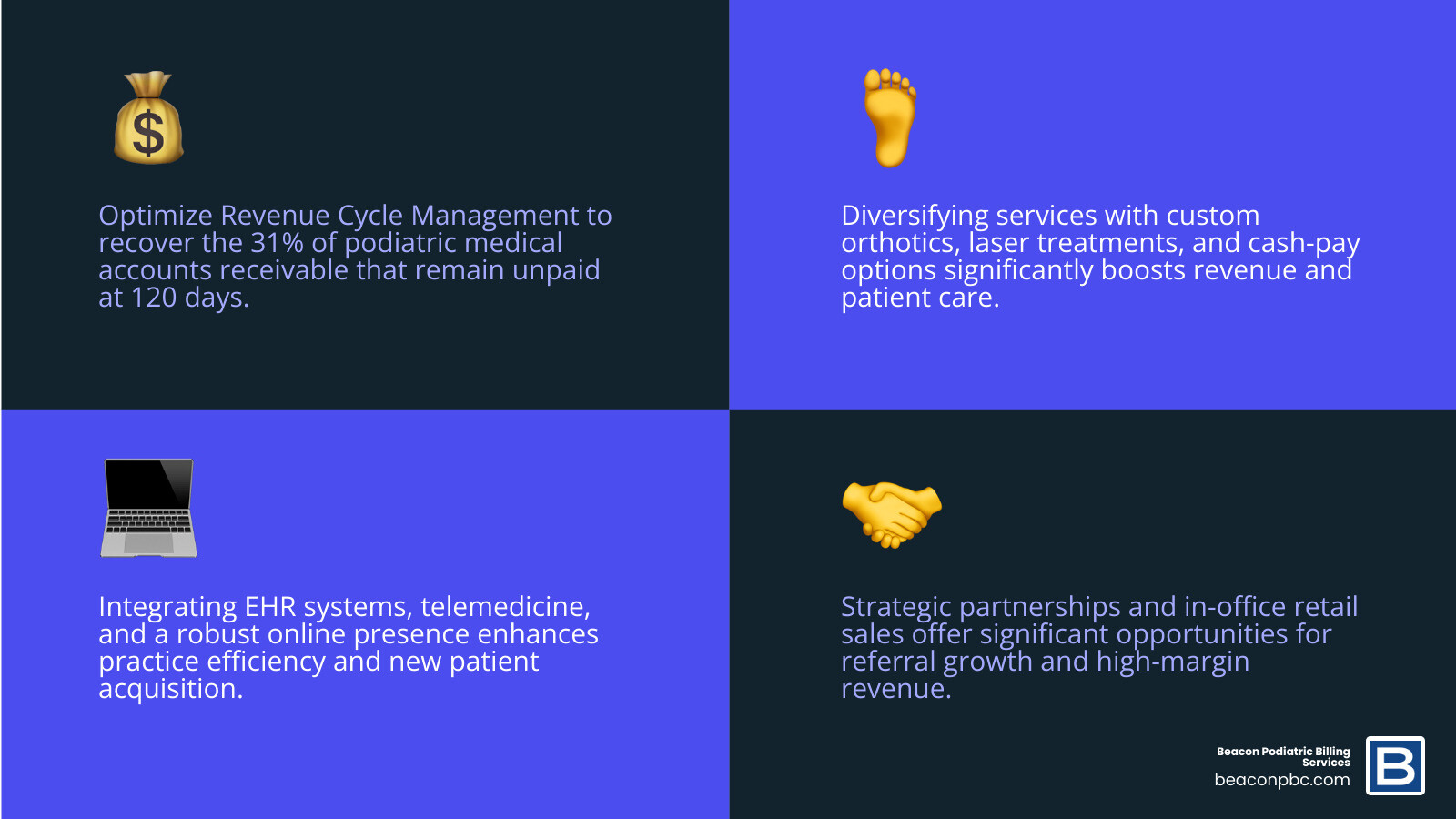
- Master Revenue Cycle Management – Reduce the 31% of unpaid accounts receivable (AR) sitting at 120+ days through better billing and coding
- Diversify Your Services – Add preventive care, custom orthotics, laser treatments, and diabetic foot care programs
- Implement Cash-Pay Options – Offer aesthetic treatments and retail products for high-margin revenue streams
- Leverage Technology – Use EHR systems, telemedicine, and patient portals to improve efficiency
- Build Strategic Partnerships – Create referral networks with physical therapists, orthopedic surgeons, and primary care physicians
- Optimize Your Online Presence – Invest in local SEO, social media, and reputation management to attract new patients
The numbers tell a compelling story. The United States Podiatry Services Market was valued at $972.5 million in 2022 and is projected to reach $1,184 million by 2027. That’s significant growth potential.
But here’s the challenge: podiatry physician practice revenues have decreased by an average of 55 percent since 2022, according to the Medical Group Management Association (MGMA). Many practices struggle with complex insurance billing, delayed reimbursements, and inefficient revenue cycles. In fact, about 31 percent of podiatric medical accounts receivable remain unpaid at 120 days, and practices typically collect only about 69 percent of charges.
The good news? There are proven strategies to reverse this trend.
This guide walks you through the four pillars of sustainable revenue growth for your podiatry practice. You’ll learn how to optimize your billing processes, expand your service offerings, leverage technology effectively, and build strategic partnerships that create new revenue streams.
Whether you’re struggling with claim denials, looking to add new services, or simply want to build a more profitable practice, these strategies will help you get there.
Master Your Revenue Cycle: The Financial Foundation for Growth
At the heart of every thriving podiatry practice is a robust Revenue Cycle Management (RCM) system. For us, this isn’t just about processing claims; it’s about safeguarding our financial health and ensuring we get paid for the vital services we provide. Podiatry billing can be complex, with its unique codes, payer rules, and documentation requirements. This complexity is often why we see significant revenue leakage.
One of the primary challenges podiatry practices face in generating revenue is the high percentage of unpaid accounts receivable (AR). Statistics show that about 31 percent of podiatric medical ARs are unpaid at 120 days. This means nearly a third of our hard-earned money is lingering, impacting our cash flow and overall financial stability. Furthermore, podiatry groups often collect on only about 69 percent of their charges, which highlights a substantial gap between services rendered and payments received. Our goal should be to keep that 120-day AR percentage below 20% of total practice revenue.
To combat this, we need to focus on key performance indicators (KPIs) like average revenue per patient, claim denial rates, and payment turnaround times. By watching these metrics, we can identify bottlenecks and inefficiencies in our RCM process. Accurate record-keeping and electronic claims submission are not just best practices; they are essential tools for minimizing errors, speeding up reimbursement, and reducing financial risks. For more detailed insights into optimizing these processes, we often refer to specialized Billing Services.
Optimizing Billing, Coding, and Insurance Reimbursement
The nuances of billing and coding in podiatry are extensive and constantly evolving. Accurate CPT, ICD-10, and HCPCS codes are our secret weapons against claim rejections and denials. Incorrect coding is a primary reason for claim delays and lost revenue, and given the ever-changing landscape of medical billing, staying current is a full-time job. We must ensure our staff receives continuous training and that our systems are updated to reflect the latest guidelines.
Understanding the intricacies of different insurance plans is also critical. Medicare Podiatry Billing Guidelines require meticulous adherence, as do the specific policies of private insurance carriers and state Medicaid programs in places like New Jersey, Nevada, and Nebraska. Each payer has its own rules, coverage specifics, and reimbursement rates. Verifying patient eligibility and coverage before services are rendered can prevent many future headaches and financial disputes.
Managing co-payments and deductibles effectively is another cornerstone of strong RCM. Implementing and communicating a clear policy for upfront collection of co-pays and deductibles can significantly improve our collections. Patients appreciate transparency, and it minimizes billing surprises later. We need to train our front-office personnel to communicate these financial matters clearly and effectively.
Regular billing audits are not just for compliance; they are a proactive measure to catch errors, reduce financial risks, and optimize reimbursement. By conducting internal audits, we can identify patterns of denials, refine our processes, and ensure we’re capturing every dollar we’ve earned. Staying informed about regulatory changes, whether federal or state-specific, is also paramount. Subscribing to industry publications and participating in professional associations helps us remain adaptable and compliant.
Understanding and Improving Cash Flow
The statement of cash flows (SCF) is often called the “lifeblood of any medical practice.” It offers a revealing window into how we maintain and increase office revenue by summarizing cash inflow and outflow from operating, investment, and financial activities. Analyzing our SCF helps us understand our practice’s financial health, answer questions about potential earnings, and avoid situations where our accounts might be overdrawn despite seemingly good revenue.
Rapid growth can sometimes lead to less cash, which seems counterintuitive! This is why accurate cash flow analysis (CFA) is crucial. It allows us to study the effects of past business decisions and project future liquidity. Our goal is to reduce long-overdue ARs. By implementing strategies to ensure patients pay bills in a timely manner and promptly addressing contested bills, we can significantly improve our cash flow.
Fluid relationships with local vendors, managing payment terms, and spacing out payment timelines for our services versus vendor payments can create a favorable cash conversion cycle. However, we must be cautious with short-term bridge loans, understanding the time value of money, personal guarantees, and potential usury rates.
Finally, accurate record-keeping is not just good practice; it’s a defense against potential financial risks, including unintentional fraud. Reconciling patient visits with claim submissions daily helps prevent billing errors and ensures that all services are accounted for. This diligence protects our practice and ultimately helps us make more money.

Expand Your Clinical Offerings and Accept Cash-Pay Models
To truly increase podiatry revenue, we must think beyond traditional routine care. Diversifying our services not only opens up new income streams but also allows us to offer more comprehensive care, improving patient outcomes and convenience. Offering an assortment of podiatry-related products and services doesn’t make us greedy; on the contrary, it makes us and our practice more valuable in the eyes of our patients by saving them extra trips and headaches. This approach, as highlighted in an article on how to improve patient care while increasing revenue, can improve patient loyalty and trust.
Key Strategies to Increase Podiatry Revenue with Ancillary Services
Preventive care is a powerful, yet often underused, revenue generator. Services like foot screenings and gait analysis not only identify potential issues early but also build long-term patient relationships. When we offer custom orthotics custom to individual patient needs, we provide a vital service that often comes with a healthy profit margin. Patients tend to prefer buying orthotics directly from their trusted podiatrist, ensuring they get the right product.
Modern laser treatments, such as those for toenail fungus, warts, or even soft tissue inflammations like plantar fasciitis and Achilles tendonitis, represent significant opportunities. These advanced therapies can widen our service offerings, improve our practice’s image, and attract new patients. For instance, BritaMed’s high-powered lasers can treat a variety of conditions, contributing directly to our bottom line.
Beyond these, we can explore other ancillary services like diabetic foot care programs and wound care. These are essential services that cater to chronic conditions and often require ongoing care, ensuring a steady patient flow. Considering a multi-specialty practice, perhaps by bringing in a physical therapist, can also attract patients and ensure continuous, comprehensive care, though we must carefully consider federal financial arrangement rules.

Implementing Profitable Cash-Pay Services
Cash-pay services offer an excellent way to increase podiatry revenue without the complexities of insurance reimbursement. These services often have higher profit margins and cater to patients willing to pay out-of-pocket for specialized or aesthetic treatments.
Here are some potential cash-pay services we can implement:
- Aesthetic foot treatments: Think medi-pedis, advanced nail restoration, or treatments for cosmetic concerns like bunionettes. These can appeal to a broader demographic.
- Advanced therapies not covered by insurance: Regenerative medicine, specialized injection therapies, or certain cutting-edge diagnostic tests might fall into this category.
- Retail product sales: This is arguably the single biggest opportunity for podiatry practice revenue growth. Selling complementary products directly in our office – creams, specialized footwear, orthotics, diabetic socks, cast protectors – provides convenience for patients and a significant revenue stream for us. One podiatrist reported making $50,000 in a year just from selling podiatric Crocs! Patients trust our recommendations, and by integrating these products, we save them the hassle of searching elsewhere. Private-label products can also improve our brand identity.
When implementing cash-pay options, pricing strategies are key. We need to ensure our prices are competitive yet reflect the value and expertise we provide. Marketing these options effectively involves communicating their benefits clearly, often through in-office displays, brochures, our website, and social media.
While some podiatrists might hesitate due to ethical concerns about appearing “retail-focused,” we should frame these offerings as an extension of our commitment to holistic patient care. We are providing convenience and ensuring patients get high-quality products directly from a trusted source.
How to Increase Podiatry Revenue by Leveraging Technology and Marketing
Leveraging technology and smart marketing isn’t just an option; it’s a necessity to increase podiatry revenue. This digital shift helps us improve practice efficiency, improve the patient experience, and attract new patients in a competitive healthcare landscape.
Integrating Technology for a More Efficient Practice
Podiatry-specific Electronic Health Record (EHR) systems are foundational. They streamline administrative tasks, reduce paperwork, and improve accuracy in billing and patient data management. Features like common complaint templates and digitized diagrams, as offered by some EHRs, can significantly reduce charting time. For more information on how technology can transform our practice, we can explore resources on Technology in Podiatry.
Patient portals are another game-changer. They empower patients to schedule appointments, manage prescriptions, access medical history, and communicate with us, reducing the burden on our front desk. This improves patient satisfaction and engagement.
Telemedicine, which gained significant traction during the pandemic, continues to be a powerful tool. It allows us to conduct virtual visits for follow-up appointments, minor consultations, and routine check-ups, expanding our patient reach and creating new revenue streams. We need to explore telehealth options with insurance carriers, educate patients on platforms, and train our staff on technology usage.
Automated appointment reminders, whether via text or email, drastically reduce no-show rates, ensuring our schedules are optimized and our revenue streams are consistent. Finally, in a post-pandemic world, technology helps us communicate safety measures to rebuild patient trust and encourage return visits. We can use digital platforms to inform patients about pre-screening, social distancing, and office sanitization protocols.
How Marketing and a Strong Online Presence Can Increase Podiatry Revenue
Even with excellent clinical skills, a practice won’t thrive without effective marketing. Our primary challenge is attracting new patients, and that requires a multi-faceted approach. As Dr. Daniel T. Hall IV notes, consistent outreach through social media platforms like Facebook and Instagram is crucial. We also need to understand our Unique Selling Proposition (USP) to differentiate our practice. What makes us special? Is it our specialized treatments, convenient hours, or exceptional patient experience? Our offers should align with this USP, such as package rates for faster recovery or 24-hour appointment setting for convenience.
Digital marketing strategies are paramount. Optimizing our website content for search engines (SEO) and registering with Google Business Profile helps us appear in local searches, which is where most patients look for healthcare providers. A user-friendly, mobile-responsive website is often a prospective patient’s first impression.
Social media engagement is vital. With people spending significant time on platforms like Facebook (commanding 53% of all social media visits in America), we have a direct channel to inform, attract, and build credibility. Video content is particularly effective, given that US adults watch nearly 50 minutes of content on YouTube daily.
Online reputation management, including patient reviews and testimonials, is the digital equivalent of word-of-mouth. Ninety percent of patients use online reviews to evaluate physicians. We should actively encourage satisfied patients to leave reviews and respond thoughtfully to all feedback. This not only builds trust but also boosts our visibility.
Build Strategic Alliances and In-Office Retail
To truly increase podiatry revenue, we often need to look beyond the four walls of our clinic and consider how we fit into the broader healthcare ecosystem. Building strategic alliances and capitalizing on in-office retail opportunities creates a holistic patient care approach that benefits everyone.
Fostering Referral Networks and Collaborations
Collaborations with other healthcare providers are a powerful way to increase patient volume and revenue. Forming alliances with physical therapists, orthopedic surgeons, primary care physicians, and endocrinologists can establish a robust referral network. For example, a podiatrist in New Jersey might partner with a local physical therapist to offer comprehensive rehabilitation for foot and ankle injuries, ensuring continuous care for patients and a steady stream of referrals for both practices. Similarly, working closely with primary care physicians can ensure early detection and referral for diabetic foot care.
Establishing clear referral protocols and regularly communicating with our network partners ensures a smooth patient journey and strengthens these professional relationships. As insights from “5 Pearls of Solo Practice” suggest, understanding the business aspect of our practice includes actively cultivating these professional relationships. For more insights on growing our practice through strategic management, we often refer to resources on Practice Management & Growth.
Capitalizing on In-Office Product Sales
We’ve touched on this before, but it bears repeating: the single biggest opportunity for podiatry practice revenue growth is arguably in retail products. As doctors, we sometimes shy away from selling products due to ethical concerns or the perception of being a “retail store.” However, this perspective misses a crucial point: by offering complementary products directly in our office, we provide a better, more holistic service to our patients. We’re saving them an extra trip to a pharmacy or big-box store and ensuring they get high-quality, doctor-recommended items.
Think about it: orthotics and footwear, creams and lotions for various foot conditions, diabetic socks, and even cast protectors are all items our patients need. Instead of sending them elsewhere, we can be their trusted source. This not only creates supplementary revenue from every customer but also reinforces our role as their comprehensive foot health expert. Patients clearly appreciate having access to products that they would otherwise have to seek out for themselves at stores or online. Providing these items in-house improves patient convenience and builds loyalty.
For instance, we can stock natural podiatry products from MD Private Label, footwear and orthotics from Dia-Foot or Vionic, professional foot care products from Blaine Labs, or specialized socks from Simcan. These providers often offer products exclusively through doctor’s offices, ensuring they don’t compete with mass retailers. This creates a reliable and ethical revenue stream that directly benefits our practice and our patients.
Frequently Asked Questions about Increasing Podiatry Revenue
What is the most common reason podiatry practices lose revenue?
The most common reasons podiatry practices lose revenue stem from inefficiencies and errors in their revenue cycle management. This includes incorrect billing and coding, which leads to claim denials and rejections. A significant portion of revenue is also lost due to inefficient management of accounts receivable (AR), with about 31 percent of podiatric medical ARs remaining unpaid at 120 days. Failure to collect co-payments and deductibles upfront, and a lack of diligent follow-up on unpaid claims, also contribute substantially to lost revenue.
Can selling products in my office really make a difference?
Absolutely, selling products in your office can make a significant difference in increasing podiatry revenue. It creates a high-margin, cash-based revenue stream that is often overlooked. Beyond the direct profit, it improves patient convenience, reinforces your expertise as a trusted source for foot health solutions, and can improve patient loyalty. Anecdotal evidence, such as a podiatrist making $50,000 in a year by selling podiatric Crocs, highlights the substantial income potential from complementary products like specialized footwear, creams, orthotics, and diabetic socks.
How can I start offering telemedicine services?
To start offering telemedicine services, first, thoroughly check state regulations in your area (e.g., New Jersey, Nevada, Nebraska, North Carolina, Kentucky) and the specific policies of your insurance payers regarding telehealth reimbursement. Next, select a HIPAA-compliant video conferencing platform that ensures patient privacy and data security. Train your staff on how to use the platform, schedule virtual appointments, and educate patients on the process. Begin with simple follow-up appointments, minor consultations, or routine check-ups to get comfortable, gradually expanding your telemedicine offerings as your team and patients adapt.
Conclusion
To increase podiatry revenue is a multifaceted endeavor that requires a strategic and proactive approach. We’ve explored how mastering Revenue Cycle Management, diversifying our services, leveraging technology, and building strategic alliances can transform our practice’s financial health. From optimizing billing and coding to embracing cash-pay models and fostering referral networks, each strategy plays a crucial role.
A financially healthy practice is better positioned to provide exceptional patient care. By adopting these high-profit procedures and smart strategies, we can not only ensure our practice’s sustainability but also improve our ability to serve our communities in New Jersey, Nevada, Nebraska, North Carolina, and Kentucky.
For expert help in optimizing your revenue cycle and implementing growth strategies, explore Guide Podiatric’s dedicated Billing Services.