
How to Fix Podiatry CPT and ICD-10 Coding Errors for Good
Why Podiatry Billing Errors Are Costing Your Practice More Than You Think
Podiatry billing errors are one of the leading causes of claim denials, delayed payments, and lost revenue for foot and ankle practices across the country.
Here’s a quick summary of the most common errors and what drives them:
| Billing Error | Why It Happens |
|---|---|
| Missing or wrong modifiers (Q7, Q8, Q9) | At-risk foot conditions not properly identified |
| ICD-10 and CPT code mismatches | Unspecified or outdated codes used |
| Incomplete documentation | Class findings, vascular, or neuro exams not recorded |
| Timely filing missed | Payer deadlines as short as 90 days overlooked |
| Lack of medical necessity detail | Systemic conditions not linked to treatment |
| Unbundling or upcoding | Procedures billed separately without proper justification |
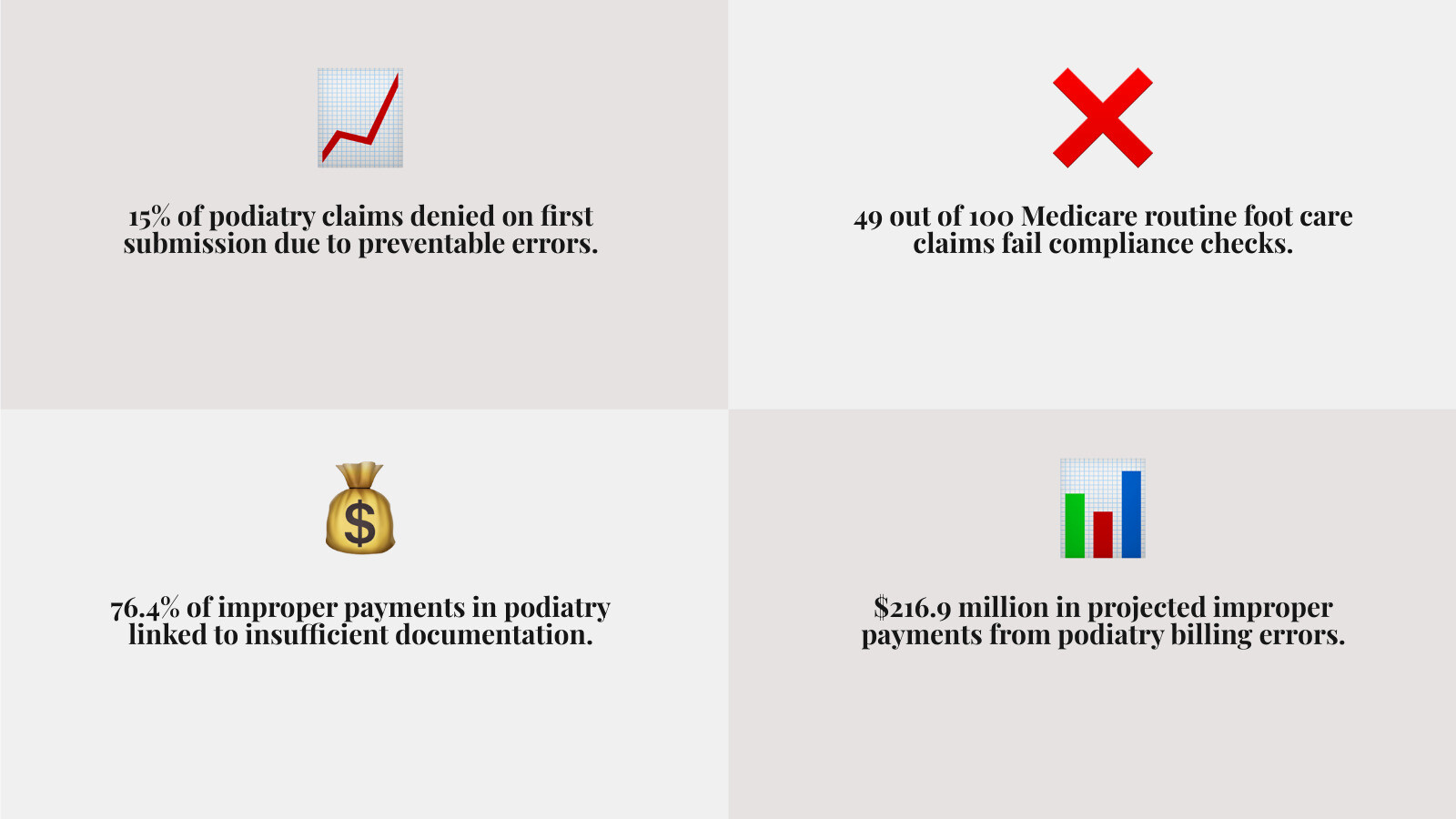
The numbers tell a hard story. According to data cited by the OIG, 49 out of 100 sampled Medicare claims for routine foot care failed compliance. And CMS data points to insufficient documentation as the cause behind 76.4% of improper payments in podiatry — adding up to an estimated $216.9 million in projected improper payments.
Nearly 15% of podiatry claims are denied on first submission — most due to errors that are entirely preventable.
For a busy podiatrist, these aren’t just billing headaches. They’re real hits to your cash flow, your compliance standing, and your time.
This guide breaks down exactly which coding and documentation mistakes trigger those denials — and what you can do to fix them for good.
Common Podiatry Billing Errors and Their Financial Impact
Running a podiatry practice is a bit like performing surgery: precision is everything. When that precision slips in the billing office, the financial health of your practice can take a serious stumble. With a 15% denial rate being the industry average for initial submissions, many practices are essentially working for free one day out of every week.
Podiatric practice challenges often stem from the fact that foot and ankle care is highly specialized. General medical billers often treat a “toe” like a “finger,” but as we know, the coding requirements for weight-bearing extremities are far more stringent. These revenue leaks happen when claims aren’t “scrubbed” for errors before they leave the building.
In our guide, Don’t Trip Up: A Podiatrist’s Guide to Coding and Claims, we emphasize that a single digit wrong on a modifier or an unspecified ICD-10 code can trigger an automatic rejection. These aren’t just “oops” moments; they are systemic issues that drain your bank account.

Mismanaged Modifiers and Podiatry Billing Errors
If modifiers are the “adjectives” of the billing world, then podiatry uses some very specific vocabulary. The most frequent podiatry billing errors involve the misuse of Q-modifiers and E/M modifiers.
- The “At-Risk” Modifiers (Q7, Q8, Q9): These are the bread and butter of routine foot care for patients with systemic conditions like diabetes or PVD.
- Q7: One Class A finding.
- Q8: Two Class B findings.
- Q9: One Class B and two Class C findings. If you bill for nail debridement without these modifiers—or without the clinical documentation to back them up—the claim is dead on arrival.
- Modifier -25: This is arguably the most “dangerous” modifier in podiatry. It indicates a “significant, separately identifiable” evaluation and management (E/M) service on the same day as a procedure. Because it is so frequently overused, it is a massive red flag for auditors. If you use it, your notes must clearly show why the E/M was separate from the procedure itself.
- Modifier -59: Used to identify distinct procedural services. In podiatry, this often applies when you are treating different anatomical sites (like two different toes) during the same visit.
- Anatomical Modifiers (T1-T9, RT, LT): Insurance companies want to know exactly which toe you worked on. Forgetting a T-code or an RT/LT indicator is one of the common podiatry billing mistakes that leads to immediate rejections.
ICD-10 and CPT Mismatches in Podiatry Billing Errors
A common pitfall is the “mismatch.” This happens when the procedure (CPT) doesn’t logically follow the diagnosis (ICD-10). For instance, billing CPT 11721 (debridement of 6 or more nails) with a diagnosis code for a simple corn (which should be 11055) will cause an immediate denial.
Specificity is your best friend. Using “unspecified” codes is a fast track to an audit. If a patient has diabetic neuropathy, the ICD-10 code should reflect the specific type of diabetes and the specific complication. Our handbook, Footing the Bill: A Podiatrist’s Handbook to CPT and ICD-10 Codes, details how to link these codes so that “medical necessity” is crystal clear to the payer.
Navigating CMS Regulations and Audit Triggers
Medicare is the largest payer for most podiatrists, and they are also the strictest. To stay compliant, you must live by Local Coverage Determinations (LCDs) and National Coverage Determinations (NCDs). These documents are the “rulebooks” that tell you exactly which diagnoses justify which treatments.
One of the biggest triggers for an audit is a high frequency of “routine foot care” billing without the required “class findings.” CMS expects to see evidence of vascular or neurological impairment if they are going to pay for nail trimming or callus debridement. We cover this extensively in our Medicare Podiatry Billing Guidelines.
When the auditors come knocking, they usually come in one of three flavors:
| Audit Type | Who Conducts It? | What Are They Looking For? |
|---|---|---|
| RAC (Recovery Audit Contractor) | Third-party contractors | Overpayments and simple coding errors. |
| ZPIC (Zone Program Integrity Contractor) | CMS-authorized investigators | Potential fraud, waste, and abuse. These are serious. |
| CERT (Comprehensive Error Rate Testing) | CMS | Measuring the overall error rate of the Medicare program. |
Documentation Requirements for Audit Protection
If it isn’t documented, it didn’t happen. That is the golden rule of medical billing. To audit-proof your practice, your charts must be robust.
For at-risk foot care, your notes should include:
- Monofilament testing results: To prove neurological deficit.
- Pedal pulses and vascular assessment: Documenting the presence or absence of Dorsalis Pedis and Posterior Tibial pulses.
- Dermatological findings: Describing the thickness, color, and texture of nails or skin.
- Qualifying systemic diseases: Explicitly linking the foot condition to the patient’s diabetes, PVD, or other chronic illness.
Don’t forget the Advance Beneficiary Notice (ABN). If you suspect Medicare won’t cover a service (like routine care for a patient who doesn’t meet the “at-risk” criteria), you must have a signed ABN on file before the service is rendered. Without it, you cannot legally bill the patient for the denied service.
Strategies to Optimize Your Revenue Cycle Management
The “Revenue Cycle” isn’t just about sending bills; it’s about the entire life of a patient’s account. It starts at the front desk with insurance verification and ends when the balance is zero.
One of the most heartbreaking podiatry billing errors is missing a timely filing deadline. Some commercial payers have windows as short as 90 days. If your biller is behind and submits on day 91, you lose that money forever. No amount of “medical necessity” can fix a late claim.
To stay on track, we recommend:
- Customized EHR Templates: Use templates specifically designed for podiatry that prompt you to enter class findings and vascular checks.
- Regular Staff Training: Coding rules change every year (remember the ICD-11 transition?). Your team needs to stay sharp.
- Claim Scrubbing: Use software that checks for common errors (like missing modifiers) before the claim is transmitted.
In The Foot-Friendly Guide to Podiatry Billing and Coding, we highlight how a clean RCM dashboard can help you spot denial trends before they become a crisis.
Outsourcing vs. In-House Billing Management
Deciding whether to keep billing in-house or to outsource is a major crossroads for any practice.
In-House Billing:
- Pros: Direct control over staff; immediate access to billers.
- Cons: High overhead (salary, benefits, space); risk of “single point of failure” if a biller quits; often lacks specialized podiatry expertise.
Outsourced Podiatry Billing:
- Pros: Access to certified coders who only do podiatry; lower overhead; 100% US-based support (with Beacon); better scalability as you grow.
- Cons: Less “eyes-on” control over the daily process.
Choosing the right partner is vital. You don’t want a general billing company; you want someone who knows the difference between a bunionectomy and a matrixectomy. Check out our guide on Choosing the Right Podiatry Billing Service for more tips. As we discuss in Navigating Foot and Ankle Billing, specialized expertise is the only way to truly maximize your collections in today’s complex regulatory environment.
Frequently Asked Questions about Podiatry Billing
What are the most common reasons for podiatry claim denials?
The most common reasons include missing or incorrect modifiers (especially Q7, Q8, Q9), lack of medical necessity documentation (missing class findings), and mismatches between the CPT procedure code and the ICD-10 diagnosis code. Missing timely filing deadlines is also a frequent (and avoidable) culprit.
How often can routine foot care be billed to Medicare?
Generally, Medicare covers routine foot care (like nail trimming or callus removal) once every 61 days, provided the patient has a qualifying systemic condition and meets the “at-risk” criteria. Billing more frequently than this without a very specific, documented acute complication will lead to an automatic denial.
When should modifier -25 be used in podiatry?
Modifier -25 should be used when you perform a significant and separately identifiable E/M service on the same day as a procedure. For example, if a patient comes in for a scheduled wart treatment (procedure) but also complains of new, unrelated heel pain that requires a full exam and diagnosis (E/M), you would use modifier -25 on the E/M code.
Conclusion
Fixing podiatry billing errors isn’t just about avoiding a “slap on the wrist” from an auditor—it’s about ensuring your practice has the financial resources to provide the best possible care to your patients. Whether you are in New Jersey, North Carolina, or Nebraska, the rules of the road remain the same: document thoroughly, code specifically, and never ignore your data.
At Beacon Podiatric Billing Services, we specialize in taking the weight of the revenue cycle off your shoulders. Our 100% US-based team understands the nuances of podiatry coding because it’s all we do. By fostering a “compliance culture” and staying ahead of CMS updates, we help you master The Footwork of Finance.
Don’t let preventable errors trip up your practice’s success. If you’re ready to streamline your operations and maximize your collections, explore our Podiatry Billing Services today. Let’s get your practice back on its feet—literally and financially.