How to Manage Multi Location Podiatry Billing Without Losing Your Mind
Why Multi Location Podiatry Billing Is So Hard to Get Right
Multi location podiatry billing is one of the most complex challenges in medical practice management — and if you’re running more than one site, you already know this firsthand.
Here’s a quick overview of what makes it difficult and what actually helps:
| Challenge | What You Need |
|---|---|
| Different payer rules per location | Centralized billing team with payer-specific expertise |
| Modifier errors (Q7, Q8, Q9, KX) | Certified podiatry coders who know LCDs cold |
| Multiple NPIs and TINs | Unified credentialing and NPI management |
| Revenue leakage across sites | Real-time reporting and A/R follow-up by location |
| HIPAA compliance at scale | BAA agreements and role-based data access |
| Denial management across locations | Dedicated account managers and root cause analysis |
Managing billing across multiple podiatry locations isn’t just more work — it’s a fundamentally different problem. Each location may have its own payer contracts, its own staff habits, and its own documentation gaps. Add in Medicare’s strict rules around routine foot care, laterality coding, and medical necessity, and the margin for error shrinks fast.
The numbers back this up. Podiatry practices already lose 8–12% of potential revenue due to billing errors and unresolved denials. Multiply that across two, three, or five locations, and the financial impact becomes impossible to ignore.
This guide is built for busy podiatrists who want practical, proven strategies — not theory — to get multi-site billing under control, reduce denials, and actually grow revenue as you scale.
Overcoming the Complexity of Multi Location Podiatry Billing

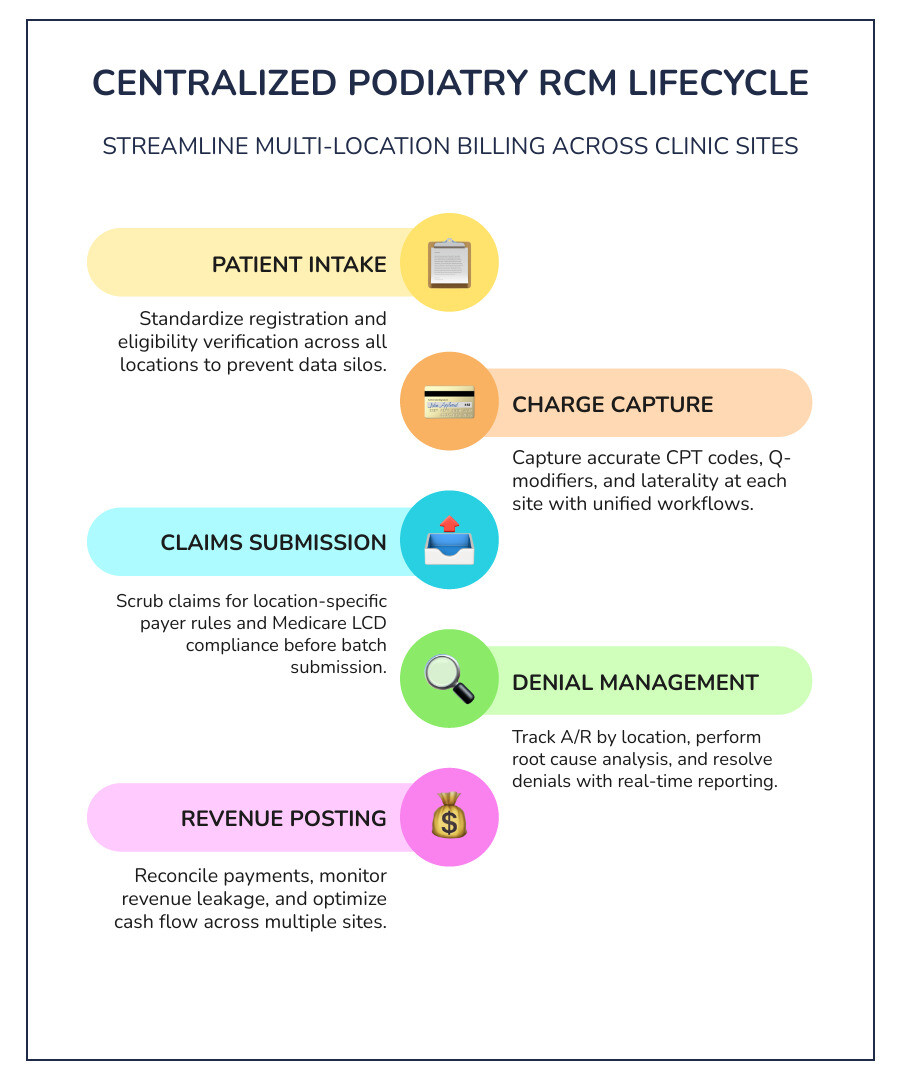
When you expand from a single office to multiple sites in New Jersey, Nevada, or North Carolina, the administrative burden doesn’t just double—it quadruples. We often see “data silos” where Site A uses one method for intake while Site B uses another. This lack of standardized workflows is the primary driver of revenue leakage.
The Problem with Data Silos
If your offices aren’t perfectly synced, patient information gets lost in the shuffle. Inter-office transfers become a nightmare when a patient seen in your Jersey City office shows up at your Succasunna location, and the front desk can’t verify if their previous orthotic claim was already fulfilled. This is where a comprehensive guide to podiatry revenue cycle management becomes essential to bridge the gap between foot traffic and actual cash flow.
NPI and Credentialing Headaches
Managing multiple National Provider Identifiers (NPIs) and Tax Identification Numbers (TINs) across various locations requires surgical precision. If a provider isn’t properly credentialed for a specific location—even if they are a partner in the practice—claims will be rejected immediately. We’ve seen many multi-site groups struggle with “location-based denials” simply because the payer’s database didn’t match the physical address on the claim.
Common Multi-Site Billing Pitfalls
- Inconsistent Charge Capture: One doctor logs a nail avulsion immediately; another waits until the end of the week, leading to “billing lag.”
- Duplicate Patient Records: Creating a new chart for an existing patient at a second location, leading to double-billing or insurance conflicts.
- Fragmented Patient Statements: Sending a patient two different bills for two different locations, which confuses the patient and delays payment.
- Credentialing Lapses: Forgetting to update a provider’s location-specific credentials when they start rotating to the new Omaha or Charlotte office.
Navigating Location-Specific Payer Rules and Modifier Accuracy
Podiatry is unique because so much of our reimbursement depends on “laterality” and “medical necessity.” When you add multiple locations into the mix, you also have to deal with geographic variations in Local Coverage Determinations (LCDs).
The Power of the Modifier
In multi location podiatry billing, modifiers are the difference between a paid claim and a “request for records.” According to the AMA’s overview of CPT codes, modifiers provide the necessary details that determine if a treatment is covered.
For podiatrists, the “Q” modifiers (Q7, Q8, Q9) are the bread and butter of routine foot care. These indicate specific clinical findings, like Mycotic nails or Onychogryphosis, which justify the service to Medicare. If your staff in Las Vegas is using Q7 while your team in Ashland is using Q8 for the same clinical presentation, your data is inconsistent and prone to audits.
Medicare LCDs and NCD Compliance
Medicare covers nearly 35–40% of podiatry patient volume nationwide. However, they are incredibly strict about Medicare podiatry billing guidelines. For example, routine foot care is generally excluded unless the patient has a systemic condition (like diabetes or peripheral vascular disease) that makes the care medically necessary.
Each location must strictly adhere to:
- Laterality: Always specifying Left (LT), Right (RT), or Bilateral (50).
- The KX Modifier: Used to indicate that the service meets medical necessity requirements for specific procedures like debridement.
- National Coverage Determinations (NCDs): The baseline rules that apply to all your offices, regardless of state.
Centralizing Systems and Software Integration
To keep your sanity, you must move away from decentralized “office-by-office” billing. Centralization allows for specialized oversight and uniform compliance.
Centralized vs. Decentralized Billing
| Feature | Decentralized (Office-by-Office) | Centralized (Unified System) |
|---|---|---|
| Workflow | Varied and inconsistent | Standardized and repeatable |
| Visibility | Hard to see total practice health | Real-time dashboards for all sites |
| Staffing | Each office needs a biller | One expert team handles everything |
| Compliance | High risk of local errors | Audit-proof compliance |
The Role of Technology
Integrating your EHR and billing software is no longer optional for multi-site groups. Modern cloud-based systems allow us to perform “claims scrubbing”—running your claims through a database of over 3.5 million common errors before they ever reach the insurance company. This increases your first-pass clean-claim rate, which for top specialized partners often hits 98%.
Batch insurance verification is another lifesaver. Instead of calling on every patient, a centralized system can verify eligibility for all patients across all locations 24–48 hours before their appointments. This prevents the “ineligible patient” denial, which is one of the top reasons podiatry claims are rejected.
Centralizing Your Multi Location Podiatry Billing System
When you synchronize your workflows, you create data transparency. You should be able to look at a single dashboard and see the A/R (Accounts Receivable) for your New Jersey clinics compared to your North Carolina clinics. This helps you identify if one location is struggling with documentation or if a specific regional payer is slow-walking payments.
Choosing the right partner is critical. You need someone who understands the “footwork of finance.” If you’re feeling overwhelmed, choosing the right podiatry billing service can be the turning point for your practice’s profitability.
Denial Management and Compliance Strategies
Denials are the silent killer of multi-location practices. When a claim is denied at Site A, is that information being used to prevent the same denial at Site B? In a decentralized setup, the answer is usually “no.”
Root Cause Analysis
Effective multi location podiatry billing requires a “root cause” approach to denials. We don’t just resubmit the claim; we find out why it was denied. Was it a missing modifier? An outdated insurance ID? Once the root cause is found, the fix is applied across all locations simultaneously.
According to MGMA reports, over 36% of physician practices now outsource part of their billing to ensure compliance. For podiatrists, this is especially beneficial because it provides access to coders who stay updated on shifting payer edits and LCD policies.
Compliance and HIPAA
Managing multiple sites means managing multiple points of entry for patient data. HIPAA compliance and HITECH standards are non-negotiable. You must have Business Associate Agreements (BAAs) in place with every vendor, and your billing partner should provide end-to-end encryption for all data transfers. Regular internal audits are the best way to master podiatry billing compliance and keep your practice audit-free.
Frequently Asked Questions about Multi Location Podiatry Billing
Q: How long does it take to transition to a centralized billing partner? A: Typically, the onboarding process takes 2 to 4 weeks. This includes data migration, payer enrollment updates for all your NPIs, and staff training on standardized documentation.
Q: Can I keep my current EHR if I outsource billing? A: Yes! Most specialized billing companies integrate with major podiatry-specific EHRs. You don’t have to learn new software to get better results.
Q: How does outsourcing help with my A/R? A: By having a dedicated team focused solely on follow-ups, you can reduce your “days in A/R” significantly. Many practices see an increase in collections of 10–18% within the first year of switching to a specialized RCM partner.
Q: What is the biggest challenge in foot and ankle billing? A: Navigating foot and ankle billing often comes down to documenting medical necessity for surgical procedures and managing the “global period” for post-operative care across different providers in your group.
If you’re looking for the right fit, there are 5 proven ways to find a podiatry billing company that fits your specific multi-site needs.
Conclusion
Managing multi location podiatry billing doesn’t have to be a source of constant stress. By centralizing your operations, standardizing your coding (especially those tricky Q-modifiers), and leveraging the right technology, you can turn your billing department into a predictable engine for growth.
At Beacon Podiatric Billing Services, we specialize in helping practices just like yours. We offer 100% US-based billing and revenue cycle management tailored specifically for the podiatry field. Whether you have offices in Jersey City, Omaha, or Charlotte, our mission is to maximize your collections while you focus on what you do best: caring for your patients’ feet.
We provide dedicated account managers who understand the nuances of podiatry, from routine care to complex reconstructive surgery. By partnering with us, you gain a strategic ally committed to your financial health and compliance.
Ready to step into a more profitable future? Learn more about our billing services and how we can help your multi-location practice thrive.