
Step Up Your Revenue with Podiatry Billing Specialists
Why Most Podiatry Practices Leave Money on the Table
Podiatry billing specialists are medical billing professionals who focus exclusively on the complex coding, compliance, and revenue cycle needs of foot and ankle practices.
Here’s what they do and why they matter:
- Specialized coding expertise – Apply correct CPT codes, HCPCS codes, and modifiers (Q7-Q9, T1-T9) specific to podiatry procedures
- Medicare compliance – Navigate Local Coverage Determinations (LCDs) and medical necessity documentation requirements
- DME billing – Handle custom orthotics, therapeutic footwear, and braces reimbursement
- Denial management – Proactively appeal rejected claims and track accounts receivable
- Routine vs. medical care distinction – Correctly document systemic conditions to qualify non-covered services for reimbursement
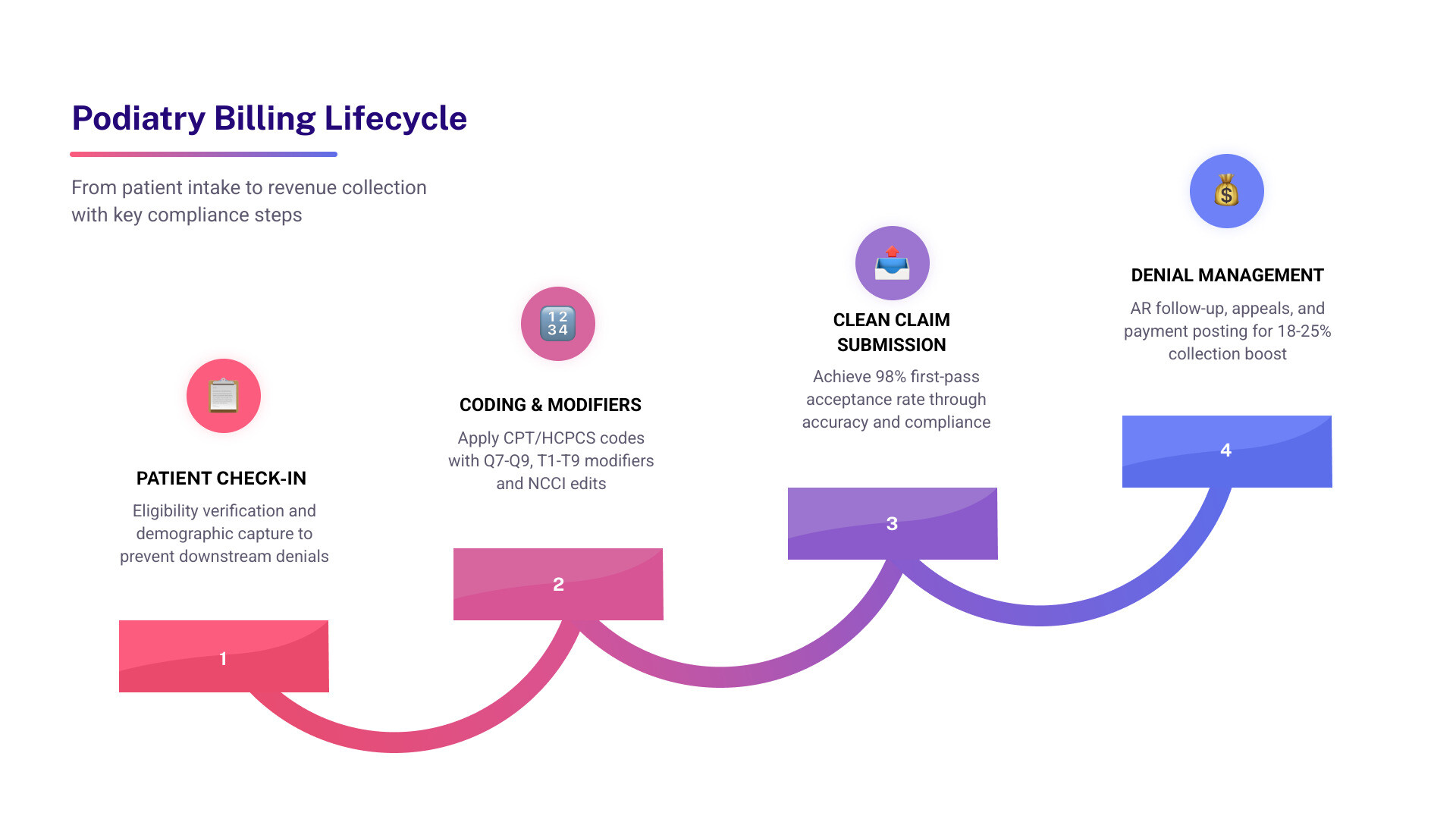
The result? Practices that use specialized podiatry billing services typically see 18-25% higher collections and significantly fewer claim denials than those using general billing services.
Running a podiatry practice is demanding enough. Between patient appointments, surgical procedures, and clinical documentation, the last thing you need is a billing system that quietly bleeds revenue every month.
Yet that’s exactly what’s happening to most practices. An estimated 90% of podiatric practices collect significantly less than they actually earn. The reason isn’t always a lack of effort — it’s a lack of specialization.
Podiatry billing isn’t like general medical billing. It involves a maze of foot-specific CPT codes, strict Medicare rules around routine foot care, modifier requirements that change by procedure, and DME documentation standards that can trip up even experienced billers. A generalist billing team simply doesn’t have the depth of knowledge to navigate all of it accurately.
That’s where podiatry billing specialists make the difference — and it’s a bigger difference than most practice owners expect.
The Strategic Value of Podiatry Billing Specialists

In the modern healthcare landscape, a podiatrist’s time is their most valuable asset. However, research suggests that podiatric practices often spend 20% or more of their time on administrative tasks. When you partner with podiatry billing specialists, you aren’t just hiring a data entry team; you are investing in a strategic partnership designed for revenue maximization and practice efficiency.
At Beacon Podiatric Billing Services, we understand that the financial health of your practice is the foundation upon which you provide patient care. By utilizing The Foot-Friendly Guide to Podiatry Billing and Coding, practices can begin to see how specialized workflows reduce the administrative burden on front-office staff. When your team isn’t wrestling with denied claims for nail debridement or complex surgical codes, they can focus on what they do best: helping patients walk without pain.
Why Generalists Fail Where Podiatry Billing Specialists Excel
Most billing services are “generalists.” They handle everything from pediatrics to cardiology. While they might be great at standard office visits, they often stumble when faced with the nuances of foot surgery and ankle procedures.
Generalists frequently miss the subtle requirements that trigger denials. For instance, did you know that certain toe modifiers (T1-T9) can actually cause a denial if applied to specific nail procedure codes like 11720 or 11721? A generalist might apply them thinking they are being thorough, whereas a specialist knows the exclusion rules. To avoid these traps, we recommend reviewing Podiatry Billing Pitfalls: Your Guide to Staying Compliant and Audit-Free to see how claim accuracy is maintained through niche expertise.
Specialized Services for Foot and Ankle Care
Podiatry is unique because it straddles the line between “routine” care and “medically necessary” treatment. Billing for wound care, for example, requires a deep understanding of debridement levels and specific documentation of the wound’s progress.
Furthermore, routine care—such as paring of calluses or nail trimming—is generally not covered by Medicare. However, there are “systemic condition” exceptions. If a patient has diabetes or peripheral vascular disease, that “routine” care becomes medically necessary. Podiatry billing specialists know exactly how to document these systemic conditions and apply the necessary “class findings” to ensure you get paid for the vital work you perform.
Mastering Podiatry-Specific Coding and Compliance
Accuracy in coding is the difference between a thriving practice and one that is constantly under the shadow of an audit. Podiatry coding is governed by a strict set of rules from the CMS and private payers. Staying compliant with HIPAA regulations and National Correct Coding Initiative (NCCI) edits is a full-time job.
We help our clients Audit-Proof Your Practice: A Guide to Podiatry Billing Compliance by ensuring every code submitted is backed by robust clinical documentation. This isn’t just about getting paid today; it’s about keeping that money when an auditor comes knocking tomorrow.
Essential CPT Codes and Modifiers
To maximize your revenue, your billing team must be fluent in the “language” of podiatry. This includes:
- CPT 11721 & 11720: Debridement of nails. These require specific modifiers and have frequency limits (often limited to six times per year by Medicare).
- CPT 11055–11057: Paring or cutting of benign hyperkeratotic lesions (warts or calluses).
- Modifiers Q7, Q8, and Q9: These are the “Class Findings” modifiers. They indicate the severity of vascular impairment, which is essential for Medicare reimbursement of routine foot care.
- Toe Modifiers T1–T9: Used to identify specific toes for surgical procedures.
- Modifier 59: Used to identify distinct procedural services that are not normally reported together but are appropriate under the circumstances.
Misusing these modifiers is one of the top reasons for claim rejections. Our specialists ensure that NCCI edits are checked before submission to prevent unbundling errors.
Navigating Medicare LCDs and Medical Necessity
Local Coverage Determinations (LCDs) are regional rules set by Medicare Administrative Contractors (MACs). What is billable in New Jersey might have different documentation requirements than in North Carolina or Nebraska.
Mastering The Footwork of Finance: Mastering Podiatry Billing Compliance requires a database of these regional LCDs. We implement tailored documentation templates that prompt your doctors to record the specific “systemic exceptions” and physical findings required by your local MAC. This proactive approach ensures that medical necessity is clearly established in the initial claim, rather than through a lengthy appeal process.
Overcoming Revenue Leaks in Podiatry Billing
Revenue leaks usually happen in three places: front-end eligibility errors, back-end denial neglect, and slow Accounts Receivable (AR) follow-up. Even seasoned office managers can find themselves “drowning” in 28-day claim cycles and double-digit denial rates.
If you feel like your practice is falling behind, it might be time to look at Don’t Get Tripped Up: Choosing the Right Podiatry Billing Service. Timely filing is another silent killer; many insurers have strict limits (ranging from 90 to 180 days). Once that window closes, the denial is often final and unappealable.
Managing DME Billing for Orthotics and Footwear
Durable Medical Equipment (DME) is a significant revenue stream for podiatrists, but it is also a compliance minefield. Billing for custom orthotics (HCPCS L3020) or therapeutic footwear for diabetic patients requires specific certifications, prescriptions, and detailed “fit and finish” notes.
Our Billing Services include specialized DME management. We track frequency limitations (e.g., how often a patient can get new inserts) and ensure that all “Supplier Standards” are met before the claim is sent. This prevents the common “non-covered” denials that plague generalist billing companies.
Reducing Denials through Proactive AR Management
A “clean claim rate” of 98% should be the goal for every practice. This is achieved through rigorous eligibility verification before the patient even enters the treatment room. By confirming copayments, deductibles, and coverage for specific procedures (like ultrasound or vascular studies), you eliminate the #1 reason for denials: “Patient not covered.”
We also focus on 5 Proven Ways to Find a Podiatry Billing Company that prioritizes payment posting and aggressive AR follow-up. When a claim is denied, our team doesn’t just “write it off.” We analyze the reason, correct the error, and appeal it within 24-48 hours.
The Financial Impact of Specialized Billing Services
The decision to outsource to podiatry billing specialists is often driven by a cost-benefit analysis. While in-house billing might seem cheaper on the surface, the hidden costs—salary, benefits, software licenses, training, and the cost of missed revenue—often exceed the cost of a professional service.
By choosing Strategic Outsourcing for Podiatry Practices, you replace a fixed overhead cost with a variable cost that is tied directly to your success. If we don’t collect, you don’t pay. This aligns our goals perfectly with yours.
Maximizing ROI with Podiatry Billing Specialists
The Return on Investment (ROI) for specialized billing is clear. Statistics show that specialized podiatry services can:
- Increase collections by 18-25%.
- Enhance first-pass claim acceptance to 98%.
- Reduce claim cycles from nearly a month to just a few days.
When you Maximize Your Revenue with Expert Podiatry Billing, you aren’t just getting more money; you’re getting it faster. This improves your cash flow, allowing you to invest in new equipment or expand your practice locations in areas like Succasunna, NJ, or Charlotte, NC.
Technology Integration and EHR Efficiency
Modern podiatry billing relies on technology. We don’t just work alongside your EHR; we integrate with it. Whether you use specialized podiatry software or a general system, we help you implement templates that enable “one-click” documentation.
This Enhancing Practice Efficiency with Specialized Billing approach uses data analytics to identify which procedures are your most profitable and which payers are the slowest to pay. With real-time reporting, you always have a pulse on your practice’s financial health.
Frequently Asked Questions about Podiatry Billing
How do podiatry billing specialists handle routine foot care vs. medically necessary services?
We implement a rigorous documentation protocol. For a service to move from “routine” (non-covered) to “medically necessary” (covered), we ensure the clinical notes capture the required systemic conditions (like diabetes or chronic venous insufficiency) and the specific physical findings (Class Findings) required by Medicare. We then apply the appropriate Q7, Q8, or Q9 modifiers to signal this to the payer.
What are the most common reasons for podiatry claim denials?
The most frequent culprits are:
- Missing or incorrect modifiers: Forgetting Modifier 59 on a second procedure or using the wrong toe modifier.
- Eligibility issues: The patient’s insurance has changed or doesn’t cover podiatry.
- Medical necessity: Lack of documentation showing why a procedure was necessary for that specific patient.
- Timely filing: Submitting the claim after the insurer’s deadline.
How does specialized DME billing work for custom orthotics and braces?
It starts with a “pre-billing” checklist. We ensure that the prescription is on file, the medical necessity is documented in the chart, and the patient has signed the necessary ABN (Advance Beneficiary Notice) if coverage is in doubt. We then use specific HCPCS codes (like L3020) and track the patient’s history to ensure we aren’t billing for a replacement too soon.
Conclusion
At Beacon Podiatric Billing Services, we believe that your focus should be on your patients’ feet, not your practice’s paperwork. As a 100% US-based team, we provide the personalized service and podiatry-specific expertise that generalist billing companies simply cannot match.
From our offices in Jersey City, NJ, to Las Vegas, NV, and beyond, we help podiatrists across the USA reclaim their time and maximize their revenue. Don’t let your hard-earned income get tripped up by complex codes and insurance denials. Step into financial success with professional billing services today and see the difference that true specialization can make for your practice.