Kickstart Your Cash Flow: The Essential Podiatry Billing Cheat Sheet
Why Every Podiatry Practice Needs a Billing Cheat Sheet
A podiatry billing cheat sheet is your quick-reference guide to the most commonly used CPT codes, ICD-10 diagnosis codes, and essential modifiers that ensure accurate claims submission and faster reimbursement.
Managing a podiatry practice isn’t just about treating patients; it’s about getting paid for the care you provide. However, healthcare billing is complex. Errors in coding or documentation can lead to denied claims, delayed payments, and even audits. A well-designed billing cheat sheet simplifies this process, putting critical information at your fingertips to help your practice avoid common mistakes and streamline its revenue cycle.
This guide breaks down the core podiatry billing codes, payer requirements, and practical best practices. Whether you’re training new staff or need a quick reference, this resource will help you maximize reimbursement while maintaining compliance.
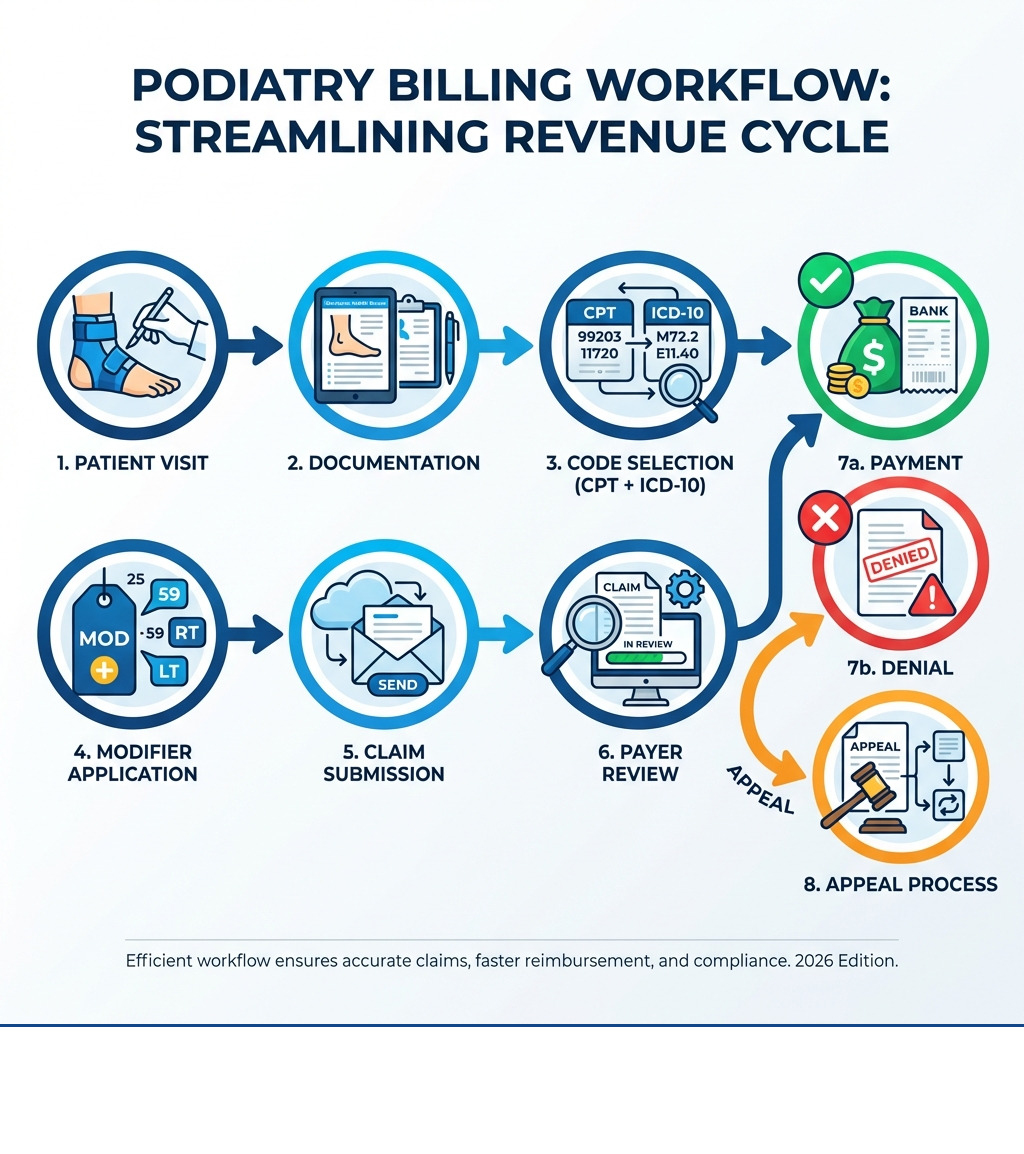
Podiatry billing cheat sheet pdf vocab to learn:
The Foundation of Podiatry Billing: Codes, Guidelines, and Documentation
To kickstart your cash flow and keep your practice financially healthy, we need to understand the bedrock of medical billing: codes, guidelines, and documentation. Think of them as the three legs of a sturdy stool – if one is wobbly, your entire reimbursement process might topple.

At its heart, podiatry billing relies on standardized numerical and alphanumeric codes. These are primarily:
- CPT (Current Procedural Terminology) codes: These describe the medical, surgical, and diagnostic procedures and services your podiatrists provide. They tell the insurance company what you did.
- ICD-10-CM (International Classification of Diseases, Tenth Revision, Clinical Modification) codes: These classify diseases, injuries, and other health problems, telling the insurance company why you did it (the patient’s diagnosis).
These codes are essential for submitting claims to insurance companies, including Medicare, Medicaid, and private payers, to receive reimbursement for services rendered.
Beyond just knowing the codes, we must adhere to general guidelines for podiatry coding, ensuring that every service provided is medically necessary and appropriately documented. This isn’t just about getting paid; it’s about compliance, avoiding audits, and maintaining the legal and ethical integrity of your practice.
Why Accurate Coding is Non-Negotiable
Accurate coding is the universal language of healthcare billing. It’s how we communicate precisely with insurance companies, ensuring they understand the services provided and the medical necessity behind them. Without this clear communication, claims are more likely to be denied, leading to revenue loss and administrative headaches.
Healthcare fraud and billing errors in America result in financial losses amounting to tens of billions of dollars annually. While some of this is intentional fraud, a significant portion comes from errors due to incorrect or incomplete coding. This level of loss highlights why payers are so vigilant.
When we carefully select codes that accurately describe the patient’s condition and services, we:
- Avoid Claim Denials: Incorrect codes are a leading cause of denials, which delay cash flow and increase administrative costs.
- Prevent Audits: Inaccurate coding can flag your practice for audits, which are time-consuming, stressful, and can result in significant penalties. You can learn more about how to Audit Proof Your Practice: A Guide to Podiatry Billing Compliance.
- Ensure Financial Health: Proper coding ensures maximum appropriate reimbursement, which is vital for your practice’s sustainability and growth.
Staying current with the latest coding updates and revisions (for both ICD-10-CM and CPT) is not merely a suggestion; it’s a financial imperative.
The Critical Role of Documentation
If coding is the language, then documentation is the story. Accurate and thorough documentation is the bedrock upon which all successful podiatry billing stands. It supports the medical necessity of the services you provide, linking a patient’s diagnosis to the treatment plan and the codes you select.
Imagine a claim as a legal brief. The codes are the statutes, but the documentation is the evidence. Without compelling evidence, even the most perfectly chosen code might be rejected. Your documentation should tell a clear, concise, and complete patient story, justifying every CPT and ICD-10 code billed.
This means:
- Supporting Medical Necessity: Every service must be clinically indicated and necessary for the patient’s condition, and your notes must clearly reflect this.
- Linking Diagnosis to Treatment: The diagnosis code (ICD-10-CM) must logically connect to the procedure code (CPT), demonstrating why the service was performed.
- Justifying Code Selection: If you use a higher-level E/M code or a complex surgical code, your documentation needs to detail the complexity of the patient’s condition, the decision-making involved, and the work performed.
- Legal Protection: In the event of an audit or legal challenge, your documentation is your primary defense. It proves that the services were rendered as billed and were medically appropriate.
As emphasized in The Footwork of Finance: Mastering Podiatry Billing Compliance, precise and thorough documentation is not just good clinical practice; it’s a compliance mandate that directly impacts your reimbursement. It’s the invisible backbone of your podiatry billing cheat sheet pdf, ensuring that the codes you choose are always backed by solid clinical evidence.
Your Ultimate Podiatry Billing Cheat Sheet PDF: Key Codes & Modifiers
This section serves as a quick-reference guide to the most frequently used codes in podiatry, helping you ensure accuracy and maximize reimbursement. While a comprehensive list would fill a textbook, this podiatry billing cheat sheet pdf focuses on the codes you’ll encounter most often in your practice.
Common CPT Codes for Podiatry
CPT codes are the core of procedure reporting. Here’s a glance at some essential codes for various podiatric services:
Evaluation & Management (E/M) Services (Office Visits): These codes reflect the complexity of patient visits.
- 99203 – New patient office visit, moderate complexity (30-44 minutes total time)
- 99204 – New patient office visit, high complexity (45-59 minutes total time)
- 99213 – Established patient office visit, low complexity (20-29 minutes total time)
- 99214 – Established patient office visit, moderate complexity (30-39 minutes total time) Note: E/M guidelines for 2023 and 2024 shifted focus to medical decision-making or total time spent, rather than just history and exam.
Routine Foot Care Services:
- 11720 – Debridement of nail(s) by any method; one to five nails
- 11721 – Debridement of nail(s) by any method; six or more nails
- 11055 – Paring or cutting of benign hyperkeratotic lesion (e.g., corn or callus); single lesion
- 11056 – Paring or cutting of benign hyperkeratotic lesion (e.g., corn or callus); two to four lesions
- 11057 – Paring or cutting of benign hyperkeratotic lesion (e.g., corn or callus); more than four lesions
Surgical Procedures:
- 11750 – Excision of nail and nail matrix, partial or complete, permanent removal (e.g., for ingrown toenail)
- 28285 – Correction, hammertoe (e.g., interphalangeal fusion, partial phalangectomy)
- 28292 – Correction, hallux valgus (bunionectomy), with sesamoidectomy, when performed; with proximal metatarsal osteotomy, any method
- 28296 – Correction, hallux valgus (bunionectomy), with sesamoidectomy, when performed; with distal metatarsal osteotomy, any method (e.g., Chevron, Mitchell, Akin)
Injections:
- 20550 – Injection(s); tendon sheath, or ligament, aponeurosis (e.g., plantar fascia)
- 20600 – Arthrocentesis, aspiration and/or injection; small joint (e.g., fingers, toes)
Orthotics:
- L3020 – Foot orthosis, insert, custom molded, thermoplastic UCB, each
- L3030 – Foot orthosis, insert, custom molded, thermoplastic, full contact, each Note: These are HCPCS codes, often used alongside CPT codes for devices and supplies.
For a more complete list and detailed descriptions, consult the American Podiatric Medical Association (APMA) CPT Coding Guide and the latest CPT manual.
Essential ICD-10 Codes for Common Diagnoses
ICD-10 codes provide the crucial “why” behind the “what” of CPT codes. They are pivotal for establishing medical necessity and ensuring your claims are justified. Specificity is key here; the more detailed your diagnosis, the clearer the medical picture for the payer.

Here are some frequently used ICD-10 codes in podiatry:
- Plantar Fasciitis: M72.2
- Ingrown Toenail (Onychocryptosis): L60.0 (for ingrown nail without infection) or L60.1 (for ingrown nail with infection)
- Hammertoe: M20.4- (requires a 5th character for laterality, e.g., M20.41 for right foot, M20.42 for left foot)
- Bunion (Hallux Valgus): M20.1- (requires a 5th character for laterality, e.g., M20.11 for right foot, M20.12 for left foot)
- Diabetic Neuropathy (Peripheral): E11.40 (Type 2 diabetes mellitus with diabetic neuropathy, unspecified)
- Diabetic Foot Ulcer: E11.621 (Type 2 diabetes mellitus with foot ulcer)
- Corns and Calluses: L84 (for unspecified corn and callus) or L85.1 (for acquired keratosis pilaris, which includes some calluses)
- Fungal Nail Infection (Onychomycosis): B35.1
Always use the most specific ICD-10 code available, including laterality (left/right) and severity, if applicable. This level of detail helps prevent denials and supports the medical necessity of your services.
Mastering Podiatry Modifiers for Clean Claims
Modifiers are two-digit codes appended to CPT codes to provide additional information about a service or procedure without changing its definition. They tell the payer that something unique occurred during the encounter. Using them correctly is paramount for avoiding denials and ensuring accurate reimbursement.
Here’s a table of common podiatry modifiers and their usage:
| Modifier | Description |
|---|---|
| 25 | Significant, Separately Identifiable E/M Service: Used when a separate E/M service is performed on the same day as another procedure. |
| 59 | Distinct Procedural Service: Indicates a procedure is independent from other services performed on the same day, often on a different anatomical site. |
| RT/LT | Right/Left Side: Anatomical modifiers to specify which side of the body was treated. |
| Q7, Q8, Q9 | Class Findings Modifiers: Used for routine foot care to indicate the severity of a patient’s systemic condition, justifying medical necessity for Medicare. |
Introduction
A podiatry billing cheat sheet pdf is your quick-reference guide to the most commonly used CPT codes, ICD-10 diagnosis codes, and essential modifiers that ensure accurate claims submission and faster reimbursement. Here’s what you need to know:
Essential Components of a Podiatry Billing Cheat Sheet:
- CPT Codes – Evaluation & Management (99202-99215), Routine Foot Care (11720-11721), Surgical Procedures (11750, 28285, 28292)
- ICD-10 Codes – Common diagnoses like plantar fasciitis (M72.2), bunions (M20.1-), diabetic neuropathy (E11.40)
- Critical Modifiers – 25 (separate E/M service), 59 (distinct procedure), RT/LT (right/left), Q7-Q9 (class findings)
- Medicare Guidelines – Class findings requirements, routine foot care exceptions, frequency limitations
Managing a podiatry practice isn’t just about treating patients. It’s about getting paid for the care you provide.
Healthcare fraud and billing errors cost the industry tens of billions of dollars annually. Much of this loss stems from incorrect coding, incomplete documentation, and misunderstanding payer rules.
For busy podiatrists, navigating the maze of CPT codes, ICD-10 diagnoses, Medicare’s class findings, and ever-changing payer policies can feel overwhelming. One wrong modifier or missing piece of documentation can mean a denied claim, delayed payment, or an audit.
That’s where a well-designed billing cheat sheet becomes invaluable. It puts the most critical information at your fingertips, helping your practice avoid common errors and streamline its revenue cycle.
This guide breaks down the essentials of podiatry billing codes, payer requirements, and best practices. Whether you’re training new staff or simply need a quick reference for complex cases, this resource will help you maximize reimbursement while maintaining compliance.
Podiatry billing cheat sheet pdf vocab to learn:
The Foundation of Podiatry Billing: Codes, Guidelines, and Documentation
To ensure your practice is financially healthy, you must master the three pillars of medical billing: codes, guidelines, and documentation.
Podiatry billing relies on two main types of codes:
- CPT (Current Procedural Terminology) codes: These describe the services and procedures you provide.
- ICD-10-CM (International Classification of Diseases, Tenth Revision, Clinical Modification) codes: These specify the patient’s diagnosis, justifying the need for the service.
Accurate coding is the universal language of healthcare billing. It’s how you communicate with insurance companies to ensure they understand the services provided and the medical necessity behind them. Incorrect or incomplete coding is a leading cause of claim denials and can even trigger audits. With healthcare fraud and billing errors costing the industry billions annually, payers are more vigilant than ever.
Just as important as the codes themselves is the documentation that supports them. Your patient records must tell a clear story, justifying every CPT and ICD-10 code used. This documentation is your primary defense in an audit and is crucial for:
- Demonstrating Medical Necessity: Proving that the service was clinically appropriate.
- Linking Diagnosis to Treatment: Showing a clear connection between the patient’s condition and the care provided.
- Justifying Code Selection: Supporting the level of service billed, especially for complex procedures.
Precise coding and thorough documentation are not just about compliance; they are essential for the financial health and sustainability of your practice. For more on this, see our guide on Mastering Podiatry Billing Compliance.
Your Ultimate Podiatry Billing Cheat Sheet: Key Codes & Modifiers
This section serves as a quick-reference guide to the most frequently used codes in podiatry.
Common CPT Codes for Podiatry
CPT codes are the core of procedure reporting. Here are essential codes for various podiatric services:
Evaluation & Management (E/M) Services:
- 99203: New patient office visit, moderate complexity
- 99204: New patient office visit, high complexity
- 99213: Established patient office visit, low complexity
- 99214: Established patient office visit, moderate complexity
Routine Foot Care Services:
- 11720: Debridement of 1-5 nails
- 11721: Debridement of 6 or more nails
- 11055: Paring or cutting of a single benign hyperkeratotic lesion
- 11056: Paring or cutting of 2 to 4 lesions
- 11057: Paring or cutting of more than 4 lesions
Surgical Procedures:
- 11750: Excision of nail and nail matrix
- 28285: Correction of hammertoe
- 28292: Bunionectomy with proximal metatarsal osteotomy
- 28296: Bunionectomy with distal metatarsal osteotomy
Injections:
- 20550: Injection(s); tendon sheath, or ligament
- 20600: Arthrocentesis, aspiration and/or injection; small joint
Orthotics (HCPCS Codes):
- L3020: Foot orthosis, insert, custom molded, thermoplastic UCB, each
- L3030: Foot orthosis, insert, custom molded, thermoplastic, full contact, each
Essential ICD-10 Codes for Common Diagnoses
ICD-10 codes provide the “why” behind the treatment, establishing medical necessity.
Frequently used ICD-10 codes in podiatry:
- Plantar Fasciitis: M72.2
- Ingrown Toenail: L60.0
- Hammertoe: M20.4- (requires laterality)
- Bunion (Hallux Valgus): M20.1- (requires laterality)
- Diabetic Neuropathy: E11.40
- Diabetic Foot Ulcer: E11.621
- Corns and Calluses: L84
- Fungal Nail Infection: B35.1
Mastering Podiatry Modifiers for Clean Claims
Modifiers add crucial information to CPT codes, preventing denials.
| Modifier | Description |
|---|---|
| 25 | Significant, Separately Identifiable E/M Service |
| 59 | Distinct Procedural Service |
| RT/LT | Right/Left Side |
| Q7, Q8, Q9 | Class Findings Modifiers for Medicare |
Navigating Payer Rules: Medicare, Private Insurance, and Class Findings
Understanding payer-specific rules is crucial for getting paid. Medicare often sets the standard, but private payer policies can vary significantly.
Explaining Medicare Podiatry Coverage
Medicare’s coverage for podiatry services can be complex. While routine foot care (like trimming nails or removing calluses) is generally not covered, there are important exceptions. Medicare will cover these services if they are deemed medically necessary for “at-risk” patients with systemic conditions like diabetes, peripheral vascular disease, or neuropathy, which could lead to severe complications if left untreated.
To qualify for coverage, the service must be “medically necessary and reasonable,” and this must be supported by thorough documentation. For more details, review our guide on Demystifying Medicare Podiatry and the official CMS guidelines on foot care.
The Impact of Class Findings (A, B, C) on Reimbursement
For routine foot care to be covered by Medicare, the patient’s condition must meet specific criteria known as “Class Findings.” These findings document the severity of the underlying systemic disease.
- Class A Findings: Indicate advanced conditions like non-traumatic amputation of a foot or leg.
- Class B Findings: Show two or more signs of neurologic or vascular disease, such as absent pulses or advanced deformities.
- Class C Findings: Show one sign of neurologic or vascular disease, like claudication or temperature changes.
These findings are linked to Q modifiers (Q7, Q8, Q9) that must be included on the claim to justify medical necessity for routine care. For example, a patient with one Class A finding would use modifier Q7. Proper use of these modifiers is essential for reimbursement.
A Note on Private Insurance Coverage
While Medicare sets a precedent, private insurance policies for podiatry can vary widely. Each insurer and even each plan has its own rules, coverage limitations, and documentation requirements.
Key considerations for private insurance:
- Policy Variability: Always check the specific coverage details for each patient’s plan.
- Prior Authorization: Many procedures, especially surgeries, require pre-approval. Failing to get this can lead to automatic denials.
- Benefit Verification: Before providing services, confirm the patient’s benefits, including deductibles, co-pays, and any service-specific limitations.
Navigating private insurance requires a proactive approach and a clear understanding of each payer’s unique guidelines.
Overcoming Problems and Maximizing Your Practice’s Revenue
Even with a great podiatry billing cheat sheet, challenges can arise. Here’s how to overcome them and improve your practice’s financial health.
Top Challenges in Podiatry Billing
- Coding Complexity: Podiatry involves a wide range of procedures, from routine care to complex surgeries. Using the wrong code or modifier can lead to denials.
- Frequent Regulation Updates: CPT, ICD-10, and payer policies change regularly. Staying current is a constant effort. Check out our Billing & Coding Updates to stay informed.
- Payer Variations: Each insurance company has its own rules and requirements, making it difficult to submit clean claims consistently.
- Claim Denials: Managing, appealing, and learning from denied claims requires significant time and expertise.
Best Practices for a Healthy Revenue Cycle
To turn these challenges into opportunities, implement these best practices:
- Invest in Training: Ensure your billing staff is up-to-date on the latest coding and billing regulations.
- Conduct Regular Audits: Periodically review claims to catch and correct errors before they become bigger problems.
- Streamline Denial Management: Create a clear process for tracking, analyzing, and appealing denied claims promptly.
- Use Specialized Services: Partnering with a dedicated podiatry billing company can significantly improve your collections and reduce administrative burdens. Our guide on 5 Proven Ways to Find a Podiatry Billing Company can help you choose the right partner.
- Verify Prior Authorizations: Always confirm which procedures require pre-approval from insurance companies to avoid automatic denials.
How to Effectively Use a Podiatry Billing Cheat Sheet PDF
A podiatry billing cheat sheet is most effective when used as part of a broader billing strategy.
Use it to:
- Train new staff on common podiatry codes and modifiers.
- Provide a quick reference during charge entry or claim review.
- Double-check frequently used codes before submission.
- Identify patterns in common errors so you can update workflows and training.
A cheat sheet is a powerful tool for efficiency and consistency, but it should complement—never replace—ongoing education, robust documentation, and adherence to payer-specific rules.
Frequently Asked Questions about Podiatry Billing
We know you have questions, and we’re here to help explain the often-complex world of podiatry billing.
What are the most important modifiers for podiatry billing?
For podiatry, several modifiers are critical for accurate billing and avoiding denials. The most important ones include:
- Modifier 25 (Significant, separately identifiable E/M service): Use this when performing a separate E/M service on the same day as a minor procedure.
- Modifier 59 (Distinct procedural service): This signifies that a procedure was distinct or independent from other services performed on the same day, often used for different anatomical sites.
- Modifiers RT & LT (Right and Left side): These are essential for indicating laterality and preventing denials for duplicate services.
- Modifiers Q7, Q8, Q9 (Routine foot care class findings): These are vital for justifying medically necessary routine foot care under Medicare by linking the service to specific class findings (A, B, C).
Mastering these modifiers is a cornerstone of getting your podiatry claims paid.
How often will Medicare cover routine foot care services like CPT 11721?
Medicare coverage for routine foot care, such as nail debridement (CPT 11721), is not automatic. If a patient has a qualifying systemic condition with documented class findings, Medicare may cover the service.
The general frequency limitation for covered routine foot care is once every 61 days. However, this is not a guarantee. Each claim must be supported by:
- Medical Necessity: Clear documentation showing the service was necessary to prevent complications.
- Qualifying Class Findings: Objective evidence of the systemic condition’s impact on the patient’s feet.
- Appropriate Q Modifier: The correct Q modifier must be appended to the CPT code.
Without this documentation and coding, claims for routine foot care will likely be denied.
Is a downloadable podiatry billing cheat sheet pdf enough for compliance?
While a podiatry billing cheat sheet pdf is an excellent tool for quick reference and training, it is not a substitute for comprehensive knowledge of payer policies and coding guidelines.
For full compliance, you must also:
- Engage in Continuous Education: Stay updated on CPT, ICD-10, and payer-specific policy changes.
- Consult Official Resources: Always refer to the latest CPT manual, ICD-10-CM guidelines, and Medicare’s Local/National Coverage Determinations (LCDs/NCDs).
- Understand Payer-Specific Rules: Be aware that private insurance plans and state Medicaid programs may have unique requirements.
- Prioritize Robust Documentation: Thorough, medically necessary documentation is required to support every code you bill.
A cheat sheet is a powerful tool to improve efficiency, but it’s part of a larger ecosystem of compliance and expertise.
Conclusion: Step Up Your Practice’s Financial Health
Navigating the complexities of podiatry billing doesn’t have to be a constant source of stress. As we’ve explored, accuracy, meticulous documentation, and continuous learning are paramount to ensuring your practice’s financial health. A well-crafted podiatry billing cheat sheet is an invaluable tool in this endeavor, providing quick access to essential CPT and ICD-10 codes, along with critical modifiers and payer-specific insights.
This cheat sheet is a powerful ally, helping your team make fewer mistakes, speed up reimbursements, and maintain compliance. However, true expertise goes beyond a single document. It requires dedicated knowledge, continuous adaptation to evolving regulations, and a proactive approach to revenue cycle management.
For practices aiming to eliminate billing errors, maximize collections, and streamline operations without the headache, partnering with a dedicated expert can make all the difference. At Guide Podiatric Billing Services, we specialize in 100% US-based billing and revenue cycle management, offering the podiatry-specific expertise and personalized service needed to ensure your financial operations are as healthy as your patients’ feet.
Let us handle the intricate footwork of finance, so you can focus on providing exceptional patient care. Explore our specialized podiatry billing services today and take the next step towards a more financially secure practice.