
How to Choose the Best Podiatry Billing Consultant for Your Practice
Is a Podiatry Billing Consultant Right for Your Practice?
A podiatry billing consultant is a specialized revenue cycle expert who manages the complex coding, claim submission, denial management, and compliance requirements unique to foot and ankle practices — so you get paid faster and more accurately.
Quick answer: What does a podiatry billing consultant do?
- Handles podiatry-specific CPT codes, ICD-10 diagnosis codes, and modifiers (Q7, Q8, Q9, T1-T9)
- Manages Medicare, Medicaid, and commercial payer compliance
- Submits clean claims and follows up on denials and unpaid balances
- Monitors accounts receivable (AR) and improves collection rates
- Ensures HIPAA compliance and supports audit readiness
- Integrates with your existing EHR and practice management software
Podiatry billing is not like general medical billing. Medicare alone has strict rules around routine foot care — requiring documented systemic conditions, class findings, and precise modifier usage just to get a claim approved. Miss one detail, and the claim is denied.
The numbers tell the story. The average initial denial rate for medical claims climbed to 11.81% in 2024. For podiatry practices, where a single procedure like a bunionectomy or diabetic wound debridement can represent significant revenue, even a small spike in denials creates a serious cash flow problem.
That’s why more practices are turning to specialists. Outsourced billing now accounts for roughly 53% of total billing volume across healthcare — and podiatry is no exception.
This guide walks you through exactly what to look for in a podiatry billing consultant, what questions to ask, and how to find the right partner to protect and grow your practice revenue.
Why Your Practice Needs a Specialized Podiatry Billing Consultant

If you have ever felt like you are fighting an uphill battle with insurance companies, you aren’t alone. Podiatry is a unique field where the clinical work is highly specialized, and the billing must be too. A general medical biller might be great at coding a physical exam, but do they understand the nuances of “at-risk” foot care?
Many podiatry practices struggle with routine foot care exclusions. Medicare generally considers things like nail trimming or callus removal to be non-covered. However, there are exceptions for patients with systemic conditions like diabetes or peripheral vascular disease. A specialized podiatry billing consultant knows exactly how to document these “class findings” to prove medical necessity. Without this niche expertise, your practice could be leaving thousands of dollars on the table or, worse, inviting an audit.
By partnering with a consultant, you can outsource your worries and focus on what you do best: treating patients.
Navigating Podiatry-Specific Coding and Compliance
Coding for podiatry is a language of its own. It involves a specific set of CPT codes—like 11721 for debridement of five or more nails—and a complex web of ICD-10 diagnosis codes that must be linked perfectly.
Furthermore, the regulatory landscape is shifting. Medicare reimbursement penalties of up to 9% can be applied to practices that fail to report MIPS (Merit-based Incentive Payment System) data correctly. A consultant doesn’t just submit claims; they act as a compliance officer. They ensure your documentation supports the level of service billed and that you are meeting the requirements of the Cures Act and the No Surprises Act. If you are feeling overwhelmed by these regulations, there are proven ways to find a podiatry billing company that can handle the heavy lifting for you.
Overcoming Routine Foot Care and Modifier Challenges
One of the biggest “gotchas” in our industry involves modifiers. In podiatry, we use T-modifiers (T1-T9) to identify specific toes and Q-modifiers (Q7, Q8, Q9) to indicate class findings for routine foot care.
For example:
- Q7: One Class A finding (like a non-traumatic amputation).
- Q8: Two Class B findings (like absent posterior tibial pulses and skin changes).
- Q9: One Class B and two Class C findings (like edema and thickened nails).
If these aren’t applied correctly, or if they clash with NCCI (National Correct Coding Initiative) edits, your claim will be rejected before a human even looks at it. A podiatry billing consultant understands these “if-then” scenarios. They ensure that your “date last seen” by a primary care physician is included when required and that the primary physician’s NPI is on the claim. This level of detail is exactly why choosing the right podiatry billing service is critical for your cash flow.
Key Benefits of Outsourcing to a Podiatry Billing Consultant

When you move your billing out-of-house to a specialist, you aren’t just hiring a data entry clerk; you are gaining a strategic partner. The financial impact can be massive. On average, outsourcing can cut costs by up to 30% by eliminating the need for in-house salaries, benefits, and expensive billing software licenses.
Beyond cost savings, the revenue growth is often immediate. Some practices report an increase in collections of over 23% simply because the claims are being coded correctly the first time. Consultants also take over the “headache” tasks, such as managing prior authorizations for surgeries and fighting denials. Instead of your front desk spending hours on hold with payers, a dedicated team is working those claims in the background. To see how this fits into a broader practice strategy, you can explore how to outsource and optimize for better efficiency.
Leveraging AI and EHR Integration for RCM
Modern podiatry billing is powered by technology. Top-tier consultants use AI-driven “Denial Preventer” tools that scrub claims for errors before they are submitted. This technology can check for real-time patient eligibility while the patient is still standing at your front desk, ensuring you collect co-pays and identify out-of-network issues immediately.
We believe that your billing software should talk to your clinical software. A good consultant will provide seamless integration with your existing EHR, whether you are in Jersey City, NJ or Charlotte, NC. This “hands-free” approach to documentation and billing reduces the administrative burden on your doctors. If you want to see how different vendors stack up in this area, check out our review of top podiatry billing companies.
Real-World Results: Reducing AR and Boosting Revenue
The proof is in the numbers. Practices that switch to a specialized podiatry billing consultant often see a 98% first-pass claim acceptance rate. This means nearly every claim is paid on the first try, which drastically reduces your Days in AR (Accounts Receivable).
In one case study, a practice experienced a 50% reduction in billing errors and a 20% increase in revenue within just a few months. Another saw their denials drop by more than 25%. These aren’t just statistics; they represent the difference between a practice that is struggling to stay afloat and one that is thriving and expanding. You can learn more about the specific billing services that drive these results to see what might work for your clinic.
What to Look for When Selecting a Billing Partner
Not all billing companies are created equal. Since you are trusting this partner with the financial health of your practice, you need to vet them thoroughly. You want a team that is 100% US-based—meaning they understand the local payer nuances in states like Nebraska, Kentucky, and Nevada.
Look for a company that carries AAPC certification and maintains strict HIPAA compliance. You should always sign a Business Associate Agreement (BAA) to ensure your patient data is protected. A consultant should be an “objective outsider” who can look at your books with fresh eyes and identify where money is slipping through the cracks.
Essential Qualifications and Pricing Models
When evaluating a podiatry billing consultant, look for niche experience. Have they worked with podiatry-specific conditions like bunionectomies, hammertoes, and diabetic wound care?
Pricing models typically fall into two categories:
- Percentage-based: The most common model, where the consultant takes a flat percentage (usually between 5% and 10%) of the revenue they actually collect for you. This aligns their goals with yours—they only get paid when you get paid.
- Flat Fees: Some consultants charge a per-claim fee or a monthly retainer for specific services like auditing.
At Beacon, we pride ourselves on our personalized service and specialized knowledge. You can learn more about Beacon and our commitment to US-based expertise.
Questions to Ask During the Selection Process
Before you sign a contract, we recommend asking these key questions:
- What is your typical turnaround time? Most top consultants submit claims within 24–48 hours and post payments within two business days.
- Which EHR platforms do you support? Ensure they can integrate with your specific system without data loss.
- What is your denial management process? Do they just tell you a claim was denied, or do they actively appeal it and fix the root cause?
- What are your termination clauses? Look for flexibility, such as a 30- or 60-day notice period, rather than being locked into a multi-year contract.
If you are ready to start these conversations, contact Beacon for a consultation.
Frequently Asked Questions about Podiatry Billing
How much does hiring a podiatry billing consultant cost?
While we don’t list specific prices here, most consultants work on a percentage of collections. This means the service often pays for itself through the increased revenue and reduced overhead costs (like no longer needing a full-time in-house biller).
How long does the onboarding process typically take?
Onboarding usually takes between 2 to 4 weeks. This includes signing the HIPAA agreements, granting access to your EHR, and performing an initial audit of your current AR to see where the practice stands.
Can a consultant help with prior authorizations and collections?
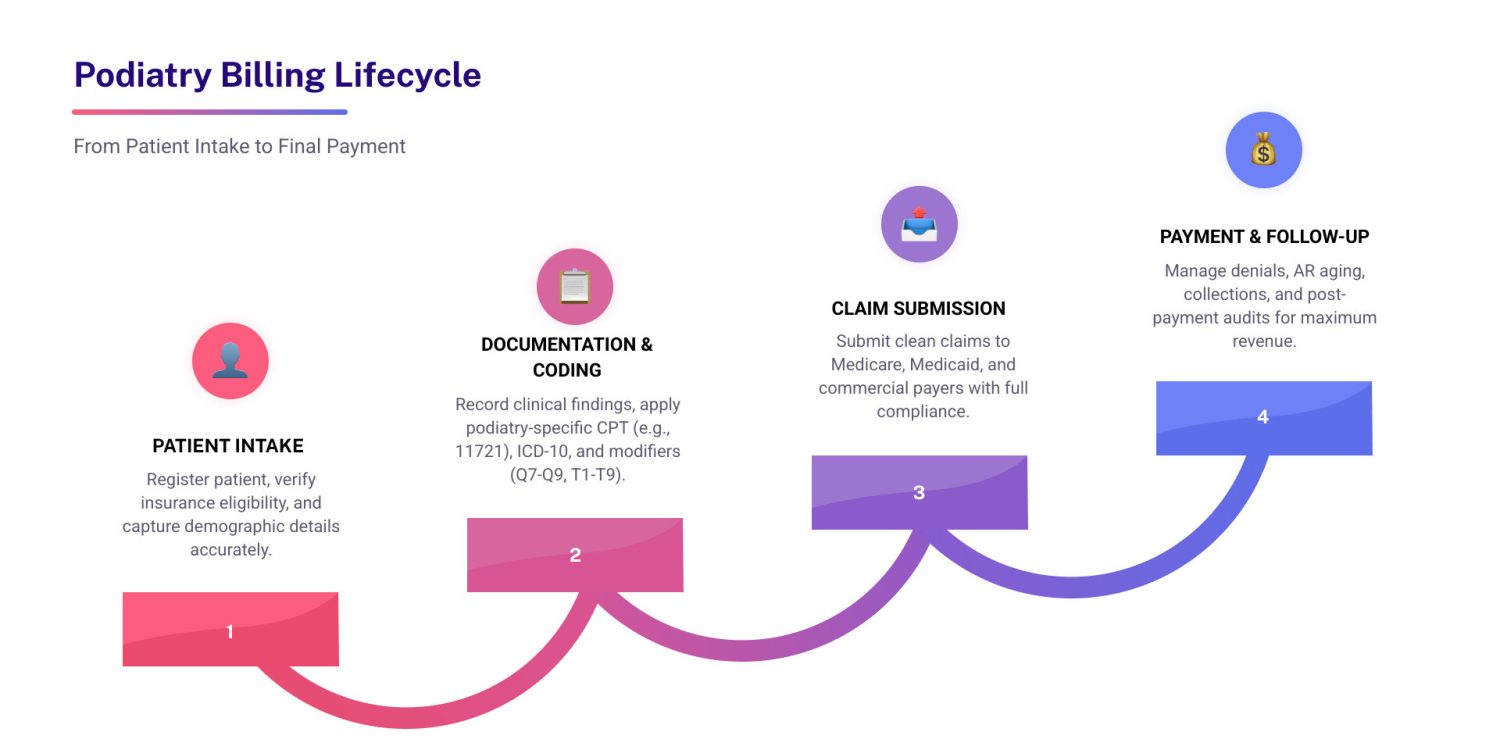
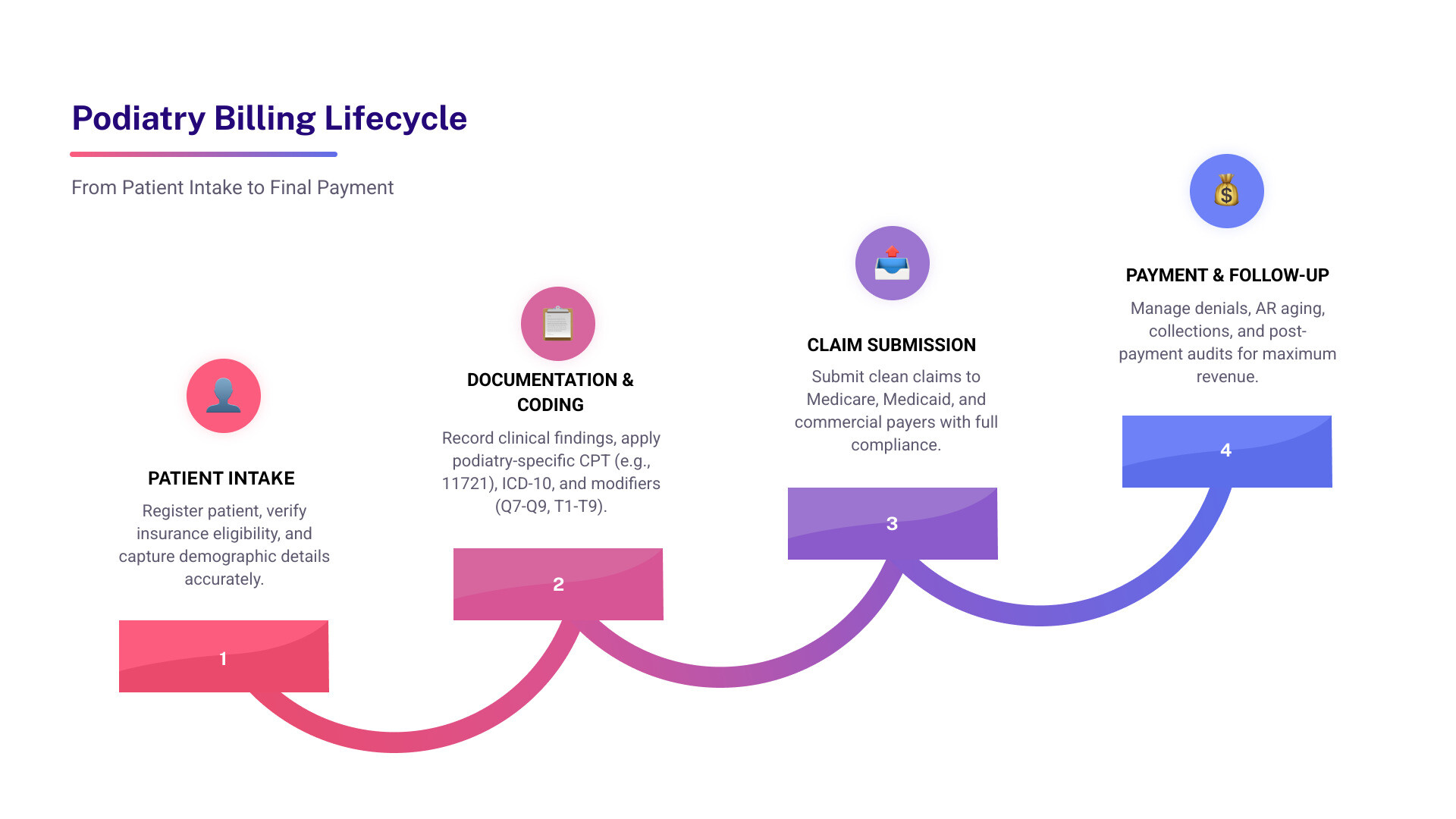
Yes! A full-service podiatry billing consultant handles the entire lifecycle. This includes verifying patient eligibility before the visit, obtaining prior authorizations for surgeries, and even sending patient statements to help collect outstanding balances.
Conclusion
Choosing the right podiatry billing consultant is one of the most important business decisions you will make for your practice. By moving away from the risks of a single in-house employee and leveraging the power of specialized expertise and AI-driven technology, you can protect your revenue and reduce your stress.
At Beacon Podiatric Billing Services, we offer 100% US-based, personalized revenue cycle management. Whether you are in New Jersey, North Carolina, or any of our other service areas, our goal is to maximize your collections so you can focus on your patients’ feet, not your practice’s finances.
Ready to see how much more your practice could be collecting? Explore our billing services today and take the first step toward financial clarity.