

How Often Does Medicare Pay for Podiatry: 3 Crucial Tips
Why Understanding Medicare Podiatry Frequency Matters for Your Practice
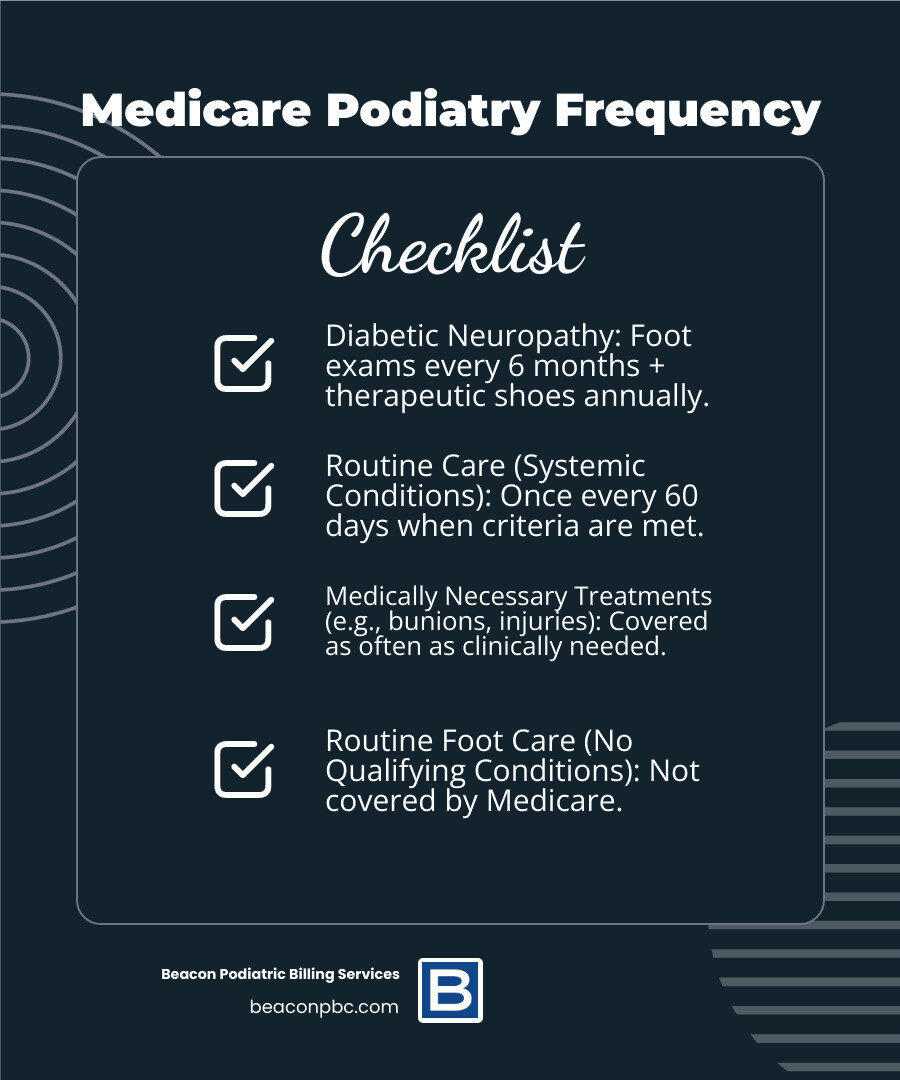
How often does Medicare pay for podiatry depends entirely on the medical necessity of the service and the patient’s underlying conditions. For diabetic patients with nerve damage, Medicare covers foot exams every six months, while patients with other systemic conditions may receive coverage once every 60 days for certain routine foot care services. Medically necessary treatments for foot injuries, diseases, or conditions have no specific frequency limits—coverage is determined case-by-case based on clinical need.
Quick Answer: Medicare Podiatry Payment Frequency
- Diabetic patients with neuropathy: Foot exams every 6 months (if no other foot care visits occurred between exams)
- Routine foot care with systemic conditions: Once every 60 days (when specific medical criteria are met)
- Medically necessary treatments: No frequency limit (bunions, hammer toe, heel spurs, foot injuries—covered as often as clinically necessary)
- Therapeutic shoes for diabetics: One pair per calendar year (with up to 3 pairs of inserts for extra-depth shoes)
- Routine foot care without qualifying conditions: Not covered at any frequency
One-third of older adults experience foot pain, stiffness, or aching feet—yet navigating Medicare’s coverage rules for podiatry services remains one of the most confusing aspects of practice management. The complexity stems from Medicare’s fundamental distinction between medically necessary care and routine foot care. This distinction directly impacts your practice’s revenue cycle, claim approval rates, and ultimately, your bottom line.
The stakes are high. According to Medicare data, the improper payment rate for podiatry care reached 11.2% in 2024, totaling $216.9 million in projected improper payments. Insufficient documentation alone accounted for 76.4% of claim denials for podiatric providers. Understanding not just what Medicare covers, but how often and under what specific conditions, is critical to maximizing legitimate reimbursement while avoiding costly denials.
This guide breaks down Medicare’s frequency rules, cost-sharing requirements, and documentation standards in clear, actionable terms designed specifically for busy podiatry practices navigating the complexities of medical billing.
Understanding the Foundation: Medically Necessary vs. Routine Foot Care
Medicare, particularly Part B, is designed to cover medically necessary services. But what exactly does “medically necessary” mean when it comes to podiatry? This is where the rubber meets the road for both patients and providers. Simply put, if a service is deemed medically necessary, Medicare Part B will generally cover it. If it’s considered routine or cosmetic, it’s typically excluded. This fundamental distinction is crucial for understanding how often does Medicare pay for podiatry services in your practice.
Medicare Part B pays for podiatrist services when they are essential for treating a foot injury, disease, or other medical condition affecting the foot, ankle, or lower leg. This often involves specific systemic conditions or acute issues that require professional intervention to prevent more severe complications.
What Medicare Considers ‘Medically Necessary’ Podiatry
Medicare Part B covers a range of podiatry services when they are considered medically necessary. This means the treatment is required to diagnose or treat an illness, injury, condition, disease, or its symptoms. Our research indicates that this includes specific conditions like:
- Bunion deformities: Those pesky bumps at the base of your big toe that can cause significant pain and mobility issues.
- Hammer toe: A deformity that causes your toe to bend or curl downward instead of pointing forward.
- Heel spurs: Calcium deposits that cause a bony protrusion on the underside of the heel bone, often leading to pain.
- Foot diseases: Any disease affecting the foot that requires professional medical intervention.
- Foot injuries: Acute injuries like fractures or severe sprains.
- Treatment integral to systemic disease: This is a big one! If a foot problem arises directly from or is complicated by a broader health condition, Medicare may cover the podiatry service. Examples of systemic conditions mentioned in our research include diabetes, cancer, chronic kidney disease, multiple sclerosis, or vein inflammation. For more information on various foot problems, you can visit More information on foot problems.
For any of these services to be covered, your patient’s medical record must clearly document the diagnosis and the medical necessity of the treatment. No documentation, no payment – it’s that simple, and unfortunately, a common pitfall for many practices.
The Exclusion of Routine Foot Care
Now, let’s talk about what Medicare generally doesn’t cover. This is often where confusion arises for patients and can lead to unexpected out-of-pocket costs if not properly explained upfront.

Medicare Part B generally does not cover routine foot care services. These are procedures typically performed by the beneficiary themselves or a caregiver, and they are not considered medically necessary to treat an active disease or injury. Non-covered routine services include:
- Cutting or removing corns and calluses: Unless medically necessary due to a specific condition that makes it hazardous for the patient.
- Trimming, cutting, or clipping nails: Again, unless there’s a medical reason that makes self-care dangerous.
- Hygienic or other preventive maintenance: This includes services like cleaning or soaking the feet, or using skin creams without localized illness, injury, or symptoms.
The general rule is that if the service is for hygienic maintenance or purely preventive care without an underlying medical necessity, it’s usually excluded. For a comprehensive overview of general Medicare foot care rules, refer to General Medicare foot care rules.
How Often Does Medicare Pay for Podiatry? A Look at Frequency Limits
This is the million-dollar question for many practices: how often does Medicare pay for podiatry? The answer isn’t a simple number; it varies significantly based on the patient’s condition and the specific service provided. Medicare sets frequency limitations for certain services, while others are covered as often as medically necessary. Understanding these nuances is key to accurate billing and preventing denials.
How often does Medicare pay for podiatry for diabetic patients?
Diabetic patients are a special case in Medicare podiatry coverage, and for good reason. Diabetes can lead to severe foot complications, including nerve damage (neuropathy) and poor circulation, which significantly increase the risk of infections, ulcers, and even limb loss. Recognizing this heightened risk, Medicare provides specific coverage for diabetic foot care.
Our research shows that for patients with diabetes-related lower leg nerve damage (diabetic peripheral neuropathy) and loss of protective sensation (LOPS) that increases the risk of limb loss, Medicare Part B covers:
- Foot exams every six months: This is a critical preventive measure. However, there’s a catch: the patient must not have seen a foot care professional for another reason between these visits. This ensures that the specialized diabetic foot exam is the primary intervention.
- Therapeutic shoes and inserts annually: For individuals with severe diabetic foot disease, Medicare covers one pair of therapeutic shoes and accompanying orthotic inserts each calendar year. For custom-molded shoes, up to two additional pairs of inserts can be covered, and for extra-depth shoes, up to three additional pairs of inserts can be covered each calendar year. These items are considered durable medical equipment (DME) and require a prescription from a qualified doctor or podiatrist, and the supplier must be Medicare-enrolled.
This improved coverage for diabetic patients highlights Medicare’s focus on preventing severe complications, which ultimately saves money and improves patient outcomes. For more official Medicare guidance on diabetic foot care, please visit Official Medicare guidance on diabetic foot care.
How often does Medicare pay for podiatry services for other conditions?
For conditions other than diabetic foot exams, the frequency of Medicare coverage can be a bit more nuanced.
- 60-day rule for covered routine care exceptions: When routine foot care becomes medically necessary due to specific systemic conditions (like peripheral vascular disease or certain neurological disorders) or complications (e.g., infected toenails), Medicare may cover these services. Our research indicates that covered exceptions to routine foot care services are generally considered medically necessary once (1) in 60 days. More frequent services than this will likely be denied as not reasonable and necessary. This is a crucial guideline for billing services like debridement of nails or corns/calluses when they meet the medical necessity criteria.
- Mycotic nails: Treatment for mycotic nails (fungal infections) can be covered under specific circumstances. If a patient has mycotic nails and experiences marked limitation of ambulation, pain, or secondary infection resulting from the condition, Medicare may cover debridement, even in the absence of a systemic disease. The frequency here would still generally follow the 60-day rule if considered a routine exception.
- Systemic disease class findings: For routine foot care to be covered, documentation must show the presence of systemic conditions with specific class findings (e.g., absent pulses, advanced trophic changes, claudication, edema, paresthesia). These findings help establish the medical necessity.
- Post-surgical follow-up and acute injury treatment: For medically necessary treatments of conditions like bunions, hammer toe, heel spurs, or acute foot injuries, there isn’t a strict “how often” limit. Coverage is determined by the clinical need for follow-up appointments, treatments, or procedures. If a patient requires daily wound care after surgery, for example, Medicare would cover it as medically necessary, not subject to a 60-day rule. Medical necessity dictates the frequency here, and proper documentation of the patient’s progress and ongoing need for care is paramount.
To ensure your practice is aligning with these frequency rules and documentation requirements, we encourage you to review comprehensive resources like our Medicare Podiatry Billing Guidelines.
Navigating the Financials: Costs and Billing Requirements
Understanding how often does Medicare pay for podiatry is only half the battle. The other half involves navigating the financial landscape of patient costs and the stringent billing requirements set by Medicare. For podiatry practices, maximizing reimbursement hinges on a deep understanding of these rules, especially given the high rate of claim denials due to improper billing and documentation.
Patient Costs Under Medicare Part B
When Medicare Part B covers podiatry services, patients typically share in the costs. It’s important for your practice to clearly communicate these potential expenses to avoid surprises for your patients:
- Part B deductible: Before Medicare begins to pay its share, patients must first meet their annual Part B deductible. For 2025, this deductible is $257.
- 20% coinsurance: After the deductible is met, Medicare Part B generally pays 80% of the Medicare-approved amount for medically necessary podiatry services. The patient is responsible for the remaining 20% coinsurance.
- Medicare-approved amount: This is the amount that Medicare determines is reasonable for a covered service. If a provider does not accept Medicare assignment, they may charge more than the Medicare-approved amount, but there are limits to how much.
- Hospital outpatient copayment: If services are provided in a hospital outpatient setting (e.g., for certain surgical procedures), patients may also be responsible for a copayment in addition to the coinsurance.
- Medigap plans: Many patients choose to enroll in Medicare Supplement Insurance plans, also known as Medigap. These plans can help cover some of the out-of-pocket costs, such as the Part B coinsurance, making medically necessary podiatry care more affordable for them.
The Critical Role of Documentation and Coding
We cannot stress this enough: impeccable documentation and precise coding are the bedrock of successful Medicare reimbursement for podiatry services. Our research confirms that insufficient documentation was responsible for a staggering 76.4% of improper payments for podiatric providers in 2024. This isn’t just about getting paid; it’s about demonstrating the medical necessity and appropriateness of the care you provide.
Here’s what your practice needs to focus on:
- Medical necessity proof: Every claim must be backed by clear, concise, and comprehensive documentation in the patient’s medical record that unequivocally supports the medical necessity of the service provided. This includes the patient’s history, physical exam findings, assessment, and treatment plan.
- Diagnosis codes (ICD-10): Accurate ICD-10-CM codes are essential. These codes must reflect the patient’s diagnosis and align with the services rendered. For podiatry, specific ICD-10 codes are often required to support medical necessity for foot care services, particularly for routine care exceptions.
- Procedure codes (CPT): Correct CPT codes identify the specific services performed. Using the right CPT code ensures that Medicare understands exactly what was done.
- Q Modifiers (Q7, Q8, Q9): These modifiers are particularly important for routine foot care services when systemic conditions justify coverage.
- Q7: One class A finding (nontraumatic amputation of foot or integral skeletal portion).
- Q8: Two class B findings (absent posterior tibial pulse, advanced trophic changes, etc.).
- Q9: One class B and two class C findings (claudication, temperature changes, edema, paresthesia, burning).
These modifiers signal to Medicare that although the service might appear routine, it’s medically necessary due to the patient’s underlying systemic condition.
- Physician NPI and Date of Last Visit: For certain diagnoses, Medicare requires the National Provider Identifier (NPI) of the patient’s managing physician and the date the patient was last seen by that physician. This helps Medicare verify the patient’s overall health status and the coordination of care.
Essential Documentation Elements:
- Patient’s chief complaint and history of present illness.
- Detailed physical examination findings relevant to the foot condition.
- Assessment/diagnosis, including the specific ICD-10 code.
- Treatment plan, including the CPT code for the service provided.
- Clear rationale for medical necessity, especially for “routine” services.
- Documentation of systemic conditions and their impact on the foot, if applicable.
- For diabetic foot exams, confirmation of peripheral neuropathy and LOPS.
- For therapeutic shoes, a physician’s prescription and documentation of severe diabetic foot disease.
- Date of the patient’s last visit with their managing physician (if required).
By carefully adhering to these documentation and coding standards, we can significantly reduce claim denials and ensure your practice receives the reimbursement it deserves.
Original Medicare vs. Medicare Advantage: What’s the Difference for Podiatry?
When discussing how often does Medicare pay for podiatry, it’s crucial to distinguish between Original Medicare (Parts A and B) and Medicare Advantage Plans (Part C). While both are Medicare programs, they can offer different experiences for patients seeking podiatry services, particularly concerning routine care and out-of-pocket costs.
Coverage Under Original Medicare (Part B)
As we’ve discussed, Original Medicare (specifically Part B) focuses strictly on medically necessary podiatry services. This means:
- Medically necessary focus: Coverage is primarily for treating foot injuries, diseases, or conditions that are critical for the patient’s health, such as those related to diabetes-induced nerve damage, bunions, hammer toe, or heel spurs.
- Strict guidelines: The rules for what’s covered and when are federal and apply uniformly across all states where we operate, including New Jersey, Nevada, Nebraska, North Carolina, and Kentucky. These guidelines are quite specific, leaving little room for interpretation.
- Provider choice: Patients with Original Medicare can generally see any podiatrist who accepts Medicare, regardless of network affiliations.
How Medicare Advantage (Part C) Plans Can Differ
Medicare Advantage Plans are offered by private companies approved by Medicare. While they must cover at least everything Original Medicare covers, they often provide additional benefits that can be particularly appealing for podiatry patients.
- Mandatory coverage parity: By law, Medicare Advantage Plans must cover all medically necessary podiatry services that Original Medicare Part B covers. So, if Original Medicare covers a service, your patient’s Medicare Advantage plan will too.
- Potential for extra benefits: This is where Medicare Advantage plans can shine. Many plans offer additional benefits not covered by Original Medicare, and this can include routine foot care. Some plans might cover a certain number of routine foot care visits per year, or provide coverage for services like nail trimming or callus removal that Original Medicare would typically deny. It’s essential for patients to check their specific plan’s benefits.
- Copayments vs. coinsurance: While Original Medicare typically involves a 20% coinsurance after the deductible, Medicare Advantage plans often use fixed copayments for services. These costs can vary significantly between plans.
- HMOs and PPOs: Most Medicare Advantage plans operate within networks (HMOs, PPOs), meaning patients might need to see a podiatrist who is part of their plan’s network to receive the highest level of coverage. This can impact a patient’s choice of podiatrist.
- Plan-specific rules: Each Medicare Advantage plan is different. Therefore, patients should always review their plan’s Evidence of Coverage or contact their plan directly to understand their specific podiatry benefits, including how often certain services are covered and what their out-of-pocket costs will be.
For practices, understanding the nuances of a patient’s specific Medicare Advantage plan is just as important as knowing Original Medicare rules. This helps in accurately estimating patient costs and ensuring proper billing.
Frequently Asked Questions about Medicare Podiatry Coverage
We know that Medicare coverage can feel like a labyrinth, especially for podiatry. Here, we tackle some of the most common questions our practices (and their patients) ask about how often does Medicare pay for podiatry.
Does Medicare cover toenail clipping at all?
Generally, Medicare does not cover routine toenail clipping. As mentioned earlier, this falls under the umbrella of “routine foot care” which is typically excluded.
However, there’s a crucial exception: Medicare will cover toenail clipping if self-care is hazardous to the patient’s health. This usually occurs when a patient has a systemic condition that makes it dangerous for them to perform their own foot care, such as severe diabetes, peripheral vascular disease, or certain neurological disorders that impair sensation or circulation. In such cases, the service is deemed medically necessary to prevent infection or injury.
For coverage, there must be clear physician documentation (from the podiatrist or the patient’s managing physician) establishing the medical necessity and the hazardous nature of self-care due to the underlying condition.
How can a patient find a podiatrist who accepts Medicare?
Finding a podiatrist who accepts Medicare is usually straightforward for patients. Here are the best ways:
- Medicare.gov provider finder: The official Medicare website offers a comprehensive provider search tool. Patients can visit Medicare.gov provider finder, enter their ZIP code, and search for podiatrists who accept Medicare assignment.
- Primary care physician referrals: A patient’s primary care physician (PCP) is an excellent resource. PCPs often have established networks of specialists, including podiatrists, whom they trust and know accept Medicare.
- Plan network directories: If a patient has a Medicare Advantage Plan, they should consult their plan’s network directory or website. This will list all the podiatrists within their plan’s network, which is important for maximizing their benefits and minimizing out-of-pocket costs.
What are therapeutic shoes and are they always covered for diabetics?
Therapeutic shoes are specialized footwear designed to protect and support the feet of individuals with specific medical conditions, primarily severe diabetes. They are not just fancy shoes; they are a critical part of managing diabetic foot health.
Therapeutic shoes and accompanying orthotic inserts are indeed covered by Medicare, but specifically for patients with severe diabetic foot disease. This coverage is not automatic for all diabetics. For a patient to qualify:
- They must have a diagnosis of severe diabetic foot disease.
- A qualified doctor or podiatrist must prescribe the shoes and inserts.
- The shoes and inserts must be fitted and supplied by a Medicare-enrolled supplier.
- Medicare covers one pair of therapeutic shoes and accompanying orthotic inserts each calendar year. As noted earlier, there are specific limits on additional pairs of inserts (up to two for custom-molded shoes, up to three for extra-depth shoes).
These shoes are considered durable medical equipment (DME) and are vital in preventing serious complications like ulcers and infections that can lead to amputations. For more detailed information on therapeutic shoes and inserts, patients (and your practice) can refer to Details on therapeutic shoes.
Conclusion: Maximizing Reimbursement in a Complex System
Navigating the intricacies of how often does Medicare pay for podiatry is no small feat, but it’s an essential skill for any successful podiatry practice. The journey through Medicare’s rules reveals a system built on medical necessity, meticulous documentation, and a keen understanding of specific patient conditions.
Our deep dive has highlighted several key takeaways:
- Medical necessity is key: Medicare Part B primarily covers services deemed medically necessary to treat an illness, injury, or specific condition. Routine care is generally excluded unless it meets stringent exceptions.
- Documentation is paramount: The vast majority of claim denials stem from insufficient documentation. Every service, every diagnosis, and every treatment plan must be clearly and comprehensively recorded to support the medical necessity of the care provided.
- Diabetes coverage exceptions: Patients with diabetes and related nerve damage receive improved coverage, including regular foot exams and therapeutic footwear, reflecting Medicare’s focus on preventing severe complications.
- Frequency varies: There’s no single answer to “how often.” It depends on the condition, with specific rules for diabetic foot exams (every 6 months) and routine care exceptions (once every 60 days), while other medically necessary treatments are covered as clinically needed.
- Medicare Advantage can offer more: While Original Medicare sets the baseline, Medicare Advantage plans may offer additional benefits, including some routine foot care, though they come with their own network and cost-sharing structures.
For busy podiatry practices, keeping up with these changing rules can be a full-time job in itself. That’s where expert support becomes invaluable. At Beacon Podiatric Billing Services, we specialize in 100% US-based billing and revenue cycle management, exclusively for podiatry practices across New Jersey, Nevada, Nebraska, North Carolina, and Kentucky. Our dedicated, podiatry-specific expertise is designed to maximize your collections and streamline your operations, allowing your team to focus on what they do best: providing exceptional patient care.
Don’t let the complexities of Medicare reimbursement hinder your practice’s growth. Let us help you steer these waters with confidence. Optimize your practice with expert billing services.